University of Oxford, Oxford, UK.
Pfizer Inc, Groton, CT, USA.
Arthritis Res Ther. 2021 Mar 26;23(1):94. doi: 10.1186/s13075-021-02474-2.
In psoriatic arthritis (PsA), further understanding of the relationships between clinical measures and patient-reported outcomes (PROs) is needed. This post hoc analysis evaluated associations between minimal disease activity (MDA) as a continuous outcome (termed ScoreMDA) or Psoriatic Arthritis Disease Activity Score (PASDAS) with selected PROs not included in the composite measures.
Data from two phase 3 studies of tofacitinib in PsA (OPAL Broaden [NCT01877668; N = 422]; OPAL Beyond [NCT01882439; N = 394]) were included. MDA (binary outcome) was defined as meeting ≥5/7 criteria. For ScoreMDA, each criterion was assigned a value (1 = true; 0 = false; score range, 0-7; scores ≥5 indicated MDA). For PASDAS (score range, 0-10), higher scores indicated worse disease activity. PROs analyzed included Functional Assessment of Chronic Illness Therapy-Fatigue (FACIT-F), Patient's Assessment of Arthritis Pain visual analog scale (Pain VAS), and EuroQoL-Five Dimensions-Three Level Health Questionnaire visual analog scale (EQ-5D-3L VAS) and utility index. Relationships were evaluated using repeated measures regression models.
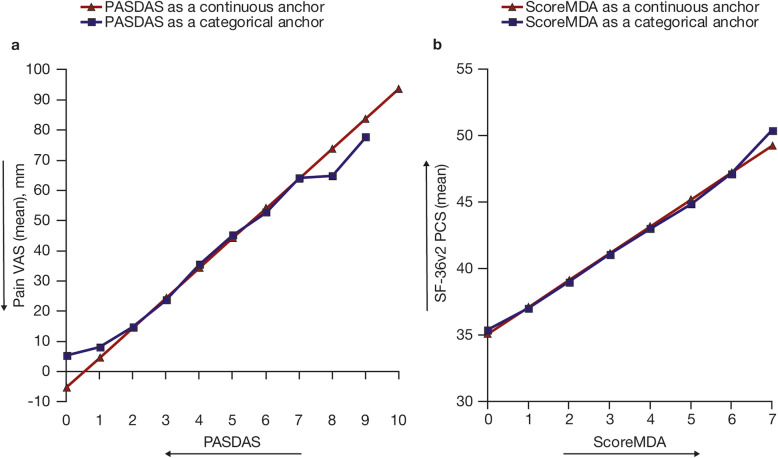
Similar, approximately linear relationships were confirmed between PASDAS or ScoreMDA and PROs in both studies. In OPAL Broaden and OPAL Beyond, a one-point difference in PASDAS was associated with clinically relevant differences in PROs, including EQ-5D-3L VAS (- 6.7 mm, - 6.9 mm), Pain VAS (9.9 mm, 10.7 mm), and FACIT-F (- 2.8, - 3.3). A one-point difference in ScoreMDA was associated with clinically relevant differences in PROs, including EQ-5D-3L VAS (5.0 mm, 5.5 mm) and FACIT-F (1.9, 2.7) in OPAL Broaden and OPAL Beyond, respectively.
Linear associations between PASDAS or ScoreMDA and PROs provide interpretable and quantifiable metrics between composite clinical measures and PROs, highlighting the importance of these measures in understanding the relevance of treat-to-target goals in PsA.
ClinicalTrials.gov, NCT01877668 . Registered on June 12, 2013. ClinicalTrials.gov, NCT01882439 . Registered on June 18, 2013.
在银屑病关节炎(PsA)中,需要进一步了解临床指标与患者报告结局(PROs)之间的关系。本事后分析评估了作为连续结局的最小疾病活动度(MDA)(称为 ScoreMDA)或银屑病关节炎疾病活动度评分(PASDAS)与复合指标中未包含的特定 PROs 之间的关联。
纳入了两项托法替尼治疗 PsA 的 3 期研究(OPAL Broaden[NCT01877668;N=422];OPAL Beyond[NCT01882439;N=394])的数据。MDA(二分类结局)定义为符合≥5/7 项标准。对于 ScoreMDA,每个标准赋值 1(真)或 0(假)(评分范围 0-7;评分≥5 表示 MDA)。对于 PASDAS(评分范围 0-10),评分越高表示疾病活动度越差。分析的 PROs 包括慢性病治疗疲劳的功能性评估-疲劳量表(FACIT-F)、关节炎疼痛患者评估视觉模拟量表(Pain VAS)和欧洲五维健康量表-3 级视觉模拟量表(EQ-5D-3L VAS)和效用指数。使用重复测量回归模型评估相关性。
在两项研究中,均证实 PASDAS 或 ScoreMDA 与 PROs 之间存在相似的、近似线性关系。在 OPAL Broaden 和 OPAL Beyond 中,PASDAS 评分相差 1 分与 PROs 具有临床相关差异,包括 EQ-5D-3L VAS(-6.7mm,-6.9mm)、Pain VAS(9.9mm,10.7mm)和 FACIT-F(-2.8,-3.3)。ScoreMDA 相差 1 分与 PROs 具有临床相关差异,包括在 OPAL Broaden 和 OPAL Beyond 中,EQ-5D-3L VAS(5.0mm,5.5mm)和 FACIT-F(1.9,2.7)。
PASDAS 或 ScoreMDA 与 PROs 之间的线性关联为复合临床指标与 PROs 之间提供了可解释和可量化的度量,突出了这些指标在理解银屑病关节炎靶向治疗目标相关性方面的重要性。
ClinicalTrials.gov,NCT01877668。2013 年 6 月 12 日注册。ClinicalTrials.gov,NCT01882439。2013 年 6 月 18 日注册。