Öztürk Erkut, Kafalı Hasan Candaş, Tanıdır İbrahim Cansaran, Tunca Şahin Gülhan, Onan İsmihan Selen, Haydin Sertaç, Güzeltaş Alper, Ergül Yakup
Department of Pediatric Cardiology, University of Health Sciences, Istanbul Mehmet Akif Ersoy Thoracic and Cardiovascular Surgery Training and Research Hospital, Istanbul, Turkey.
Department of Pediatric Cardiovascular Surgery, University of Health Sciences, Istanbul Mehmet Akif Ersoy Thoracic and Cardiovascular Surgery Training and Research Hospital, Istanbul, Turkey.
Turk Gogus Kalp Damar Cerrahisi Derg. 2021 Jan 13;29(1):27-35. doi: 10.5606/tgkdc.dergisi.2021.20366. eCollection 2021 Jan.
This study aims to evaluate early postoperative arrhythmias in children undergoing congenital cardiac surgery.
A total of 670 pediatric patients (355 males, 315 females; median age: 4 months; range, 1 day to 18 years) who underwent cardiac surgery due to congenital heart defects between December 2018 and November 2019 were included. The rate of postoperative arrhythmias, diagnosis, potential risk factors, and management strategies were evaluated. Multivariate regression analysis was used to identify significant factors of development of postoperative arrhythmias.
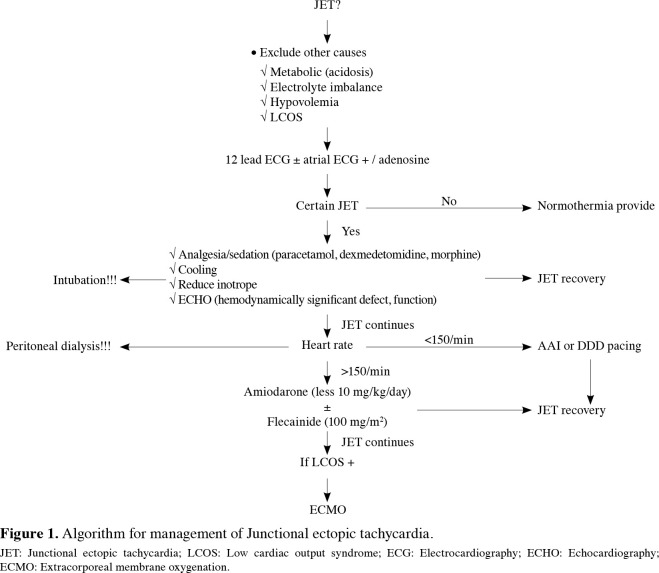
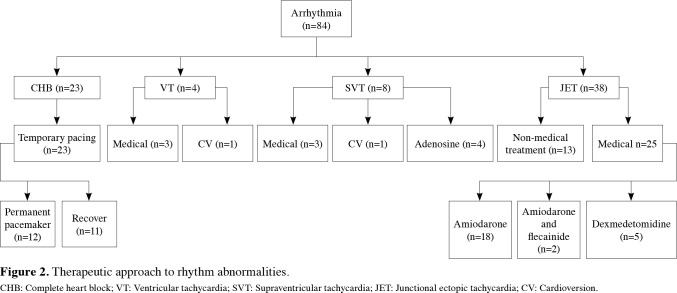
Tachyarrhythmia was detected in 54 patients (8.1%), and the most common tachyarrhythmia was junctional ectopic tachycardia. Medical treatment was required in 25/38 (66%) of junctional ectopic tachycardia patients. Amiodarone was initiated in 18, dexmedetomidine in five, and flecainide + amiodarone in two of the patients. Different degrees of atrioventricular block were observed in 30 patients (4.5%). In 12 patients, permanent pacemakers were implanted during hospitalization. Age at the time of surgery under one-year-old, high inotropic scores, prolonged operation time, and high Aristotele"s scores were independent risk factors associated with early postoperative arrhythmia (p<0.05). The most common operations associated with early postoperative arrhythmia were left ventricular outflow tract, (6/20, 30%), complete atrioventricular septal defect (13/53, 24%), and tetralogy of Fallot (20/134, 14%) surgeries.
Cardiac arrhythmias are common in the early period after congenital heart surgery in children. The diagnosis and frequency of arrhythmias may vary according to different surgical procedures.
本研究旨在评估先天性心脏手术患儿术后早期心律失常情况。
纳入2018年12月至2019年11月期间因先天性心脏缺陷接受心脏手术的670例儿科患者(男355例,女315例;中位年龄:4个月;范围:1天至18岁)。评估术后心律失常的发生率、诊断、潜在危险因素及管理策略。采用多因素回归分析确定术后心律失常发生的显著因素。
54例患者(8.1%)检测到快速性心律失常,最常见的快速性心律失常为交界性异位性心动过速。38例交界性异位性心动过速患者中有25例(66%)需要药物治疗。18例患者开始使用胺碘酮,5例使用右美托咪定,2例使用氟卡尼+胺碘酮。30例患者(4.5%)观察到不同程度的房室传导阻滞。12例患者在住院期间植入了永久性起搏器。手术时年龄小于1岁、高变力性评分、手术时间延长和高亚里士多德评分是术后早期心律失常的独立危险因素(p<0.05)。与术后早期心律失常相关最常见的手术是左心室流出道手术(6/20,30%)、完全性房室间隔缺损手术(13/53,24%)和法洛四联症手术(20/134,14%)。
心律失常在儿童先天性心脏手术后早期很常见。心律失常的诊断和发生率可能因不同的手术方式而异。