Department of Orthopaedic Surgery, UConn Health, Farmington, Connecticut, USA; Department of Medicine, UConn Health, Farmington, Connecticut, USA; UConn Musculoskeletal Institute, UConn Health, Farmington, Connecticut, USA.
Department of Orthopaedic Surgery, UConn Health, Farmington, Connecticut, USA; UConn Musculoskeletal Institute, UConn Health, Farmington, Connecticut, USA.
J Biol Chem. 2021 Jan-Jun;296:100583. doi: 10.1016/j.jbc.2021.100583. Epub 2021 Mar 24.
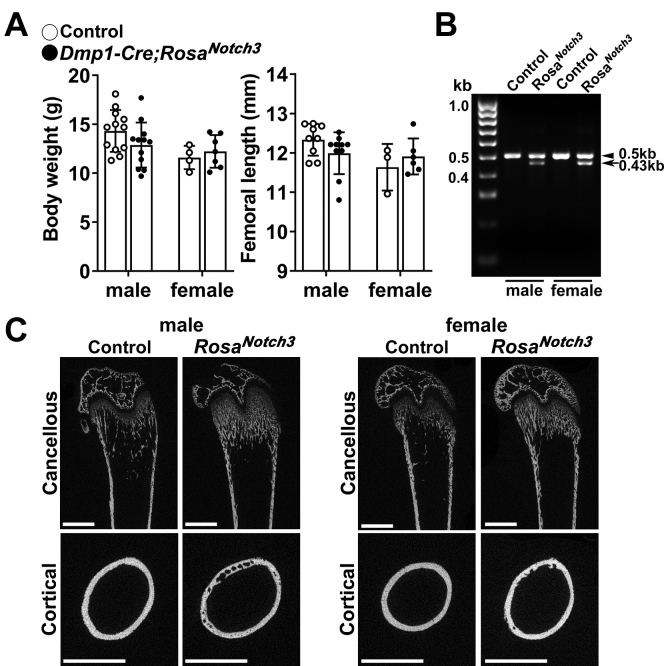
Notch receptors maintain skeletal homeostasis. NOTCH1 and 2 have been studied for their effects on bone remodeling. Although NOTCH3 plays a significant role in vascular physiology, knowledge about its function in other cellular environments, including bone, is limited. The present study was conducted to establish the function of NOTCH3 in skeletal cells using models of Notch3 misexpression. Microcomputed tomography demonstrated that Notch3 null mice did not have appreciable bone phenotypes. To study the effects of the NOTCH3 activation in the osteoblast lineage, BGLAP-Cre or Dmp1-Cre transgenics were crossed with Rosa mice, where the NOTCH3 intracellular domain is expressed following the removal of a loxP-flanked STOP cassette. Microcomputed tomography demonstrated that BGLAP-Cre;Rosa and Dmp1-Cre;Rosa mice of both sexes exhibited an increase in trabecular bone and in connectivity, with a decrease in cortical bone and increased cortical porosity. Histological analysis revealed a decrease in osteoclast number and bone resorption in trabecular bone and an increase in osteoclast number and void or pore area in cortical bone of Rosa mice. Bone formation was either decreased or could not be determined in Cre;Rosa mice. NOTCH3 activation in osteoblasts inhibited Alpl (alkaline phosphatase) and Bglap (osteocalcin) and induced Tnfsf11 (RANKL) and Tnfrsf11b (osteoprotegerin) mRNA, possibly explaining the trabecular bone phenotype. However, NOTCH3 induced Tnfsf11 and suppressed Tnfrsf11b in osteocytes, possibly explaining the cortical porosity. In conclusion, basal NOTCH3 is dispensable for skeletal homeostasis, whereas activation of NOTCH3 in osteoblasts/osteocytes inhibits osteoclastogenesis and bone resorption in cancellous bone but increases intracortical remodeling and causes cortical porosity.
Notch 受体维持骨骼内稳态。NOTCH1 和 2 因其对骨重塑的影响而被研究。尽管 NOTCH3 在血管生理学中发挥着重要作用,但关于其在其他细胞环境(包括骨骼)中的功能的知识是有限的。本研究旨在使用 Notch3 过表达模型来确定 NOTCH3 在骨骼细胞中的功能。微计算机断层扫描表明,Notch3 缺失小鼠没有明显的骨骼表型。为了研究 NOTCH3 在成骨细胞谱系中的激活作用,BGLAP-Cre 或 Dmp1-Cre 转基因与 Rosa 小鼠杂交,其中 NOTCH3 细胞内结构域在loxP 侧翼的 STOP 盒去除后表达。微计算机断层扫描表明,BGLAP-Cre;Rosa 和 Dmp1-Cre;Rosa 雌雄小鼠均表现出小梁骨和连接性增加,皮质骨减少,皮质骨孔隙率增加。组织学分析显示,Rosa 小鼠的小梁骨中破骨细胞数量减少,骨吸收减少,而皮质骨中破骨细胞数量增加,空泡或孔隙面积增加。Cre;Rosa 小鼠的骨形成减少或无法确定。成骨细胞中 NOTCH3 的激活抑制了 Alpl(碱性磷酸酶)和 Bglap(骨钙素),并诱导了 Tnfsf11(RANKL)和 Tnfrsf11b(骨保护素)mRNA,这可能解释了小梁骨表型。然而,NOTCH3 在成骨细胞中诱导 Tnfsf11 并抑制 Tnfrsf11b,这可能解释了皮质骨孔隙率。总之,基础 NOTCH3 对于骨骼内稳态是可有可无的,而 NOTCH3 在成骨细胞/成骨细胞中的激活抑制了松质骨中的破骨细胞生成和骨吸收,但增加了皮质内重塑并导致皮质骨孔隙率增加。