Drug Discovery Center and Cardiovascular Center, 8701 Watertown Plank Road, Milwaukee, WI 53226, USA.
Department of Pharmacology & Toxicology, Medical College of Wisconsin, Milwaukee, WI 53226, USA.
Int J Mol Sci. 2021 Mar 10;22(6):2793. doi: 10.3390/ijms22062793.
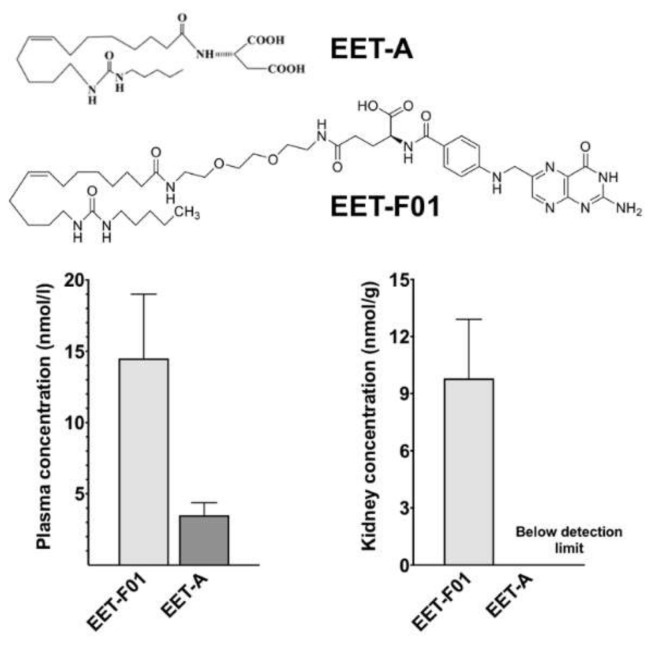
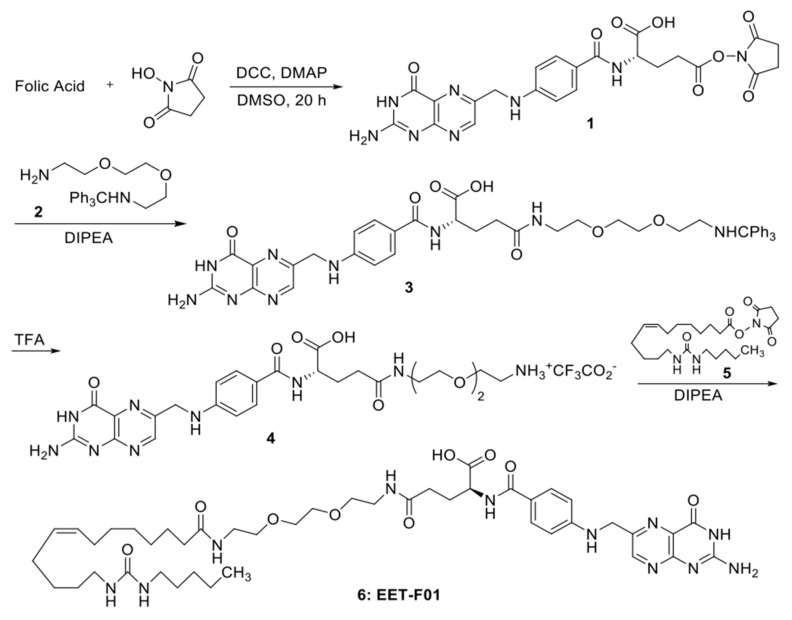
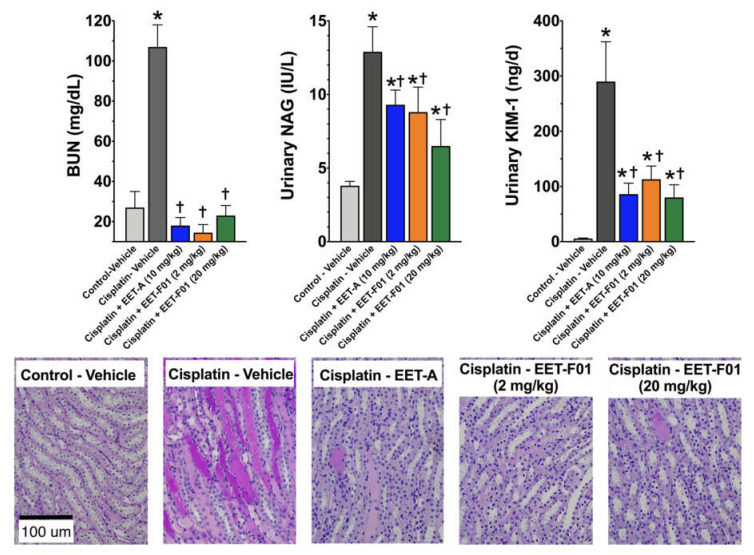
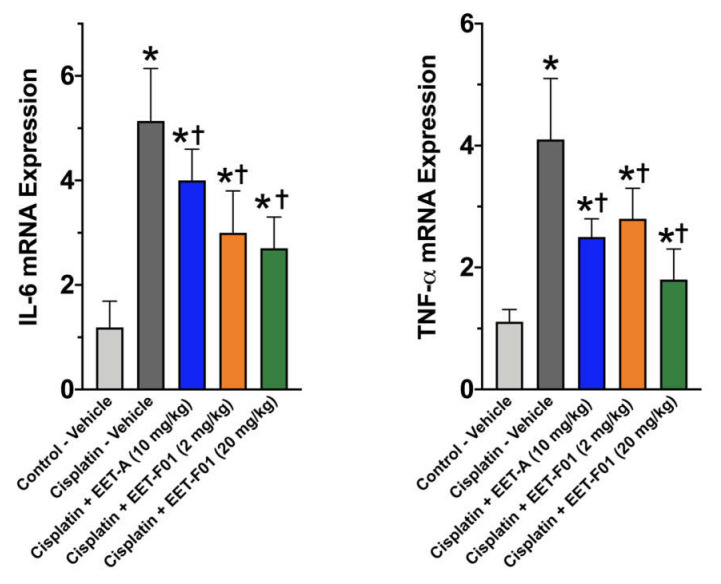
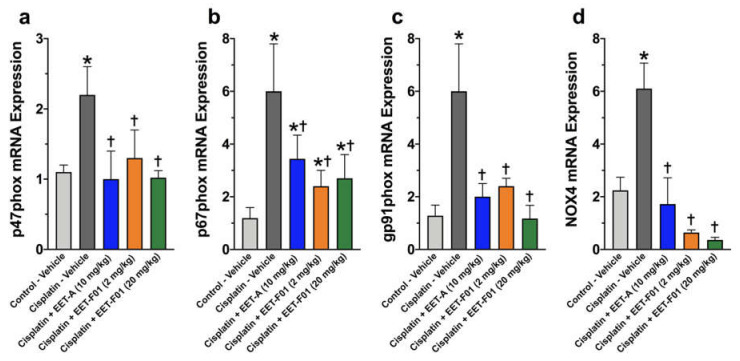
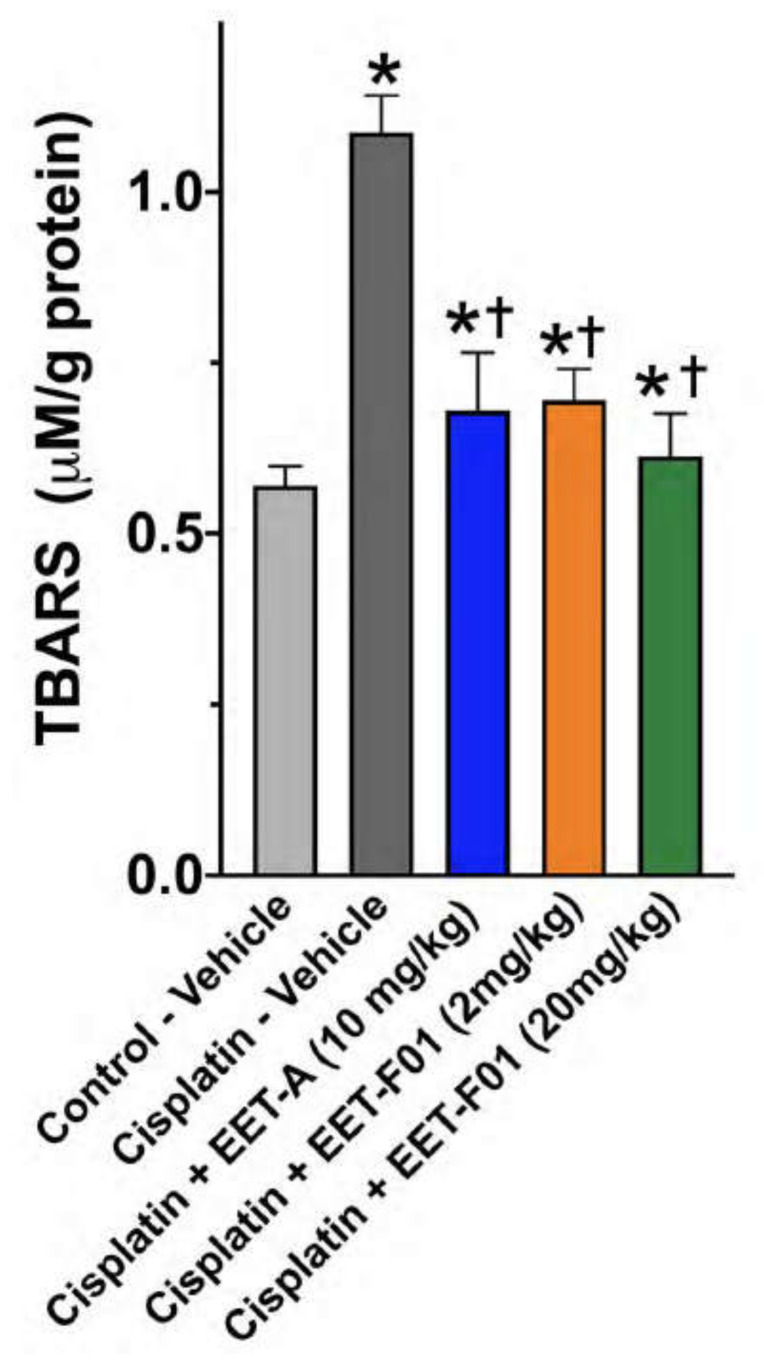
Although epoxyeicosatrienoic acid (EET) analogs have performed well in several acute and chronic kidney disease models, targeted delivery of EET analogs to the kidney can be reasonably expected to reduce the level of drug needed to achieve a therapeutic effect and obviate possible side effects. For EET analog kidney-targeted delivery, we conjugated a stable EET analog to folic acid via a PEG-diamine linker. Next, we compared the kidney targeted EET analog, EET-F01, to a well-studied EET analog, EET-A. EET-A or EET-F01 was infused i.v. and plasma and kidney tissue collected. EET-A was detected in the plasma but was undetectable in the kidney. On the other hand, EET-F01 was detected in the plasma and kidney. Experiments were conducted to compare the efficacy of EET-F01 and EET-A for decreasing cisplatin nephrotoxicity. Cisplatin was administered to WKY rats treated with vehicle, EET-A (10 mg/kg i.p.) or EET-F01 (20 mg/kg or 2 mg/kg i.p.). Cisplatin increased kidney injury markers, viz., blood urea nitrogen (BUN), N-acetyl-β-(D)-glucosaminidase (NAG), kidney injury molecule-1 (KIM-1), and thiobarbituric acid reactive substances (TBARS). EET-F01 was as effective as EET-A in decreasing BUN, NAG, KIM-1, TBARS, and renal histological injury caused by cisplatin. Despite its almost 2×-greater molecular weight compared with EET-A, EET-F01 was comparably effective in decreasing renal injury at a 10-fold / lower dose. EET-F01 decreased cisplatin nephrotoxicity by reducing oxidative stress and inflammation. These data demonstrate that EET-F01 targets the kidney, allows for a lower effective dose, and combats cisplatin nephrotoxicity. In conclusion, we have developed a kidney targeted EET analog, EET-F01, that demonstrates excellent potential as a therapeutic for kidney diseases.
尽管环氧二十碳三烯酸(EET)类似物在几种急性和慢性肾病模型中表现良好,但合理预期将 EET 类似物靶向递送至肾脏可以降低实现治疗效果所需的药物水平,并避免可能的副作用。对于 EET 类似物的肾脏靶向递药,我们通过 PEG-二胺接头将稳定的 EET 类似物与叶酸偶联。接下来,我们将靶向肾脏的 EET 类似物 EET-F01 与一种研究充分的 EET 类似物 EET-A 进行比较。静脉内输注 EET-A 或 EET-F01,并收集血浆和肾脏组织。EET-A 可在血浆中检测到,但在肾脏中无法检测到。另一方面,EET-F01 可在血浆和肾脏中检测到。进行了实验以比较 EET-F01 和 EET-A 降低顺铂肾毒性的效果。将顺铂给予用载体、EET-A(10 mg/kg 腹腔内注射)或 EET-F01(20 mg/kg 或 2 mg/kg 腹腔内注射)处理的 WKY 大鼠。顺铂增加了肾脏损伤标志物,即血尿素氮(BUN)、N-乙酰-β-(D)-氨基葡萄糖苷酶(NAG)、肾脏损伤分子-1(KIM-1)和硫代巴比妥酸反应物质(TBARS)。EET-F01 与 EET-A 一样有效,可降低 BUN、NAG、KIM-1、TBARS 和顺铂引起的肾组织损伤。尽管其分子量几乎是 EET-A 的 2 倍,但 EET-F01 在降低肾损伤方面的有效剂量低 10 倍。EET-F01 通过降低氧化应激和炎症来降低顺铂的肾毒性。这些数据表明,EET-F01 靶向肾脏,允许使用更低的有效剂量,并对抗顺铂肾毒性。总之,我们已经开发出一种靶向肾脏的 EET 类似物 EET-F01,它作为肾脏疾病的治疗药物具有巨大的潜力。