Lapidus Alla L, Korobeynikov Anton I
Center for Algorithmic Biotechnology, St. Petersburg State University, Saint Petersburg, Russia.
Front Microbiol. 2021 Mar 23;12:613791. doi: 10.3389/fmicb.2021.613791. eCollection 2021.
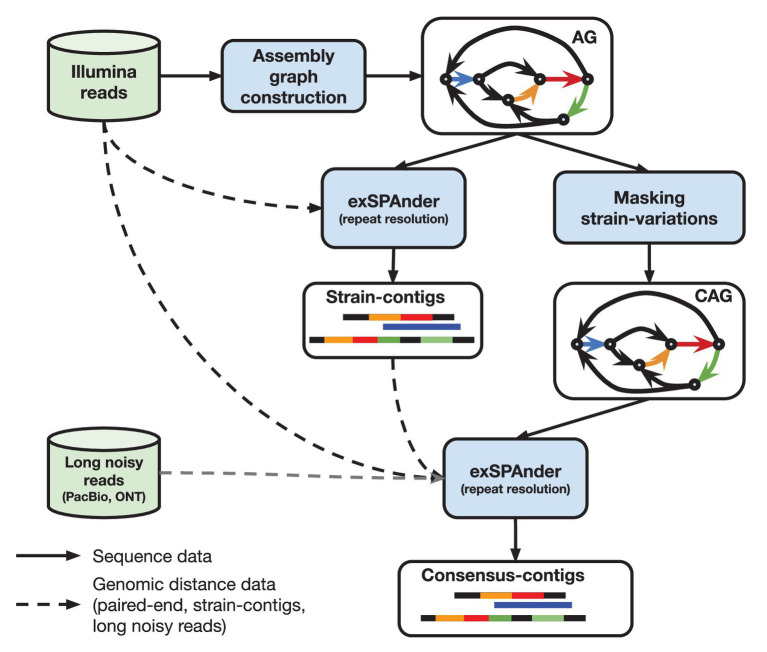
Metagenomics is a segment of conventional microbial genomics dedicated to the sequencing and analysis of combined genomic DNA of entire environmental samples. The most critical step of the metagenomic data analysis is the reconstruction of individual genes and genomes of the microorganisms in the communities using metagenomic assemblers - computational programs that put together small fragments of sequenced DNA generated by sequencing instruments. Here, we describe the challenges of metagenomic assembly, a wide spectrum of applications in which metagenomic assemblies were used to better understand the ecology and evolution of microbial ecosystems, and present one of the most efficient microbial assemblers, SPAdes that was upgraded to become applicable for metagenomics.
宏基因组学是传统微生物基因组学的一个分支,致力于对整个环境样本的混合基因组DNA进行测序和分析。宏基因组数据分析的最关键步骤是使用宏基因组组装程序——将测序仪器产生的已测序DNA小片段拼接在一起的计算程序,来重建群落中微生物的单个基因和基因组。在这里,我们描述了宏基因组组装的挑战、宏基因组组装在广泛应用中的作用(通过这些应用可以更好地理解微生物生态系统的生态学和进化),并介绍了最有效的微生物组装程序之一——升级后适用于宏基因组学的SPAdes。