Jockey Club School of Public Health and Primary Care, Faculty of Medicine, The Chinese University of Hong Kong, Hong Kong, Hong Kong.
The Chinese University of Hong Kong Shenzhen Research Institute, Shenzhen, China.
JMIR Public Health Surveill. 2021 May 25;7(5):e24623. doi: 10.2196/24623.
Social media has become a ubiquitous part of daily life during the COVID-19 pandemic isolation. However, the role of social media use in depression and suicidal ideation of the general public remains unclear. Related empirical studies were limited and reported inconsistent findings. Little is known about the potential underlying mechanisms that may illustrate the relationship between social media use and depression and suicidal ideation during the COVID-19 pandemic.
This study tested the mediation effects of social loneliness and posttraumatic stress disorder (PTSD) symptoms on the relationship between social media use and depressive symptoms and suicidal ideation, as well as the moderation effect of age on the mediation models.
We administered a population-based random telephone survey in May and June 2020, when infection control measures were being vigorously implemented in Hong Kong. A total of 1070 adults (658 social media users and 412 nonusers) completed the survey. Structural equation modeling (SEM) and multigroup SEM were conducted to test the mediation and moderation effects.
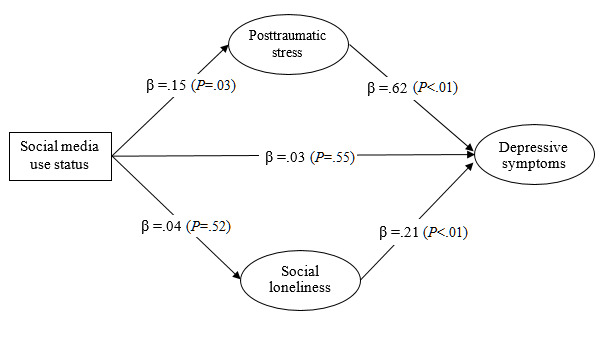
The weighted prevalence of probable depression was 11.6%; 1.6% had suicidal ideation in the past 2 weeks. Both moderated mediation models of depressive symptoms (χ=335.3; P<.05; comparative fit index [CFI]=0.94; nonnormed fit index [NNFI]=0.92; root mean square error of approximation [RMSEA]=0.06) and suicidal ideation (χ=50.8; P<.05; CFI=0.99; NNFI=0.99; RMSEA=0.02) showed acceptable model fit. There was a significantly negative direct effect of social media use on depressive symptoms among older people (β=-.07; P=.04) but not among younger people (β=.04; P=.55). The indirect effect via PTSD symptoms was significantly positive among both younger people (β=.09; P=.02) and older people (β=.10; P=.01). The indirect effect via social loneliness was significant among older people (β=-.01; P=.04) but not among younger people (β=.01; P=.31). The direct effect of social media use on suicidal ideation was not statistically significant in either age group (P>.05). The indirect effects via PTSD symptoms were statistically significant among younger people (β=.02; P=.04) and older people (β=.03; P=.01). Social loneliness was not a significant mediator between social media use and suicidal ideation among either age group (P>.05).
Social media may be a "double-edged sword" for psychosocial well-being during the COVID-19 pandemic, and its roles vary across age groups. The mediators identified in this study can be addressed by psychological interventions to prevent severe mental health problems during and after the COVID-19 pandemic.
在 COVID-19 大流行隔离期间,社交媒体已成为日常生活中无处不在的一部分。然而,公众使用社交媒体与抑郁和自杀意念之间的关系仍不清楚。相关的实证研究有限,且报告的结果不一致。对于可能说明 COVID-19 大流行期间社交媒体使用与抑郁和自杀意念之间关系的潜在机制知之甚少。
本研究检验了社会孤独感和创伤后应激障碍(PTSD)症状在社交媒体使用与抑郁症状和自杀意念之间的关系中的中介作用,以及年龄对中介模型的调节作用。
我们于 2020 年 5 月至 6 月在香港大力实施感染控制措施期间进行了一项基于人群的随机电话调查。共有 1070 名成年人(658 名社交媒体使用者和 412 名非使用者)完成了调查。采用结构方程模型(SEM)和多群组 SEM 检验中介和调节效应。
加权的可能抑郁患病率为 11.6%;过去 2 周内有 1.6%的人有自杀意念。抑郁症状(χ=335.3;P<.05;比较拟合指数[CFI]=0.94;非归一拟合指数[NNFI]=0.92;近似均方根误差[RMSEA]=0.06)和自杀意念(χ=50.8;P<.05;CFI=0.99;NNFI=0.99;RMSEA=0.02)的两个调节中介模型均具有可接受的模型拟合度。在老年人中,社交媒体使用与抑郁症状之间存在显著的负向直接效应(β=-.07;P=.04),但在年轻人中则没有(β=.04;P=.55)。在年轻人(β=.09;P=.02)和老年人(β=.10;P=.01)中,通过 PTSD 症状的间接效应均为显著阳性。在老年人中,社会孤独感的间接效应具有统计学意义(β=-.01;P=.04),但在年轻人中则没有(β=.01;P=.31)。在任何年龄组中,社交媒体使用对自杀意念的直接效应均无统计学意义(P>.05)。在年轻人(β=.02;P=.04)和老年人(β=.03;P=.01)中,通过 PTSD 症状的间接效应均具有统计学意义。在任何年龄组中,社会孤独感均不是社交媒体使用与自杀意念之间的显著中介(P>.05)。
在 COVID-19 大流行期间,社交媒体可能是心理健康的“双刃剑”,其作用因年龄组而异。本研究确定的中介因素可以通过心理干预来解决,以预防 COVID-19 大流行期间和之后的严重心理健康问题。