Department of Orthopaedics, Liaocheng People's Hospital, Dongchang West Road, Liaocheng, 252000, Shandong, China.
Department of Orthopaedics, Gaotang People's Hospital, Liaocheng, Shandong, China.
J Orthop Surg Res. 2021 Apr 14;16(1):257. doi: 10.1186/s13018-021-02416-3.
Acromial fractures are rare and there is no consensus on fixation, but an increasing number of studies have reported using two screws to fix Ogawa type I acromial fractures. The objective of this study was to obtain the ideal length, diameter, insertion point, and angle of the screw using a novel 3D simulation.
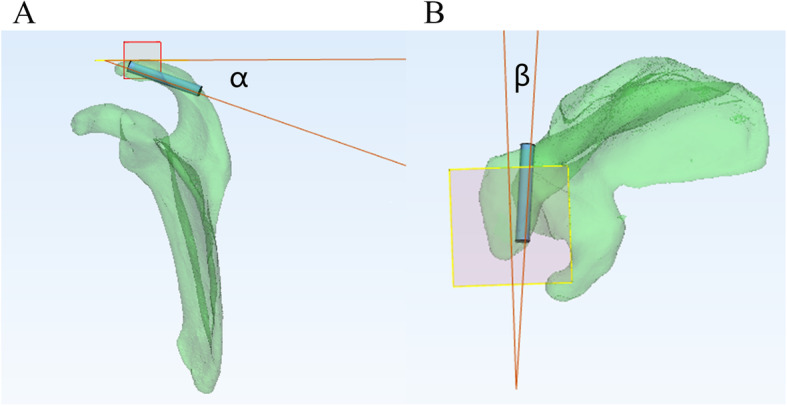
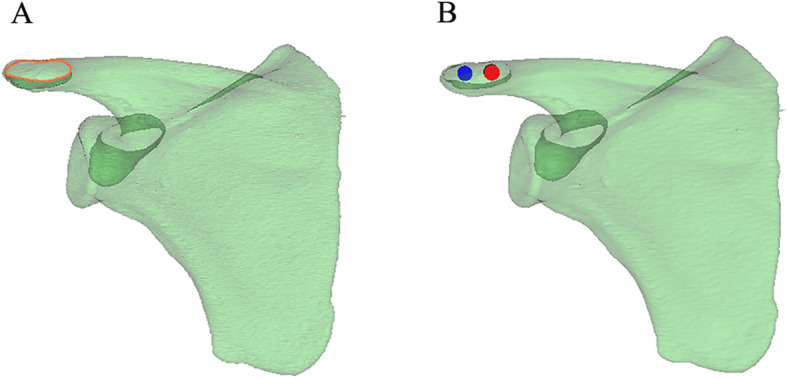
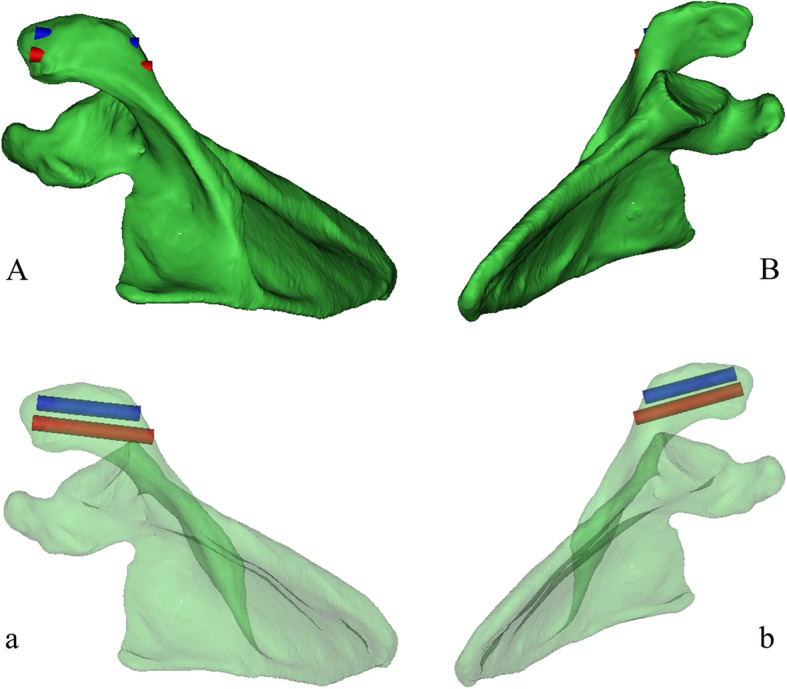
The scapular CT data of 100 individuals were obtained to reconstruct 3D models. The transparency of the 3D model was then downgraded along the axial perspective (the view perpendicular to the cross section of the acromion axis) to find the maximum translucent area. Two virtual screws were placed at the anterior edge of the acromion until they penetrated the posterior cortical bon. The largest diameters and lengths of the screw were measured, and the direction and insertion point of the screw were observed.
The mean maximum lengths of the medial and lateral screws were 43.33 ± 6.17 mm and 39.23 ± 6.01 mm, respectively. The mean maximum diameters of the medial and lateral screws were 4.71 ± 1.23 mm and 4.97 ± 1.07 mm, respectively. Differences in screw length, diameter, and insertion point between males and females were found. The differences in screw angle between sexes were not statistically significant.
Based on a 3D model test, we recommend the size, entry points, and angles of screws for Ogawa type I acromial fractures, providing valuable guidance for clinical work. More accurate screw parameters can be obtained preoperatively by establishing an individualized 3D model.
肩峰骨折较为少见,目前对于固定方式尚无共识,但越来越多的研究报告采用 2 枚螺钉固定 Ogawa Ⅰ型肩峰骨折。本研究的目的是通过一种新的 3D 模拟来获得理想的螺钉长度、直径、进钉点和角度。
获取 100 例个体的肩胛骨 CT 数据,重建 3D 模型。然后,沿着轴向透视(与肩峰轴横截面垂直的视图)降低 3D 模型的透明度,以找到最大的半透明区域。在肩峰前缘放置 2 枚虚拟螺钉,直到它们穿透骨皮质。测量螺钉的最大直径和长度,并观察螺钉的方向和进钉点。
内侧螺钉和外侧螺钉的平均最大长度分别为 43.33±6.17mm 和 39.23±6.01mm。内侧螺钉和外侧螺钉的平均最大直径分别为 4.71±1.23mm 和 4.97±1.07mm。男女之间螺钉长度、直径和进钉点存在差异。男女之间螺钉角度的差异无统计学意义。
基于 3D 模型测试,我们推荐 Ogawa Ⅰ型肩峰骨折的螺钉大小、进钉点和角度,为临床工作提供了有价值的指导。通过建立个体化的 3D 模型,可以在术前获得更准确的螺钉参数。