Oh Vincent Y S, Tong Eddie M W
Department of Psychology, National University of Singapore, Singapore, Singapore.
Affect Sci. 2021;2(3):311-323. doi: 10.1007/s42761-021-00045-x. Epub 2021 Apr 20.
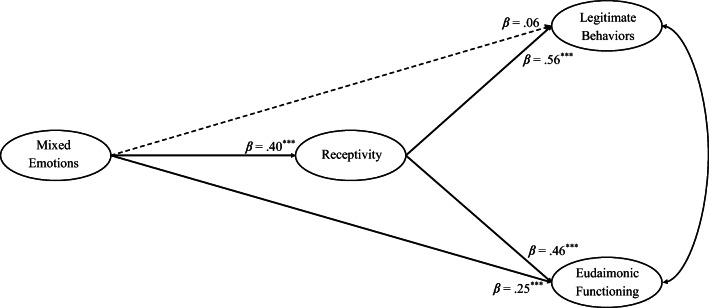
We report four studies (=1419) examining emotional reactions from March to April 2020, when COVID-19 exhibited exponentially increasing infections and fatalities. Specifically, we examined associations between emotions with self-reported intentions to enact virus-prevention behaviors that protect oneself from COVID-19 and eudaimonic functioning. Study 1A, 1B, and Study 2 provided naturalistic evidence that mixed emotions predicted legitimate virus-prevention behaviors and eudaimonic functioning in the USA and Singapore, and Study 2 also supported receptivity as a mediator. Finally, Study 3 provided experimental evidence that mixed emotions causally increased legitimate virus-prevention behaviors relative to neutral, positive emotion, and negative emotion conditions, whereas eudaimonic functioning was increased only relative to the neutral condition. Across all studies, positive and negative emotions were unrelated to legitimate virus-prevention behaviors, while relationships with eudaimonic functioning were inconsistent. While self-reported measures do not represent actual behaviors, the findings suggest a potential role for mixed emotions in pandemic-related outcomes.
The online version contains supplementary material available at 10.1007/s42761-021-00045-x.
我们报告了四项研究(共1419人),这些研究考察了2020年3月至4月期间的情绪反应,当时新冠病毒感染和死亡人数呈指数级增长。具体而言,我们研究了情绪与自我报告的实施预防病毒行为的意图之间的关联,这些行为旨在保护自己免受新冠病毒感染以及与幸福功能的关系。研究1A、1B和研究2提供了自然主义证据,表明混合情绪在美国和新加坡能够预测合理合法的病毒预防行为以及幸福功能,研究2还支持接受度作为中介变量。最后,研究3提供了实验证据,表明与中性、积极情绪和消极情绪条件相比,混合情绪会因果性地增加合理合法的病毒预防行为,而幸福功能仅相对于中性条件有所增加。在所有研究中,积极和消极情绪与合理合法的病毒预防行为无关,而与幸福功能的关系则不一致。虽然自我报告的测量方法并不代表实际行为,但研究结果表明混合情绪在大流行相关结果中可能发挥作用。
在线版本包含可在10.1007/s42761-021-00045-x获取的补充材料。