Montana State University, Department of Psychology, 319 Traphagen Hall, Bozeman, MT, USA.
University of Montana, Missoula, MT, USA.
Ann Behav Med. 2022 Feb 11;56(2):193-204. doi: 10.1093/abm/kaab032.
Historical loss in American Indians (AIs) is believed to contribute to high incidence of mental health disorders, yet less is known about the associations between historical loss and physical health.
To investigate whether frequency of thought about historical loss predicts risk factors for chronic physical health conditions in an AI community.
Using Community Based Participatory research (CBPR) and Ecological Momentary Assessment (EMA), we measured frequency of thoughts about historical loss in 100 AI adults residing on the Blackfeet reservation. Participants completed a 1-week monitoring period, during which ambulatory blood pressure and daily levels of psychological stress were measured. At the end of the week, we collected a dried blood spot sample for measurement of C-reactive protein (CRP).
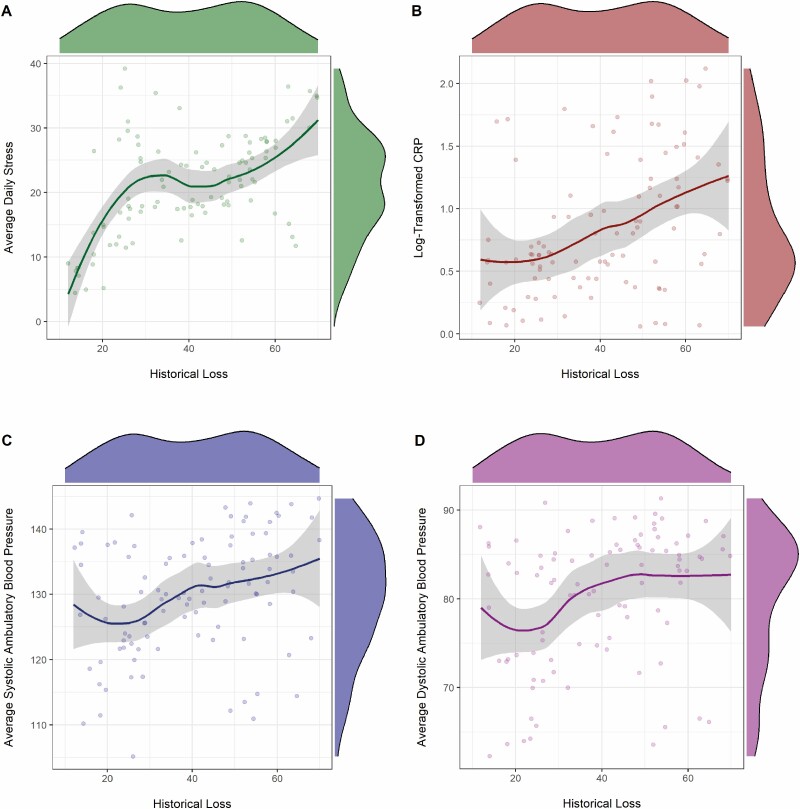
In hierarchical linear regression models controlling for demographics and relevant covariates, greater frequency of thoughts about historical loss predicted higher average daily psychological stress (B = .55, t = 6.47, p < .001, ΔR2 = .30) and higher levels of CRP (B = .33, t = 3.93, p < .001, ΔR2 = .10). Using linear mixed modeling with relevant covariates, we found that greater thoughts about historical loss were associated with higher systolic ambulatory blood pressure (B = .32, 95% CI = .22-.42, t = 6.48, p < .001, ΔR2 = .25; Fig. 1c) and greater diastolic ambulatory blood pressure (B = .19, 95% CI = .11-.27, t = 4.73, p < .001, ΔR2 = .19).
The data suggest that frequency of thought about historical loss may contribute to increased subclinical risk for cardiovascular disease in the Blackfeet community.
据信,美洲原住民(AI)的历史损失导致其心理健康障碍发病率较高,但人们对历史损失与身体健康之间的关联知之甚少。
调查在 AI 社区中,对历史损失的思考频率是否与慢性身体健康状况的风险因素相关。
我们采用社区参与式研究(CBPR)和生态瞬时评估(EMA),对居住在黑脚族保留地的 100 名 AI 成年人进行了历史损失思考频率的测量。参与者完成了为期一周的监测期,在此期间测量了动态血压和日常心理压力水平。在一周结束时,我们采集了一份干血斑样本,用于测量 C 反应蛋白(CRP)。
在控制人口统计学和相关协变量的分层线性回归模型中,对历史损失的思考频率越高,预示着日常心理压力越大(B =.55,t = 6.47,p <.001,ΔR2 =.30)和 CRP 水平越高(B =.33,t = 3.93,p <.001,ΔR2 =.10)。使用具有相关协变量的线性混合模型,我们发现对历史损失的思考频率越高,与收缩压动态血压越高(B =.32,95%CI =.22-.42,t = 6.48,p <.001,ΔR2 =.25;图 1c)和舒张压动态血压越高(B =.19,95%CI =.11-.27,t = 4.73,p <.001,ΔR2 =.19)相关。
数据表明,对历史损失的思考频率可能会增加黑脚族社区心血管疾病的亚临床风险。