Research Institute of Molecular Pathology (IMP), Vienna BioCenter (VBC), 1030 Vienna, Austria.
Max Planck Institute for Evolutionary Anthropology, 04103 Leipzig, Germany.
Dev Cell. 2021 May 17;56(10):1541-1551.e6. doi: 10.1016/j.devcel.2021.04.016.
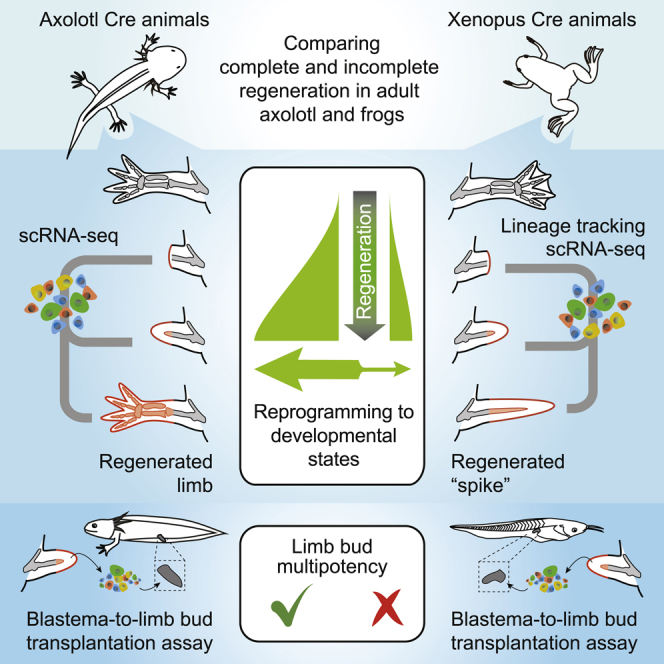
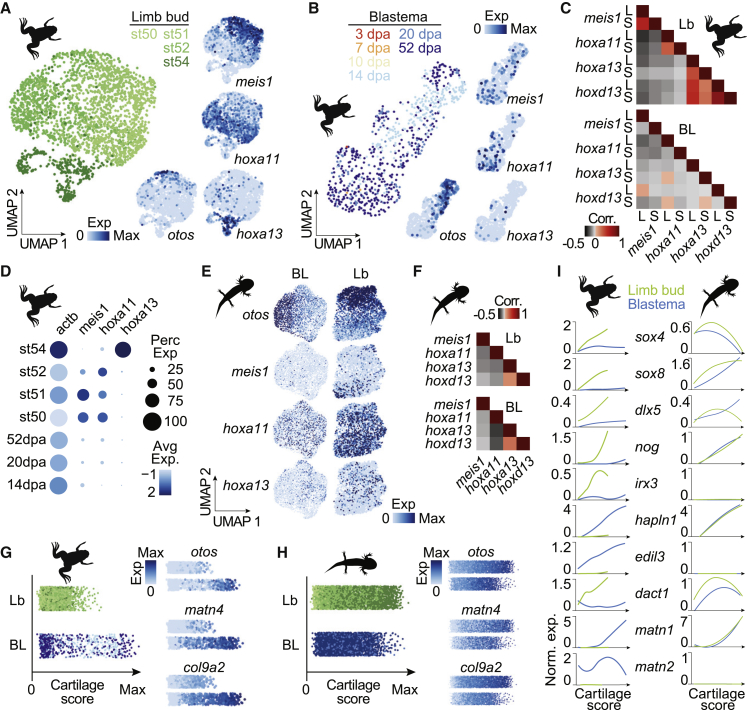
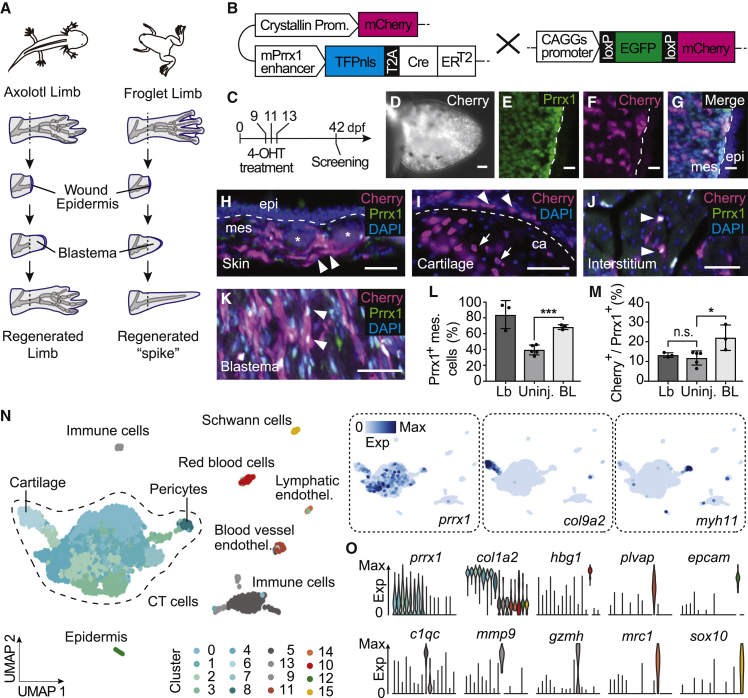
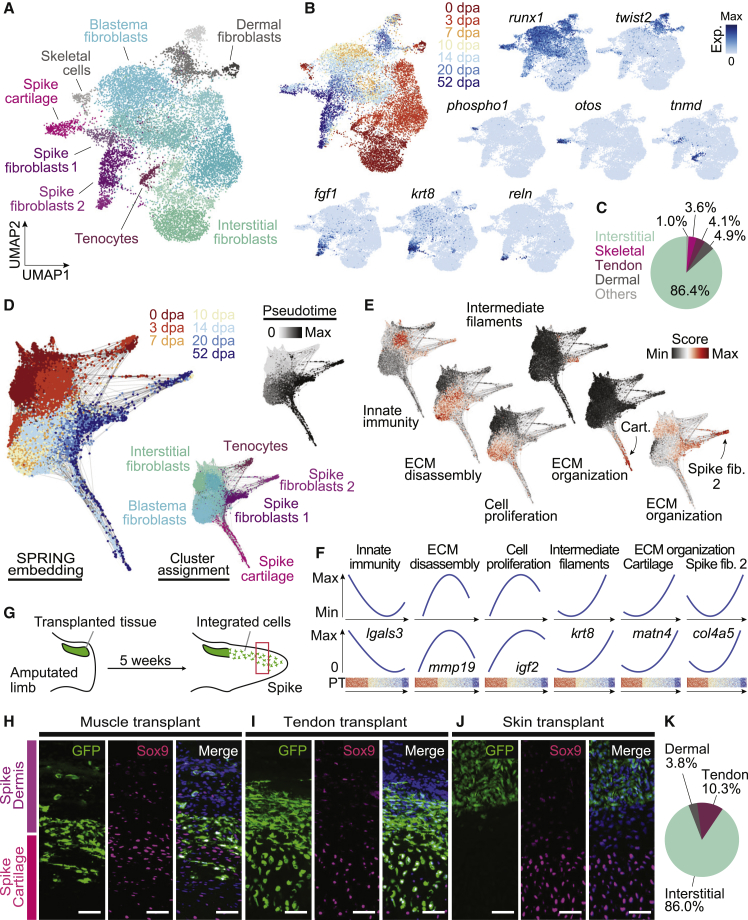
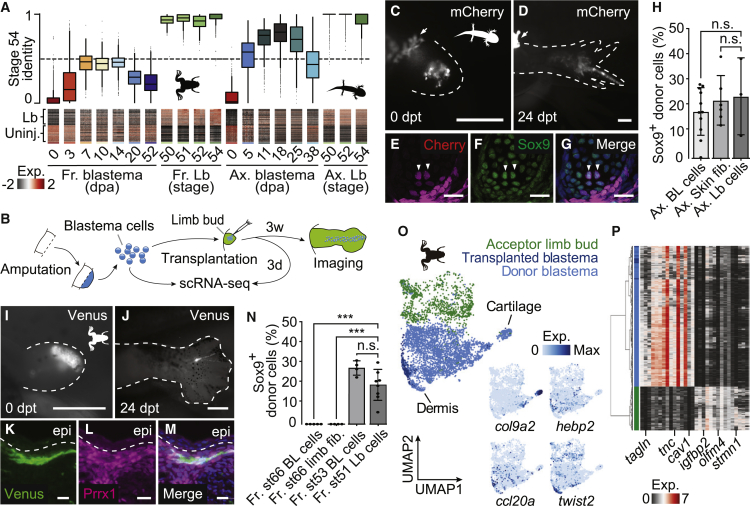
Limb regeneration, while observed lifelong in salamanders, is restricted in post-metamorphic Xenopus laevis frogs. Whether this loss is due to systemic factors or an intrinsic incapability of cells to form competent stem cells has been unclear. Here, we use genetic fate mapping to establish that connective tissue (CT) cells form the post-metamorphic frog blastema, as in the case of axolotls. Using heterochronic transplantation into the limb bud and single-cell transcriptomic profiling, we show that axolotl CT cells dedifferentiate and integrate to form lineages, including cartilage. In contrast, frog blastema CT cells do not fully re-express the limb bud progenitor program, even when transplanted into the limb bud. Correspondingly, transplanted cells contribute to extraskeletal CT, but not to the developing cartilage. Furthermore, using single-cell RNA-seq analysis we find that embryonic and adult frog cartilage differentiation programs are molecularly distinct. This work defines intrinsic restrictions in CT dedifferentiation as a limitation in adult regeneration.
肢体再生虽然在蝾螈中终生观察到,但在变形后的非洲爪蟾中受到限制。这种丧失是由于系统性因素还是细胞内在无能形成有能力的干细胞尚不清楚。在这里,我们使用遗传命运图谱来确定结缔组织 (CT) 细胞形成变形后的青蛙芽基,就像蝾螈一样。通过异时性移植到肢芽和单细胞转录组分析,我们表明蝾螈 CT 细胞去分化并整合形成谱系,包括软骨。相比之下,即使移植到肢芽中,青蛙芽基 CT 细胞也不能完全重新表达肢芽祖细胞程序。相应地,移植细胞有助于形成外骨骼 CT,但不能形成正在发育的软骨。此外,使用单细胞 RNA-seq 分析,我们发现胚胎和成体青蛙软骨分化程序在分子上是不同的。这项工作将 CT 去分化的内在限制定义为成年再生的限制。