
ResSANet:用于点云处理的几何信息学习
ResSANet: Learning Geometric Information for Point Cloud Processing.
作者信息
Zhu Xiaojun, Zhang Zheng, Ruan Jian, Liu Houde, Sun Hanxu
机构信息
School of Automation, Beijing University of Posts and Telecommunications, Beijing 100876, China.
Center for Artificial Intelligence and Robotics, Shenzhen International Graduate School, Tsinghua University, Shenzhen 518005, China.
出版信息
Sensors (Basel). 2021 May 6;21(9):3227. doi: 10.3390/s21093227.
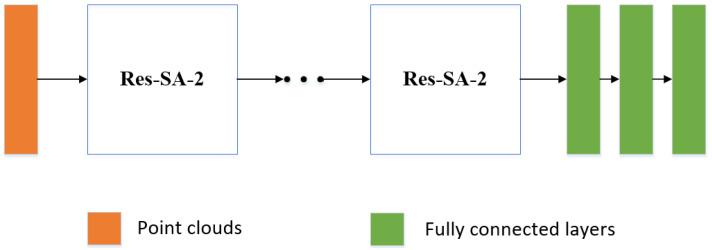
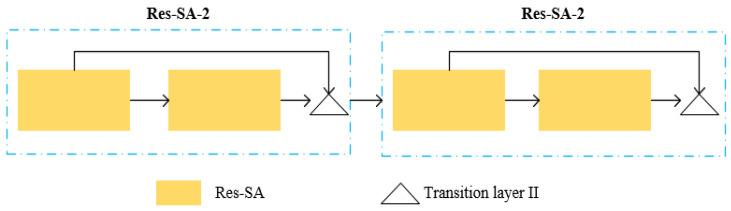
Point clouds with rich local geometric information have potentially huge implications in several applications, especially in areas of robotic manipulation and autonomous driving. However, most point cloud processing methods cannot extract enough geometric features from a raw point cloud, which restricts the performance of their downstream tasks such as point cloud classification, shape retrieval and part segmentation. In this paper, the authors propose a new method where a convolution based on geometric primitives is adopted to accurately represent the elusive shape in the form of a point cloud to fully extract hidden geometric features. The key idea of the proposed approach is building a brand-new convolution net named ResSANet on the basis of geometric primitives to learn hierarchical geometry information. Two different modules are devised in our network, Res-SA and Res-SA-2, to achieve feature fusion at different levels in ResSANet. This work achieves classification accuracy up to 93.2% on the ModelNet40 dataset and the shape retrieval with an effect of 87.4%. The part segmentation experiment also achieves an accuracy of 83.3% (class mIoU) and 85.3% (instance mIoU) on ShapeNet dataset. It is worth mentioning that the number of parameters in this work is just 1.04 M while the network depth is minimal. Experimental results and comparisons with state-of-the-art methods demonstrate that our approach can achieve superior performance.
具有丰富局部几何信息的点云在多个应用领域有着潜在的巨大影响,尤其是在机器人操作和自动驾驶领域。然而,大多数点云处理方法无法从原始点云中提取足够的几何特征,这限制了它们在诸如点云分类、形状检索和部件分割等下游任务中的性能。在本文中,作者提出了一种新方法,即采用基于几何基元的卷积,以点云的形式准确表示难以捉摸的形状,从而充分提取隐藏的几何特征。所提出方法的关键思想是在几何基元的基础上构建一个全新的卷积网络ResSANet,以学习分层几何信息。我们的网络中设计了两个不同的模块,即Res-SA和Res-SA-2,以在ResSANet的不同层次上实现特征融合。这项工作在ModelNet40数据集上实现了高达93.2%的分类准确率,在形状检索方面达到了87.4%的效果。部件分割实验在ShapeNet数据集上也分别达到了83.3%(类别平均交并比)和85.3%(实例平均交并比)的准确率。值得一提的是,这项工作中的参数数量仅为104万个,而网络深度最小。实验结果以及与现有最先进方法的比较表明,我们的方法能够实现卓越的性能。






 Zotero 插件