Yeasmin Rabeta, Brewer Ann, Fine Lela R, Zhang Liqun
Chemical Engineering department, Tennessee Technological University, 1 William L Jones Dr, Cookeville, Tennessee 38505, United States.
ACS Omega. 2021 May 18;6(21):13926-13939. doi: 10.1021/acsomega.1c01803. eCollection 2021 Jun 1.
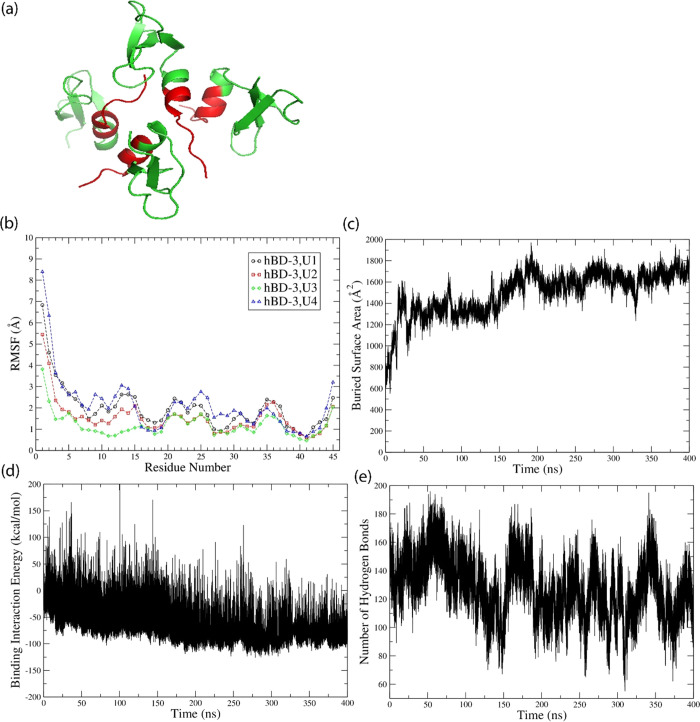
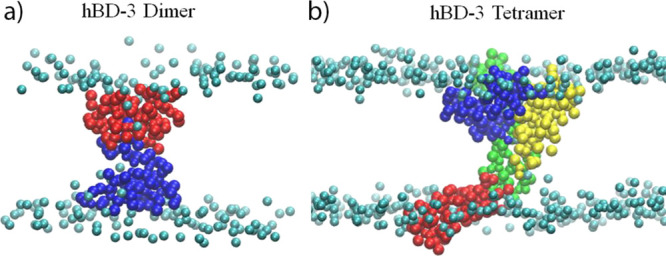
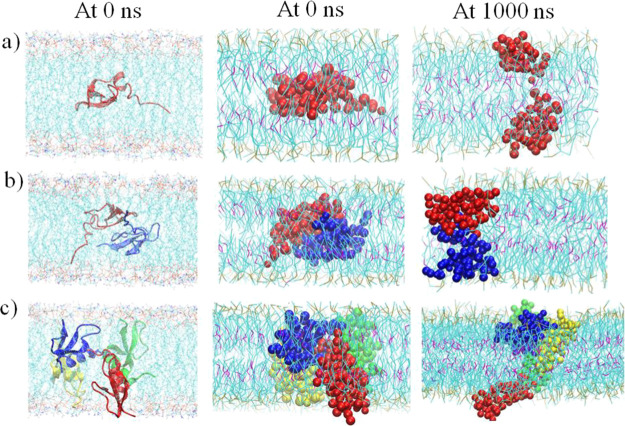
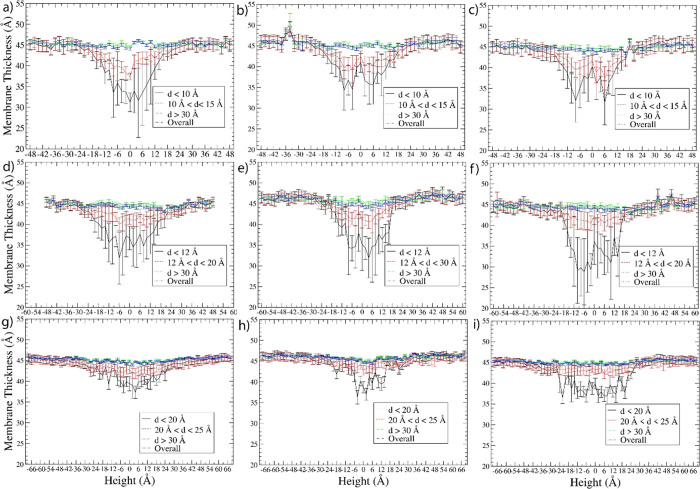
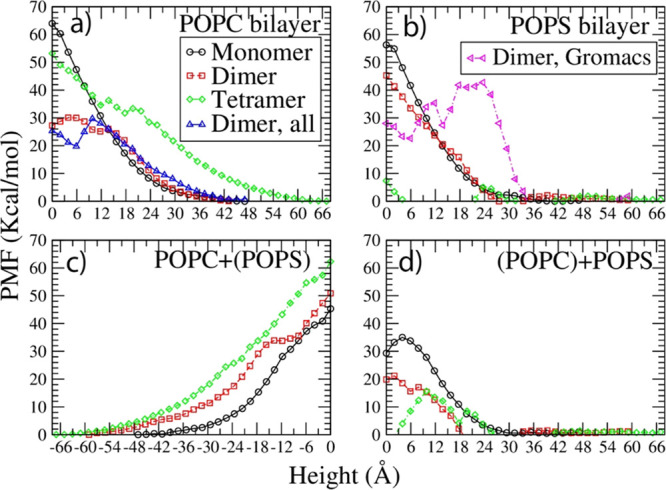
Human β defensin type 3 (hBD-3) is a small cationic cysteine-rich peptide. It has a broad spectrum of antimicrobial activities. However, at high concentrations, it also shows hemolytic activity by interrupting red blood cells. To understand the selectivity of hBD-3 disrupting cell membranes, investigating the capability of hBD-3 translocating through different membranes is important. Since hBD-3 in the analogue form in which all three pairs of disulfide bonds are broken has similar antibacterial activities to the wild-type, this project investigates the structure and dynamics of an hBD-3 analogue in monomer, dimer, and tetramer forms through both zwitterionic and negatively charged lipid bilayers using molecular dynamics (MD) simulations. One tetramer structure of hBD-3 was predicted by running all-atom MD simulations on hBD-3 in water at a high concentration, which was found to be stable in water during 400 ns all-atom simulations based on root-mean-squared deviation, root-mean-squared fluctuation, buried surface area, and binding interaction energy calculations. After that, hBD-3 in different forms was placed inside different membranes, and then steered MD simulation was conducted to pull the hBD-3 out of the membrane along the -direction to generate different configurational windows to set up umbrella-sampling (US) simulations. Because extensive sampling is important to obtain accurate free energy barriers, coarse-grained US MD simulations were performed in each window. Based on the long-term simulation result, membrane thinning was found near hBD-3 in different lipid bilayers and in different hBD-3 oligomer systems. By calculating the root-mean-squared deviation of the -coordinate of hBD-3 molecules, rotation of the oligomer inside the bilayer and stretching of the oligomer structure along the -direction were observed. Although reorientation of lipid heads toward the hBD-3 tetramer was observed based on the density profile calculation, the order parameter calculation shows that hBD-3 disrupts 1-palmitoyl-2-oleoyl-sn-glycero-3-phospho-l-serine (POPS) lipids more significantly and makes it less ordered than on 1-palmitoyl-2-oleoyl-sn-glycero-3-phosphocholine (POPC) lipids. Calculating the free energy of hBD-3 through different lipid bilayers, it was found that generally hBD-3 encounters a lower energy barrier through negatively charged lipid membranes than the zwitterionic membrane. hBD-3 in different forms needs to overcome a lower energy barrier crossing the combined POPC+POPS bilayer through the POPS leaflet than through the POPC leaflet. Besides that, the potential of mean force result suggests that hBD-3 forms an oligomer translocating negatively charged lipid membranes at a low concentration. This study supplied new insight into the antibacterial mechanism of hBD-3 through different membranes.
人β-防御素3(hBD-3)是一种富含阳离子半胱氨酸的小肽。它具有广谱抗菌活性。然而,在高浓度时,它也会通过破坏红细胞而表现出溶血活性。为了了解hBD-3破坏细胞膜的选择性,研究hBD-3穿过不同膜的能力很重要。由于所有三对二硫键均断裂的类似物形式的hBD-3具有与野生型相似的抗菌活性,因此本项目通过分子动力学(MD)模拟研究了hBD-3类似物在单体、二聚体和四聚体形式下通过两性离子和带负电荷的脂质双层的结构和动力学。通过对高浓度水中的hBD-3进行全原子MD模拟,预测了一种hBD-3四聚体结构,基于均方根偏差、均方根波动、埋藏表面积和结合相互作用能计算,发现在400 ns全原子模拟过程中该结构在水中是稳定的。之后,将不同形式的hBD-3置于不同的膜内,然后进行引导MD模拟,沿z方向将hBD-3从膜中拉出以生成不同的构型窗口,从而建立伞形采样(US)模拟。由于广泛采样对于获得准确的自由能垒很重要,因此在每个窗口中进行了粗粒度的US MD模拟。基于长期模拟结果,发现在不同脂质双层和不同hBD-3寡聚体系统中,hBD-3附近的膜会变薄。通过计算hBD-3分子z坐标的均方根偏差,观察到双层内寡聚体的旋转以及寡聚体结构沿z方向的拉伸。尽管基于密度分布计算观察到脂质头部朝向hBD-3四聚体重新定向,但序参计算表明,hBD-3对1-棕榈酰-2-油酰-sn-甘油-3-磷酸-L-丝氨酸(POPS)脂质的破坏更显著,使其比1-棕榈酰-2-油酰-sn-甘油-3-磷酸胆碱(POPC)脂质的有序性更低。通过计算hBD-3穿过不同脂质双层的自由能,发现一般来说,hBD-3穿过带负电荷的脂质膜时遇到的能垒比两性离子膜低。不同形式的hBD-3穿过组合的POPC+POPS双层通过POPS小叶比通过POPC小叶需要克服更低的能垒。除此之外,平均力势结果表明,hBD-3在低浓度下形成一种寡聚体穿过带负电荷的脂质膜。本研究为hBD-3通过不同膜的抗菌机制提供了新的见解。