
走近蛋白质屏障:真核生物复制暂停的新机制
Approaching Protein Barriers: Emerging Mechanisms of Replication Pausing in Eukaryotes.
作者信息
Shyian Maksym, Shore David
机构信息
Department of Molecular Biology, Institute of Genetics and Genomics of Geneva (iGE3), University of Geneva, Geneva, Switzerland.
出版信息
Front Cell Dev Biol. 2021 May 28;9:672510. doi: 10.3389/fcell.2021.672510. eCollection 2021.
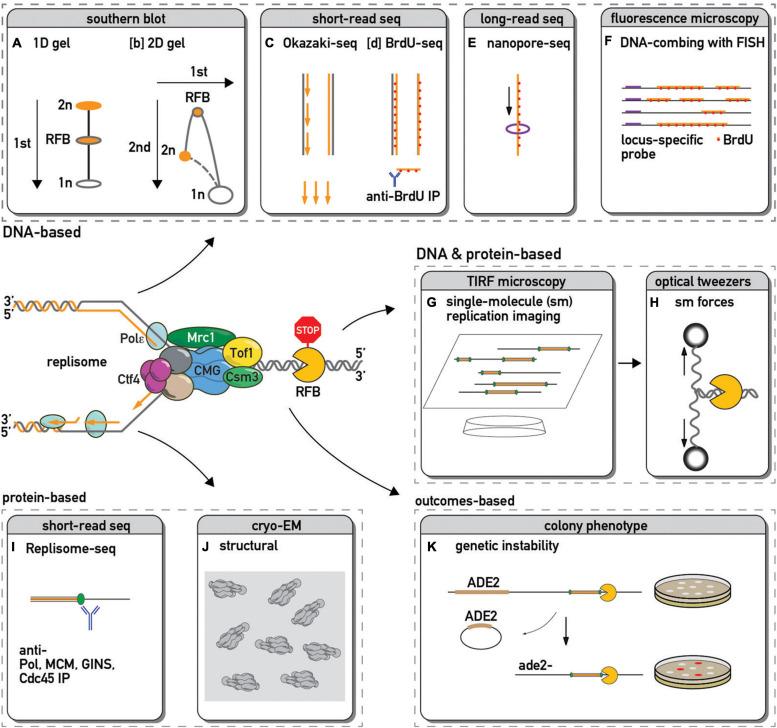
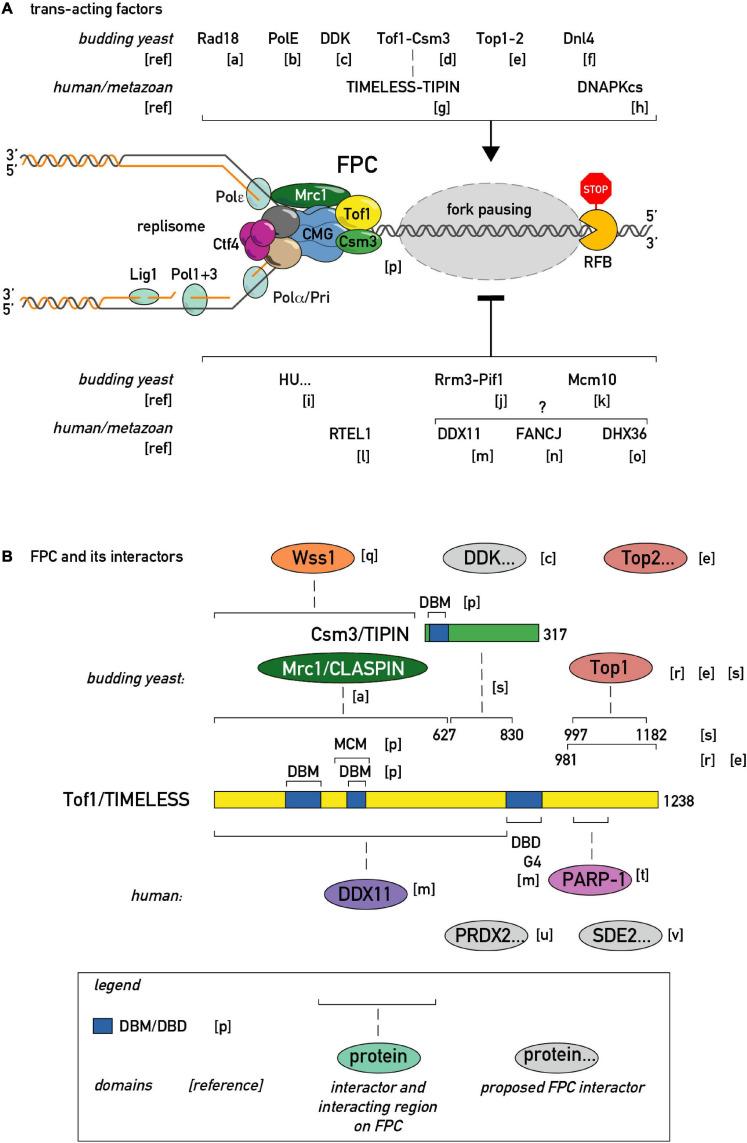
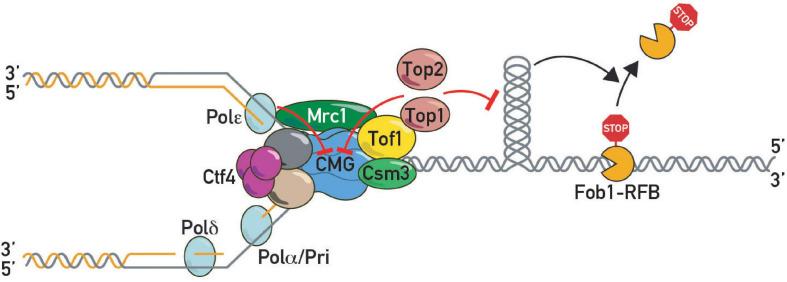
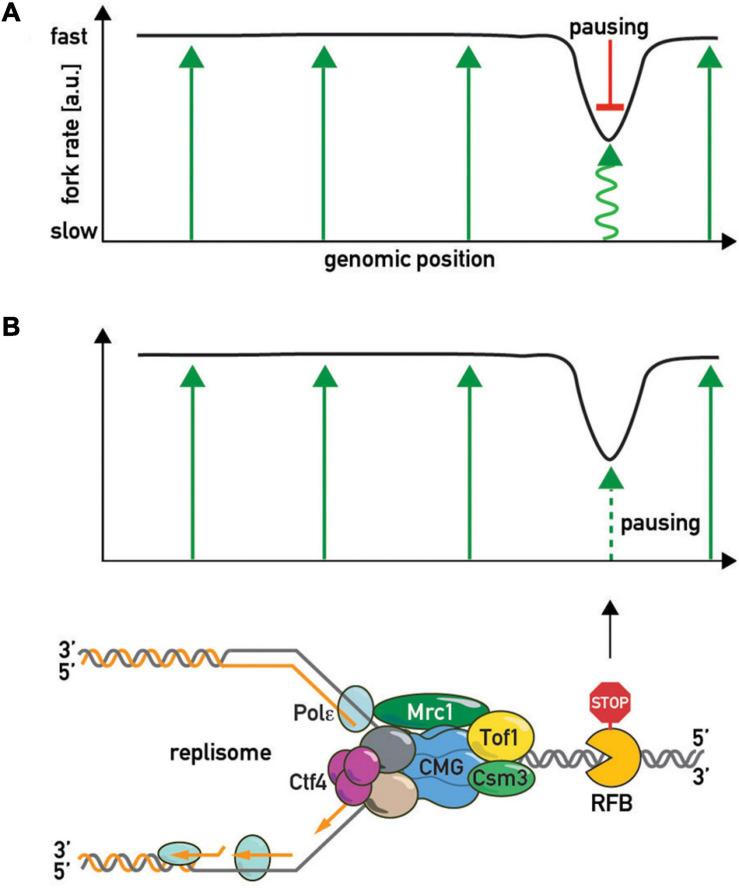
During nuclear DNA replication multiprotein replisome machines have to jointly traverse and duplicate the total length of each chromosome during each cell cycle. At certain genomic locations replisomes encounter tight DNA-protein complexes and slow down. This fork pausing is an active process involving recognition of a protein barrier by the approaching replisome an evolutionarily conserved Fork Pausing/Protection Complex (FPC). Action of the FPC protects forks from collapse at both programmed and accidental protein barriers, thus promoting genome integrity. In addition, FPC stimulates the DNA replication checkpoint and regulates topological transitions near the replication fork. Eukaryotic cells have been proposed to employ physiological programmed fork pausing for various purposes, such as maintaining copy number at repetitive loci, precluding replication-transcription encounters, regulating kinetochore assembly, or controlling gene conversion events during mating-type switching. Here we review the growing number of approaches used to study replication pausing and as well as the characterization of additional factors recently reported to modulate fork pausing in different systems. Specifically, we focus on the positive role of topoisomerases in fork pausing. We describe a model where replisome progression is inherently cautious, which ensures general preservation of fork stability and genome integrity but can also carry out specialized functions at certain loci. Furthermore, we highlight classical and novel outstanding questions in the field and propose venues for addressing them. Given how little is known about replisome pausing at protein barriers in human cells more studies are required to address how conserved these mechanisms are.
在核DNA复制过程中,多蛋白复制体机器必须在每个细胞周期内共同穿越并复制每条染色体的全长。在某些基因组位置,复制体遇到紧密的DNA-蛋白质复合物并减速。这种叉状暂停是一个活跃的过程,涉及接近的复制体识别蛋白质屏障,即一种进化上保守的叉状暂停/保护复合物(FPC)。FPC的作用可保护复制叉在程序性和意外的蛋白质屏障处不发生崩溃,从而促进基因组完整性。此外,FPC刺激DNA复制检查点并调节复制叉附近的拓扑转变。真核细胞被认为出于各种目的采用生理性程序性叉状暂停,例如维持重复位点的拷贝数、避免复制-转录冲突、调节动粒组装或控制交配型转换期间的基因转换事件。在这里,我们综述了用于研究复制暂停的方法数量不断增加的情况,以及最近报道的在不同系统中调节叉状暂停的其他因素的特征。具体而言,我们关注拓扑异构酶在叉状暂停中的积极作用。我们描述了一个模型,其中复制体的进展本质上是谨慎的,这确保了叉状稳定性和基因组完整性的总体保存,但也可以在某些位点执行特殊功能。此外,我们强调了该领域经典和新出现的突出问题,并提出了解决这些问题的途径。鉴于对人类细胞中蛋白质屏障处复制体暂停的了解非常少,需要更多的研究来解决这些机制的保守程度。


 Zotero 插件