
拉贝,1896年(肺泡虫纲:顶复门)在青蛙体内:一种新物种的描述以及提议设立一个新亚科来容纳这些神秘的寄生虫。
Labbé, 1896 (Alveolata: Apicomplexa) in frogs: Description of a new species and proposing a new subfamily to accommodate these enigmatic parasites.
作者信息
Tokiwa Toshihiro, Chou Shyun, Tochigi Yuki, Katayama Kentaro, Duszynski Donald W
机构信息
Laboratory of Veterinary Parasitology, School of Veterinary Medicine, Faculty of Veterinary Science, Nippon Veterinary and Life Science University, 1-7-1 Kyonancho, Musashino, Tokyo, 180-0023, Japan.
Laboratory of Veterinary Physiology, School of Veterinary Medicine, Faculty of Veterinary Science, Nippon Veterinary and Life Science University, 1-7-1 Kyonancho, Musashino, Tokyo, 180-0023, Japan.
出版信息
Int J Parasitol Parasites Wildl. 2021 May 28;15:199-207. doi: 10.1016/j.ijppaw.2021.05.005. eCollection 2021 Aug.
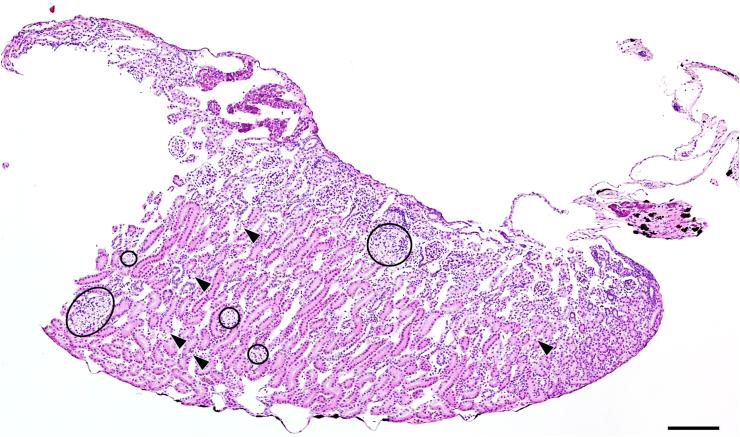
Labbé ,1896 (Alveolata: Apicomplexa) is a monotypic genus of renal coccidia found in anurans, particularly in the edible frog kl. (Amphibia: Anura: Ranidae), distributed in different parts of Europe. Here we propose a new species from the Tokyo daruma pond frog, . The coccidium detected in the renal tissue of shared some morphological characteristics with the type species, (Labbé, 1894), reported from kl. . However, in addition to size differences in several oocyst and sporocyst features between these parasites, phylogenetic analysis of gene fragments from two nuclear ribosomal loci and the mitochondrial cytochrome oxidase subunit 1, exposed distinct genetic differences between and our new species. Although our analysis validated the monophyly of with some members of the Toxoplasmatinae Biocca, 1957, Cystoisosporinae Frenkel et al., 1987, and Eumonosporinae Chou et al., 2021 (Sarcocystidae Poche, 1913), comparison of genetic differences between species from and revealed the presence of a greater number of polymorphisms than that observed when comparing inter-species ( spp., spp.) or inter-genus ( vs vs. and vs) variabilities among members of the Sarcocystidae. This indicates that , as re-erected and defined by Modrý et al. (2001, Int. J. Syst. Evol. Microbiol. 51, 767-772), with its homoxenous life cycle, requires placement in its own subfamily. Thus, we propose a new subfamily, Hyaloklossiinae n. subfam., to accommodate two species, from Europe and n. sp. which we describe here from in Japan.
拉贝属(Labbé,1896年)(肺泡虫纲:顶复门)是一种肾球虫的单型属,见于无尾目动物,特别是食用蛙(蛙科,两栖纲:无尾目),分布于欧洲不同地区。在此,我们从东京蟾蜍池蛙()中提出一个新物种。在该蛙肾组织中检测到的球虫与从食用蛙中报道的模式种拉贝球虫(Labbé,1894年)具有一些形态特征。然而,除了这些寄生虫在几个卵囊和子孢子囊特征上存在大小差异外,对来自两个核糖体基因座和线粒体细胞色素氧化酶亚基1的基因片段进行的系统发育分析,揭示了拉贝球虫与我们的新物种之间存在明显的遗传差异。尽管我们的分析验证了拉贝球虫与1957年的弓形虫亚科、1987年的囊等孢球虫亚科和2021年的真单孢子球虫亚科(1913年的肉孢子虫科)的一些成员的单系性,但对来自食用蛙的物种与新物种之间的遗传差异进行比较时发现,与比较肉孢子虫科成员之间的种间(肉孢子虫属物种、等孢球虫属物种)或属间(与、与和与)变异性相比,存在更多的多态性。这表明,如莫德里等人(2001年,《国际系统与进化微生物学杂志》51卷,767 - 772页)重新建立和定义的那样,具有同宿主生命周期的拉贝球虫需要置于其自己的亚科中。因此,我们提出一个新亚科,透明克洛西虫亚科(Hyaloklossiinae n. subfam.),以容纳来自欧洲的拉贝球虫和我们在此描述的来自日本东京蟾蜍池蛙的新物种。



 Zotero 插件