
用于直接接触膜蒸馏的具有疏水封端铜纳米颗粒的聚偏氟乙烯复合膜
PVDF Composite Membranes with Hydrophobically-Capped CuONPs for Direct-Contact Membrane Distillation.
作者信息
Saldías César, Terraza Claudio A, Leiva Angel, Koschikowski Joachim, Winter Daniel, Tundidor-Camba Alain, Martin-Trasanco Rudy
机构信息
Department of Physical Chemistry, Faculty of Chemistry and of Pharmacy, Pontificia Universidad Católica de Chile, P.O. Box 306, Post 22, Santiago 7820436, Chile.
Research Laboratory for Organic Polymers (RLOP), Faculty of Chemistry and of Pharmacy, Pontificia Universidad Católica de Chile, P.O. Box 306, Post 22, Santiago 7820436, Chile.
出版信息
Nanomaterials (Basel). 2021 Jun 5;11(6):1497. doi: 10.3390/nano11061497.
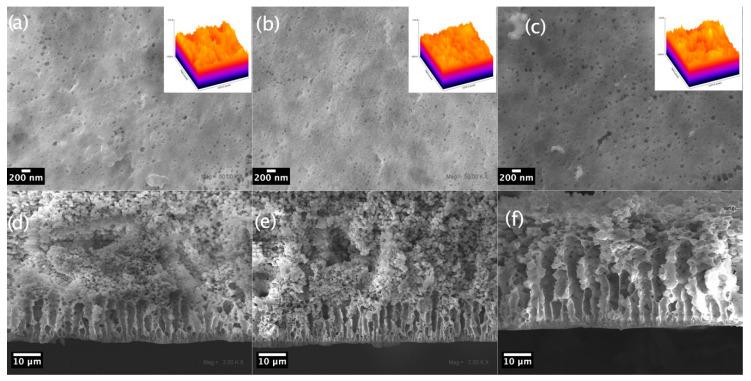
Water scarcity is an imminent problem that humanity is beginning to attempt to solve. Among the several technologies that have been developed to mitigate water scarcity, membrane distillation is of particular note. In the present work, CuO nanoparticles capped with 1-octanethiol (CuONPs@CH) or 1H,1H,2H,2H-perfluorodecanethiol (CuONPs@CF) are prepared. The nanoparticles are characterized by FT-IR and TGA methods. Two weight losses are observed in both cases, with the decomposition of the organic fragments beginning at 158 °C and 230 °C for CuONPs@CF and CuONPs@CH, respectively. Flat sheet PVDF composite membranes containing nanoparticles are prepared by the casting solution method using nanoparticle concentrations that ranged between 2-20% with a non-woven polyester fabric as support. The obtained membranes showed a thickness of 240 ± 40 μm. According to water contact angle (87° for CuONPs@CH and 95° for CuONPs@CF, both at 10% w.t) and roughness (12 pixel for CuONPs@CH and 14 pixels for CuONPs@CF, both at 10% w.t) determinations, the hydrophobicity of membranes changed due to a decrease in surface energy, while, for naked CuONPs, the roughness factor represents the main role. Membranes prepared with capped nanoparticles showed similar porosity (60-64%). SEM micrographs show asymmetric porous membranes with a 200-nm surface pore diameter. The largest finger-like pores in the membranes prepared with CuONPs, CuONPs@CH and CuONPs@CF had values of 63 ± 10 μm, 32 ± 8 μm, and 45 ± 10 μm, respectively. These membranes were submitted to a direct contact membrane distillation module and flux values of 1.8, 2.7, and 3.9 kg(m·h) at ΔT = 30 °C were obtained for the CuONPs, CuONPs@CH, and CuONPs@CF, respectively. The membranes showed 100% salt rejection during the testing time (240 min).
水资源短缺是人类即将着手解决的紧迫问题。在已开发的多种缓解水资源短缺的技术中,膜蒸馏尤为值得关注。在本研究中,制备了用1-辛硫醇(CuONPs@CH)或1H,1H,2H,2H-全氟癸硫醇(CuONPs@CF)包覆的CuO纳米颗粒。通过傅里叶变换红外光谱(FT-IR)和热重分析(TGA)方法对纳米颗粒进行了表征。在两种情况下均观察到两次失重,对于CuONPs@CF和CuONPs@CH,有机片段的分解分别始于158℃和230℃。以纳米颗粒浓度在2%-20%之间的铸膜液法,以非织造聚酯织物为支撑体,制备了含纳米颗粒的平板聚偏氟乙烯(PVDF)复合膜。所得膜的厚度为240±40μm。根据水接触角(10%重量比时,CuONPs@CH为87°,CuONPs@CF为95°)和粗糙度(10%重量比时,CuONPs@CH为12像素,CuONPs@CF为14像素)测定,膜的疏水性因表面能降低而改变,而对于裸CuO纳米颗粒,粗糙度因素起主要作用。用包覆纳米颗粒制备的膜显示出相似的孔隙率(60%-64%)。扫描电子显微镜(SEM)照片显示为不对称多孔膜,表面孔径为200nm。用CuO纳米颗粒、CuONPs@CH和CuONPs@CF制备的膜中,最大的指状孔直径分别为63±10μm、32±8μm和45±10μm。将这些膜置于直接接触膜蒸馏模块中,在ΔT = 30℃时,CuO纳米颗粒、CuONPs@CH和CuONPs@CF的通量值分别为1.8、2.7和3.9 kg/(m·h)。在测试时间(240分钟)内,这些膜的脱盐率为100%。



 Zotero 插件