• 文献检索
  • 文档翻译
  • 深度研究
  • 学术资讯
  • Suppr Zotero 插件Zotero 插件
  • 邀请有礼
  • 套餐&价格
  • 历史记录
应用&插件
Suppr Zotero 插件Zotero 插件浏览器插件Mac 客户端Windows 客户端微信小程序
定价
高级版会员购买积分包购买API积分包
服务
文献检索文档翻译深度研究API 文档MCP 服务
关于我们
关于 Suppr公司介绍联系我们用户协议隐私条款
关注我们

Suppr 超能文献

核心技术专利:CN118964589B侵权必究
粤ICP备2023148730 号-1Suppr @ 2026

文献检索

告别复杂PubMed语法,用中文像聊天一样搜索,搜遍4000万医学文献。AI智能推荐,让科研检索更轻松。

立即免费搜索

文件翻译

保留排版,准确专业,支持PDF/Word/PPT等文件格式,支持 12+语言互译。

免费翻译文档

深度研究

AI帮你快速写综述,25分钟生成高质量综述,智能提取关键信息,辅助科研写作。

立即免费体验

比较宏基因组学和宏转录组学揭示越冬辣椒果实中的微生物组。

Comparative Study of Metagenomics and Metatranscriptomics to Reveal Microbiomes in Overwintering Pepper Fruits.

机构信息

Research Institute of Agriculture and Life Sciences, College of Agriculture and Life Sciences, Seoul National University, Seoul 08826, Korea.

Horticultural and Herbal Crop Environment Division, National Institute of Horticultural and Herbal Science, RDA, Wanju 55365, Korea.

出版信息

Int J Mol Sci. 2021 Jun 8;22(12):6202. doi: 10.3390/ijms22126202.

DOI:10.3390/ijms22126202
PMID:34201359
原文链接:https://pmc.ncbi.nlm.nih.gov/articles/PMC8227054/
Abstract

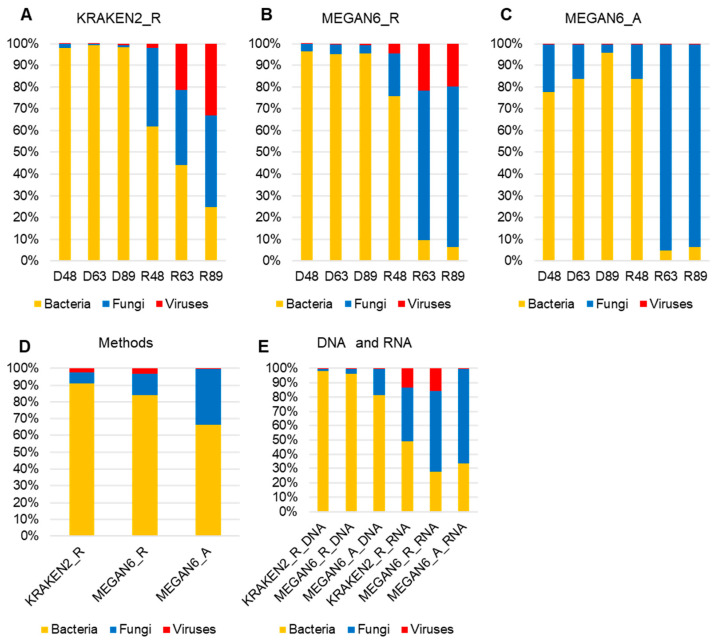
Red pepper (, L.), is one of the most important spice plants in Korea. Overwintering pepper fruits are a reservoir of various microbial pepper diseases. Here, we conducted metagenomics (DNA sequencing) and metatranscriptomics (RNA sequencing) using samples collected from three different fields. We compared two different library types and three different analytical methods for the identification of microbiomes in overwintering pepper fruits. Our results demonstrated that DNA sequencing might be useful for the identification of bacteria and DNA viruses such as bacteriophages, while mRNA sequencing might be beneficial for the identification of fungi and RNA viruses. Among three analytical methods, KRAKEN2 with raw data reads (KRAKEN2_R) might be superior for the identification of microbial species to other analytical methods. However, some microbial species with a low number of reads were wrongly assigned at the species level by KRAKEN2_R. Moreover, we found that the databases for bacteria and viruses were better established as compared to the fungal database with limited genome data. In summary, we carefully suggest that different library types and analytical methods with proper databases should be applied for the purpose of microbiome study.

摘要

红辣椒(Capsicum annum L.)是韩国最重要的香料植物之一。越冬辣椒果实是各种微生物辣椒病害的储库。在这里,我们使用从三个不同田地采集的样本进行了宏基因组学(DNA 测序)和宏转录组学(RNA 测序)。我们比较了两种不同的文库类型和三种不同的分析方法,以鉴定越冬辣椒果实中的微生物组。我们的结果表明,DNA 测序可能有助于鉴定细菌和噬菌体等 DNA 病毒,而 mRNA 测序可能有助于鉴定真菌和 RNA 病毒。在三种分析方法中,使用原始数据读取的 Kraken2(Kraken2_R)可能优于其他分析方法,有助于鉴定微生物物种。然而,Kraken2_R 将一些低读数的微生物物种错误地分配到物种水平。此外,我们发现与真菌数据库相比,细菌和病毒的数据库得到了更好的建立,真菌数据库的基因组数据有限。总之,我们建议应根据适当的数据库仔细选择不同的文库类型和分析方法,以进行微生物组研究。

https://cdn.ncbi.nlm.nih.gov/pmc/blobs/c1b4/8227054/5dfda7004c32/ijms-22-06202-g012.jpg
https://cdn.ncbi.nlm.nih.gov/pmc/blobs/c1b4/8227054/107afd6c2cef/ijms-22-06202-g001.jpg
https://cdn.ncbi.nlm.nih.gov/pmc/blobs/c1b4/8227054/f2c508f0f0bc/ijms-22-06202-g002.jpg
https://cdn.ncbi.nlm.nih.gov/pmc/blobs/c1b4/8227054/466bf691b8d0/ijms-22-06202-g003.jpg
https://cdn.ncbi.nlm.nih.gov/pmc/blobs/c1b4/8227054/e5fc2e057e44/ijms-22-06202-g004.jpg
https://cdn.ncbi.nlm.nih.gov/pmc/blobs/c1b4/8227054/3d9cc63f212e/ijms-22-06202-g005.jpg
https://cdn.ncbi.nlm.nih.gov/pmc/blobs/c1b4/8227054/d9976200af93/ijms-22-06202-g006.jpg
https://cdn.ncbi.nlm.nih.gov/pmc/blobs/c1b4/8227054/35b6c46c7336/ijms-22-06202-g007.jpg
https://cdn.ncbi.nlm.nih.gov/pmc/blobs/c1b4/8227054/f67d34895241/ijms-22-06202-g008.jpg
https://cdn.ncbi.nlm.nih.gov/pmc/blobs/c1b4/8227054/0653cd47e4fd/ijms-22-06202-g009.jpg
https://cdn.ncbi.nlm.nih.gov/pmc/blobs/c1b4/8227054/564a100a3dc5/ijms-22-06202-g010.jpg
https://cdn.ncbi.nlm.nih.gov/pmc/blobs/c1b4/8227054/1aec94ffe0e0/ijms-22-06202-g011.jpg
https://cdn.ncbi.nlm.nih.gov/pmc/blobs/c1b4/8227054/5dfda7004c32/ijms-22-06202-g012.jpg
https://cdn.ncbi.nlm.nih.gov/pmc/blobs/c1b4/8227054/107afd6c2cef/ijms-22-06202-g001.jpg
https://cdn.ncbi.nlm.nih.gov/pmc/blobs/c1b4/8227054/f2c508f0f0bc/ijms-22-06202-g002.jpg
https://cdn.ncbi.nlm.nih.gov/pmc/blobs/c1b4/8227054/466bf691b8d0/ijms-22-06202-g003.jpg
https://cdn.ncbi.nlm.nih.gov/pmc/blobs/c1b4/8227054/e5fc2e057e44/ijms-22-06202-g004.jpg
https://cdn.ncbi.nlm.nih.gov/pmc/blobs/c1b4/8227054/3d9cc63f212e/ijms-22-06202-g005.jpg
https://cdn.ncbi.nlm.nih.gov/pmc/blobs/c1b4/8227054/d9976200af93/ijms-22-06202-g006.jpg
https://cdn.ncbi.nlm.nih.gov/pmc/blobs/c1b4/8227054/35b6c46c7336/ijms-22-06202-g007.jpg
https://cdn.ncbi.nlm.nih.gov/pmc/blobs/c1b4/8227054/f67d34895241/ijms-22-06202-g008.jpg
https://cdn.ncbi.nlm.nih.gov/pmc/blobs/c1b4/8227054/0653cd47e4fd/ijms-22-06202-g009.jpg
https://cdn.ncbi.nlm.nih.gov/pmc/blobs/c1b4/8227054/564a100a3dc5/ijms-22-06202-g010.jpg
https://cdn.ncbi.nlm.nih.gov/pmc/blobs/c1b4/8227054/1aec94ffe0e0/ijms-22-06202-g011.jpg
https://cdn.ncbi.nlm.nih.gov/pmc/blobs/c1b4/8227054/5dfda7004c32/ijms-22-06202-g012.jpg