
送礼蜘蛛中的差异分配:雄性根据雌性状况调整其繁殖投资。
Differential allocation in a gift-giving spider: males adjust their reproductive investment in response to female condition.
机构信息
Programa de Pós-graduação em Ecologia, Instituto de Biociências, Universidade de São Paulo, São Paulo, Brazil.
Departamento de Ecologia, Zoologia e Genética, Instituto de Biologia, Universidade Federal de Pelotas, Campus Universitário do Capão do Leão, Pelotas, Rio Grande do Sul, Brazil.
出版信息
BMC Ecol Evol. 2021 Jul 8;21(1):140. doi: 10.1186/s12862-021-01870-1.
BACKGROUND
When males are selective, they can either reject low-quality females or adjust their reproductive investment in response to traits that indicate female quality (e.g., body size or condition). According to the differential allocation hypothesis, males increase their reproductive investment when paired with high-quality females (positive differential allocation) or increase their reproductive investment when paired with low-quality females (negative differential allocation). This hypothesis has been proposed for monogamous species with biparental care, and most empirical studies focus on birds. Here we used the polygamous spider Paratrechalea ornata, in which males offer prey wrapped in silk as nuptial gifts, to test whether males adjust their reproductive investment in gift size, pre-copulatory and copulatory courtship, and sperm transfer in response to female body condition.
RESULTS
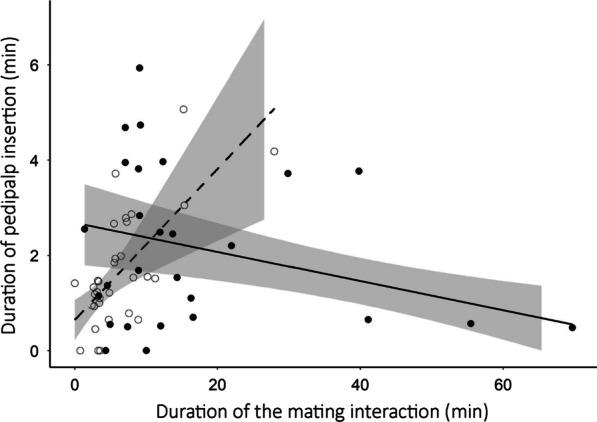
Males exposed to females in good body condition added more flies to the gift, stimulated these females longer with abdominal touches during pre-copulatory courtship, and had longer pedipalp insertions than males exposed to females in poor body condition. Female condition affected neither silk investment in nuptial gift wrapping nor the quantity of sperm transferred by males. Finally, females in good body condition oviposited faster after copulation and laid more eggs than females in poor body condition.
CONCLUSIONS
We provide experimental evidence that males of a gift-giving spider exhibit positive differential allocation in three key aspects of their reproductive investment: the size of the nutritious gift, duration of pre-copulatory courtship, and duration of pedipalp insertions, which is regarded as a form of copulatory courtship in spiders. This positive differential allocation is likely associated with the benefits of copulating with females in good body condition. These females are more fecund and oviposit faster after copulation than females in poor body condition, which under natural field conditions probably reduces the risk of multiple matings and thus the level of sperm competition faced by the males. As a final remark, our findings indicate that the hypothesis of differential allocation also applies to species with a scramble competition mating system, in which males heavily invest in nuptial gift construction, but not in parental care.
背景
当雄性具有选择性时,它们可以拒绝低质量的雌性,或者根据表明雌性质量的特征(例如身体大小或状况)来调整其繁殖投资。根据差异分配假说,当雄性与高质量的雌性配对时,会增加其繁殖投资(积极的差异分配),或者当与低质量的雌性配对时,会增加其繁殖投资(消极的差异分配)。这个假说已经被提出用于具有双亲照顾的一夫一妻制物种,并且大多数实证研究都集中在鸟类上。在这里,我们使用了多配偶制的蜘蛛 Paratrechalea ornata,雄性会用丝绸包裹猎物作为结婚礼物,来测试雄性是否会根据雌性的身体状况调整礼物大小、交配前和交配时的求偶行为以及精子转移的繁殖投资。
结果
暴露于身体状况良好的雌性环境中的雄性会在礼物中添加更多的苍蝇,在交配前的求偶行为中用腹部触摸刺激这些雌性更长时间,并且与暴露于身体状况较差的雌性的雄性相比,它们的触须插入时间更长。雌性的状况既不影响丝绸包裹的结婚礼物的投资,也不影响雄性转移的精子数量。最后,身体状况良好的雌性在交配后产卵更快,产卵量也比身体状况较差的雌性多。
结论
我们提供了实验证据表明,一种送礼蜘蛛的雄性在其繁殖投资的三个关键方面表现出积极的差异分配:营养礼物的大小、交配前求偶行为的持续时间和触须插入的持续时间,这被认为是蜘蛛交配求偶的一种形式。这种积极的差异分配可能与与身体状况良好的雌性交配的好处有关。这些雌性比身体状况较差的雌性更具生育能力,并且在交配后产卵更快,这在自然野外条件下可能会降低多次交配的风险,从而降低雄性面临的精子竞争水平。最后,我们的研究结果表明,差异分配假说也适用于具有争抢交配系统的物种,在这种系统中,雄性在结婚礼物的建造上大量投资,但不在亲代养育上投资。


 Zotero 插件