Rampersad Sephra N
Dept. of Life Sciences Faculty of Science and Technology The University of the West Indies St. Augustine Trinidad and Tobago, West Indies.
Ecol Evol. 2021 Jun 1;11(13):9010-9020. doi: 10.1002/ece3.7738. eCollection 2021 Jul.
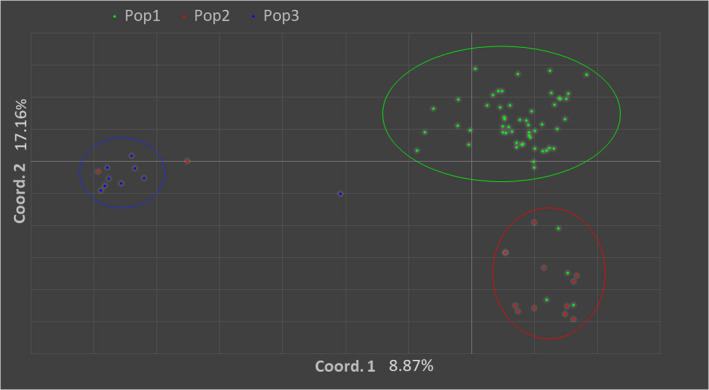
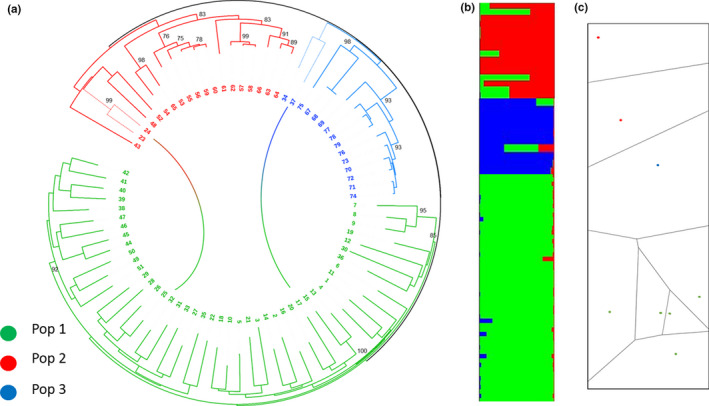
is associated with a number of wilt, blight, scab, and rot diseases in a range of economically important staple food crops worldwide. An assessment of the genetic structure and population stratification of species complex (FIESC) pathogen populations is important to understand the evolutionary potential of such populations in adapting to environmental change. Based on intersimple sequence repeat polymerase chain reaction (ISSR-PCR), it was found that the pathogen population was structured into three genetic clusters for which genetic differentiation was higher within than among populations. There was high intrapopulation genetic diversity for population 1 (94.63%) which consisted largely of isolates collected from North Trinidad. Populations 2 and 3 had a low level of admixture among the populations based on overall population differentiation. Population 1 accounted for the highest amount of genetic variation (95.82%) followed by populations 2 and 3. Population stratification was reflected in the dendrogram topology, which consisted of three main genetic clusters and which coincided with the outcome of Bayesian and PCoA analyses. The populations were isolated by distance, and Voronoi tessellations indicated physical or structural barriers to gene flow which contributed to restricted admixture between two of three populations. These findings suggest a high evolutionary potential for this FIESC pathogen population, the implications of which directly affect disease management strategies.
在全球一系列具有经济重要性的主食作物中,它与多种枯萎病、疫病、疮痂病和腐烂病相关。评估物种复合体(FIESC)病原体种群的遗传结构和种群分层对于理解此类种群适应环境变化的进化潜力很重要。基于简单重复序列间聚合酶链反应(ISSR-PCR),发现病原体种群被构建为三个遗传簇,种群内部的遗传分化高于种群之间。种群1(94.63%)具有较高的种群内遗传多样性,该种群主要由从特立尼达北部收集的分离株组成。基于总体种群分化,种群2和3在种群间的混合程度较低。种群1占遗传变异的比例最高(95.82%),其次是种群2和3。种群分层反映在聚类图拓扑结构中,该拓扑结构由三个主要遗传簇组成,与贝叶斯分析和主坐标分析(PCoA)的结果一致。种群通过距离隔离,Voronoi镶嵌图表明基因流动存在物理或结构障碍,这导致三个种群中的两个种群之间的混合受限。这些发现表明该FIESC病原体种群具有很高的进化潜力,其影响直接涉及疾病管理策略。