Environmental Engineering, Department of Civil Engineering, University of Manitoba, Winnipeg, MB R3T 5V6, Canada.
Int J Environ Res Public Health. 2021 Jul 17;18(14):7609. doi: 10.3390/ijerph18147609.
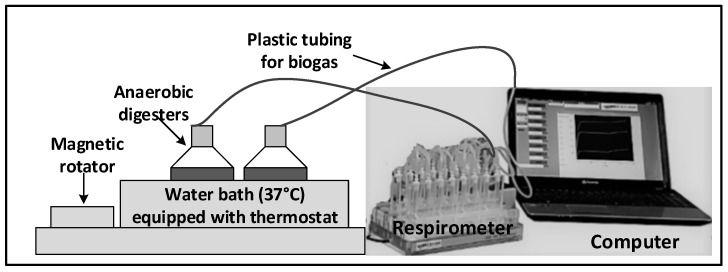
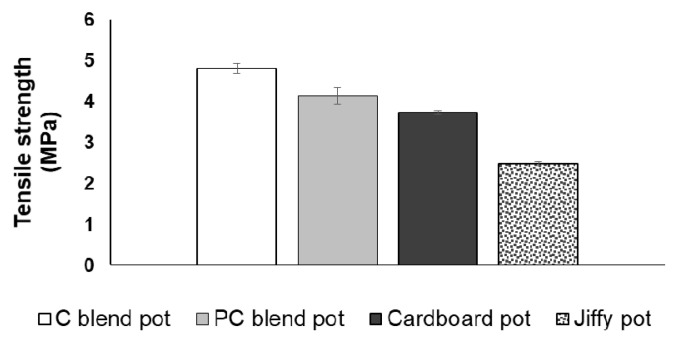
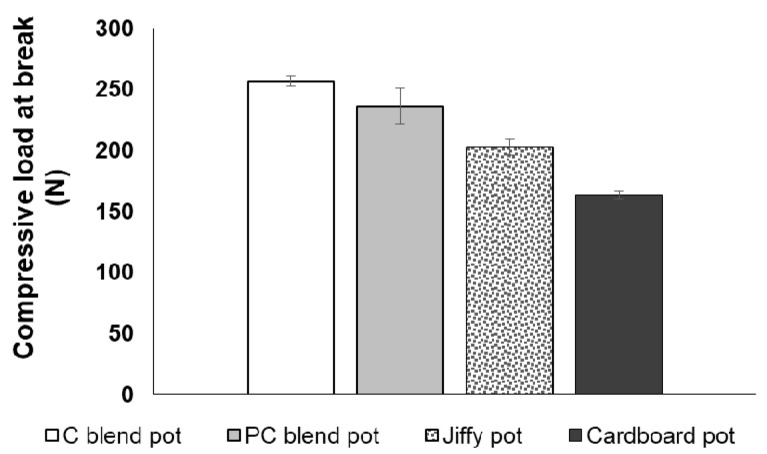
This study evaluates the efficacy of using textile waste blended with paper waste to form biodegradable seedling pots. A bio-composite blend of cotton (20% cotton, 40% newspaper, and 40% corrugated cardboard) and polycotton (20% polycotton, 40% newspaper, and 40% corrugated cardboard) with an optimum strength was formed into seedling pots. The appreciated seedling pots (untreated blends of cotton and polycotton) were compared with the commercial pots (cardboard seed starter pot and Jiffy pot) in terms of mechanical properties (tensile strength and compressive strength), biodegradability (soil burial test and anaerobic digestion), and seed germination. The untreated blends of cotton and polycotton pots demonstrated a comparable optimum strength, while the Jiffy pot and cardboard seed starter pot obtained the least tensile and compressive strengths, respectively. The anaerobic biodegradability assay suggests that the cotton blend pot, polycotton blend pot, and cardboard seed starter pot can degrade anaerobically because of high biogas and methane generation potential. A 100% seed germination was observed from the four seedling pots tested. Thus, the results demonstrate the efficacy of utilizing textile waste and paper waste to develop seedling pots with desirable strength and biodegradability compared to the commercial pots.
本研究评估了使用混合纺织废料和纸废料来形成可生物降解的育苗盆的功效。将棉(20%棉、40%报纸和 40%瓦楞纸板)和涤棉(20%涤棉、40%报纸和 40%瓦楞纸板)的生物复合材料混合物形成育苗盆,其具有最佳强度。将赞赏的育苗盆(未经处理的棉和涤棉混合物)与商业盆(纸板种子起始器和 Jiffy 盆)在机械性能(拉伸强度和压缩强度)、生物降解性(土壤掩埋试验和厌氧消化)和种子发芽方面进行比较。未经处理的棉和涤棉混合物盆表现出可比的最佳强度,而 Jiffy 盆和纸板种子起始器盆分别获得最低的拉伸和压缩强度。厌氧生物降解性测定表明,由于高沼气和甲烷产生潜力,棉混合物盆、涤棉混合物盆和纸板种子起始器盆可以进行厌氧生物降解。从测试的四个育苗盆中观察到 100%的种子发芽。因此,结果表明,与商业盆相比,利用纺织废料和纸废料开发具有理想强度和生物降解性的育苗盆是有效的。