Picolo Floriane, Grandchamp Anna, Piégu Benoît, Rolland Antoine D, Veitia Reiner A, Monget Philippe
PRC, UMR85, INRAE, CNRS, IFCE, Université de Tours, F-37380 Nouzilly, France.
Univ Rennes, Inserm, EHESP, Irset (Institut de Recherche en Santé, Environnement et Travail)-UMR S 1085, F-35000 Rennes, France.
Int J Genomics. 2021 Jul 29;2021:9028667. doi: 10.1155/2021/9028667. eCollection 2021.
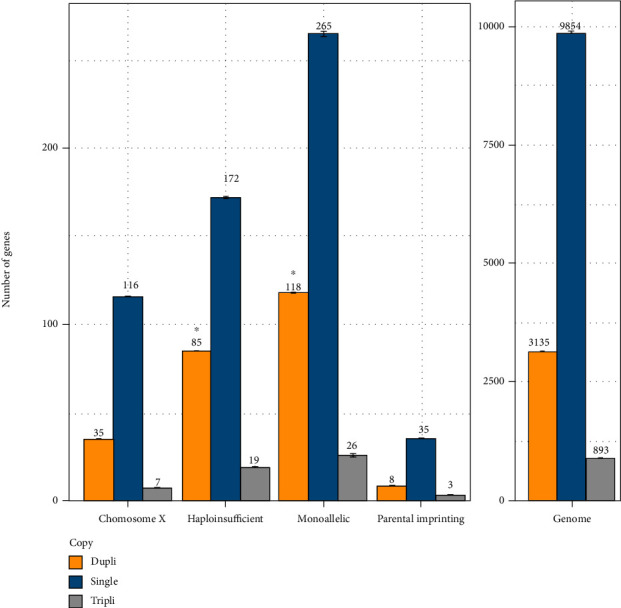
Gene dosage is an important issue both in cell and evolutionary biology. Most genes are present in two copies or alleles in diploid eukariotic cells. The most outstanding exception is monoallelic gene expression (MA) that concerns genes localized on the X chromosome or in regions undergoing parental imprinting in eutherians, and many other genes scattered throughout the genome. In diploids, haploinsufficiency (HI) implies that a single functional copy of a gene in a diploid organism is insufficient to ensure a normal biological function. One of the most important mechanisms ensuring functional innovation during evolution is whole genome duplication (WGD). In addition to the two WGDs that have occurred in vertebrate genomes, the teleost genomes underwent an additional WGD, after their divergence from tetrapods. In the present work, we have studied on 57 teleost species whether the orthologs of human MA or HI genes remain more frequently in duplicates or returned more frequently in singleton than the rest of the genome. Our results show that the teleost orthologs of HI human genes remained more frequently in duplicate than the rest of the genome in all of the teleost species studied. No signal was observed for the orthologs of genes mapping to the human X chromosome or subjected to parental imprinting. Surprisingly, the teleost orthologs of the other human MA genes remained in duplicate more frequently than the rest of the genome for most teleost species. These results suggest that the teleost orthologs of MA and HI human genes also undergo selective pressures either related to absolute protein amounts and/or of dosage balance issues. However, these constraints seem to be different for MA genes in teleost in comparison with human genomes.
基因剂量在细胞生物学和进化生物学中都是一个重要问题。大多数基因在二倍体真核细胞中以两个拷贝或等位基因的形式存在。最突出的例外是单等位基因表达(MA),它涉及位于X染色体上或在有胎盘类动物中经历亲本印记的区域中的基因,以及遍布基因组的许多其他基因。在二倍体中,单倍剂量不足(HI)意味着二倍体生物体中一个基因的单个功能拷贝不足以确保正常的生物学功能。确保进化过程中功能创新的最重要机制之一是全基因组复制(WGD)。除了脊椎动物基因组中发生的两次WGD外,硬骨鱼基因组在与四足动物分化后又经历了一次WGD。在本研究中,我们研究了57种硬骨鱼物种,与基因组的其他部分相比,人类MA或HI基因的直系同源基因是否更频繁地以重复形式保留或更频繁地以单拷贝形式出现。我们的结果表明,在所有研究的硬骨鱼物种中,人类HI基因的硬骨鱼直系同源基因比基因组的其他部分更频繁地以重复形式保留。对于映射到人类X染色体或经历亲本印记的基因的直系同源基因,未观察到信号。令人惊讶的是,对于大多数硬骨鱼物种,其他人类MA基因的硬骨鱼直系同源基因比基因组的其他部分更频繁地以重复形式保留。这些结果表明,人类MA和HI基因的硬骨鱼直系同源基因也受到与绝对蛋白量和/或剂量平衡问题相关的选择压力。然而,与人类基因组相比,这些限制在硬骨鱼中的MA基因似乎有所不同。