Department of Infectious Diseases and Allergology, Military Institute of Medicine, Warsaw, Poland.
Department of Transfusiology, Military Institute of Medicine, Warsaw, Poland.
PLoS One. 2021 Aug 13;16(8):e0256168. doi: 10.1371/journal.pone.0256168. eCollection 2021.
Platelet-activating factor (PAF) has a direct role as a mediator in the pathogenesis of various disorders with an inflammatory component, including those with allergic aetiology. The peripheral blood concentration of PAF is dynamically regulated by plasma PAF acetylhydrolase (PAF-AH). Previous research suggest that low activity of plasma PAF-AH could be a predictive marker for increased severity of some types of allergic hypersensitivity reactions-especially anaphylaxis. The purpose of the study was to evaluate the association between plasma PAF-AH activity and severity in patients with anaphylactic reactions following a wasp or bee sting.
The study group of 89 patients was divided into two subgroups depending on the increasing severity of the most severe anaphylactic reaction in the past, which was assessed according to the Müller's scale. The first subgroup included participants with a history of hypersensitivity reactions up to grade II. The second subgroup consisted of patients who have experienced at least one grade III or IV reactions in the past. A control group of 20 people was established. Plasma PAF-AH activity was measured using a colorimetric method.
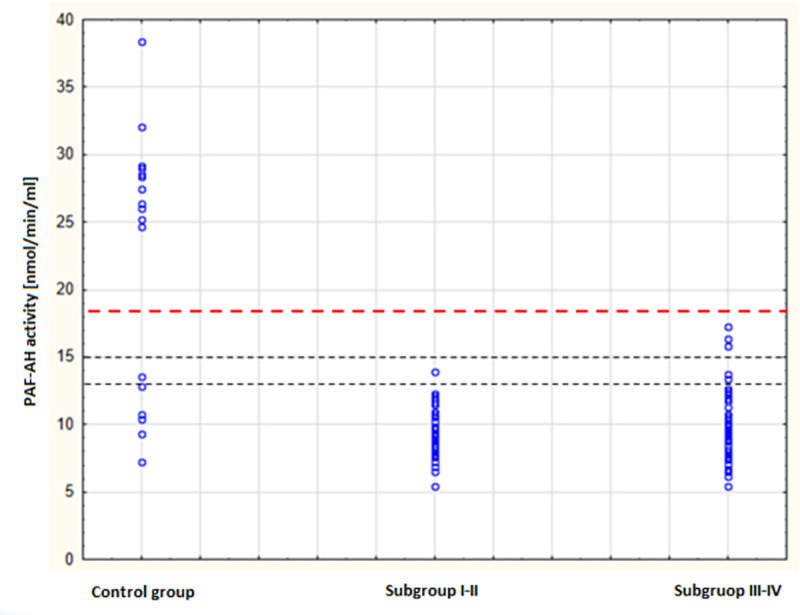
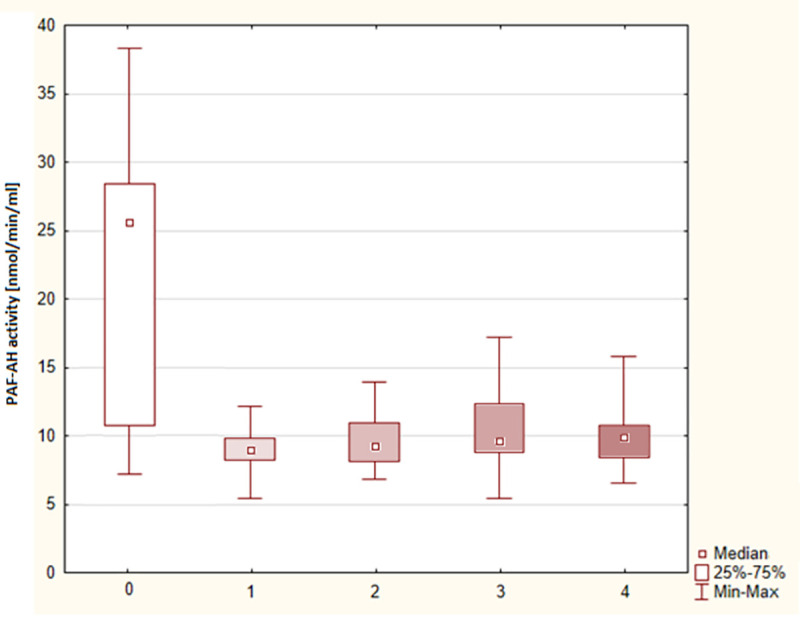
It has been observed that plasma activity of platelet-activating factor acetylhydrolase was significantly lower in patients with anaphylaxis history compared to the control group with negative atopic history (on average 21.38 nmol/min/ml for the control group, 9.47 nmol/min/ml for the first subgroup and 10.16 nmol/min/ml for the second subgroup, in both cases p < 0.0001).
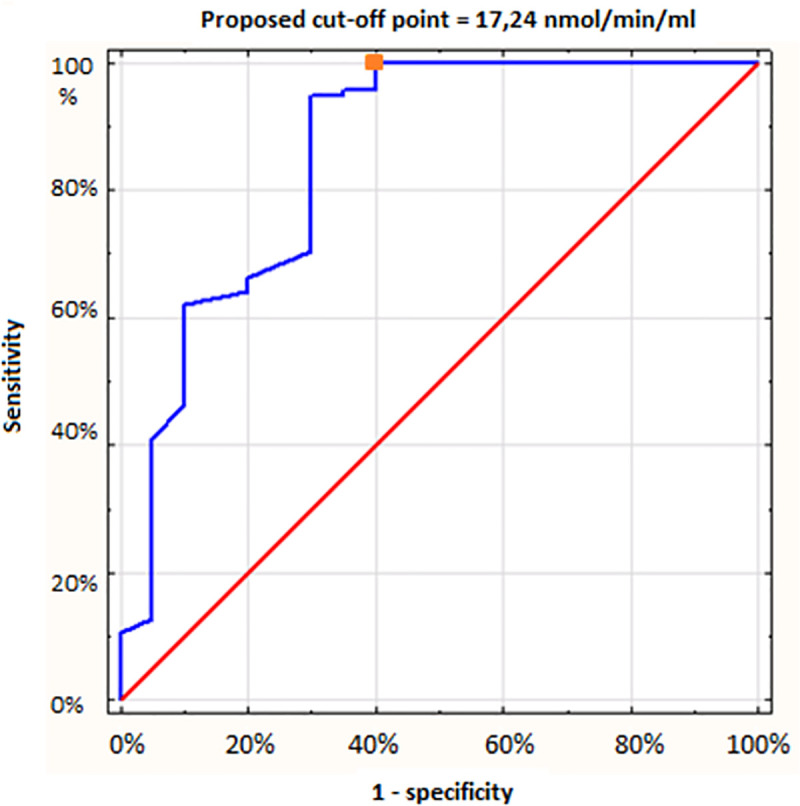
The plasma activity of PAF-AH is a promising parameter that can help to distinguish a group of patients not threatened with development of anaphylaxis and not requiring laborious or expensive prophylactic procedures.
血小板激活因子 (PAF) 作为一种介质,在具有炎症成分的各种疾病的发病机制中具有直接作用,包括具有过敏病因的疾病。血浆 PAF 乙酰水解酶 (PAF-AH) 对 PAF 的外周血浓度进行动态调节。先前的研究表明,血浆 PAF-AH 活性降低可能是某些类型过敏超敏反应(尤其是过敏反应)严重程度增加的预测标志物。本研究的目的是评估在蜂蜇或蜂蜇后发生过敏反应的患者中,血浆 PAF-AH 活性与严重程度之间的相关性。
研究组 89 例患者根据过去最严重过敏反应的严重程度(根据 Müller 量表评估)分为两个亚组。第一亚组包括过敏反应史达 II 级的参与者。第二亚组包括过去至少有过一次 III 级或 IV 级反应的患者。建立了一个 20 人的对照组。使用比色法测量血小板激活因子乙酰水解酶的血浆活性。
观察到与有阴性特应性病史的对照组相比(对照组平均为 21.38 nmol/min/ml,第一亚组为 9.47 nmol/min/ml,第二亚组为 10.16 nmol/min/ml,均 p < 0.0001),过敏反应史患者的血浆血小板激活因子乙酰水解酶活性显著降低。
PAF-AH 的血浆活性是一个很有前途的参数,可以帮助区分一组没有发生过敏反应威胁且不需要费力或昂贵的预防措施的患者。