
通过联合实体和意图确定实现对乌尔都语罗马文地图导航查询的自然语言理解。
Natural language understanding of map navigation queries in Roman Urdu by joint entity and intent determination.
作者信息
Hassan Javeria, Tahir Muhammad Ali, Ali Adnan
机构信息
National University of Sciences and Technology (NUST), Islamabad, Pakistan.
University of Science and Technology of China, Hefei, Anhui, China.
出版信息
PeerJ Comput Sci. 2021 Jul 21;7:e615. doi: 10.7717/peerj-cs.615. eCollection 2021.
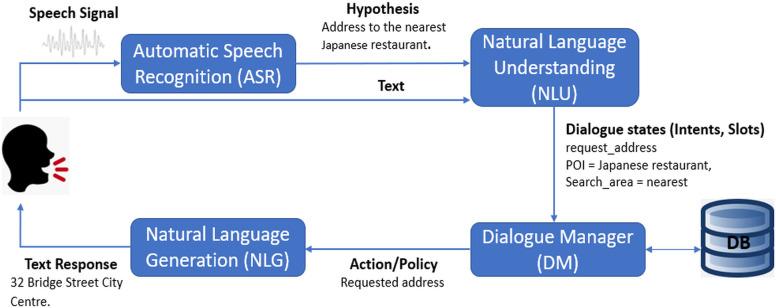
Navigation based task-oriented dialogue systems provide users with a natural way of communicating with maps and navigation software. Natural language understanding (NLU) is the first step for a task-oriented dialogue system. It extracts the important entities (slot tagging) from the user's utterance and determines the user's objective (intent determination). Word embeddings are the distributed representations of the input sentence, and encompass the sentence's semantic and syntactic representations. We created the word embeddings using different methods like FastText, ELMO, BERT and XLNET; and studied their effect on the natural language understanding output. Experiments are performed on the Roman Urdu navigation utterances dataset. The results show that for the intent determination task XLNET based word embeddings outperform other methods; while for the task of slot tagging FastText and XLNET based word embeddings have much better accuracy in comparison to other approaches.
基于导航的任务导向型对话系统为用户提供了一种与地图和导航软件进行自然交流的方式。自然语言理解(NLU)是任务导向型对话系统的第一步。它从用户话语中提取重要实体(槽位标记)并确定用户的目标(意图确定)。词嵌入是输入句子的分布式表示,包含句子的语义和句法表示。我们使用FastText、ELMO、BERT和XLNET等不同方法创建词嵌入;并研究它们对自然语言理解输出的影响。实验在罗马乌尔都语导航话语数据集上进行。结果表明,对于意图确定任务,基于XLNET的词嵌入优于其他方法;而对于槽位标记任务,与其他方法相比,基于FastText和XLNET的词嵌入具有更高的准确率。



 Zotero 插件