John Molson School of Business, Concordia University, 1450 Guy St, Montreal, Quebec, H3H 0A1, Canada.
Centre for Outcomes Research and Evaluation, McGill University, 5252 De Maisonneuve Blvd, Montreal, Quebec, H4A 3S5, Canada.
BMC Public Health. 2021 Sep 16;21(1):1686. doi: 10.1186/s12889-021-11745-1.
Vaccine hesitancy has been a growing challenge for public health in recent decades. Among factors contributing to vaccine hesitancy, concerns regarding vaccine safety and Adverse Events (AEs) play the leading role. Moreover, cognitive biases are critical in connecting such concerns to vaccine hesitancy behaviors, but their role has not been comprehensively studied. In this study, our first objective is to address concerns regarding vaccine AEs to increase vaccine acceptance. Our second objective is to identify the potential cognitive biases connecting vaccine hesitancy concerns to vaccine-hesitant behaviors and identify the mechanism they get triggered in the vaccine decision-making process.
First, to mitigate concerns regarding AEs, we quantitatively analyzed the U.S. Vaccine Adverse Event Reporting System (VAERS) from 2011 to 2018 and provided evidence regarding the non-severity of the AEs that can be used as a communicable summary to increase vaccine acceptance. Second, we focused on the vaccination decision-making process. We reviewed cognitive biases and vaccine hesitancy literature to identify the most potential cognitive biases that affect vaccine hesitancy and categorized them adopting the Precaution Adoption Process Model (PAPM).
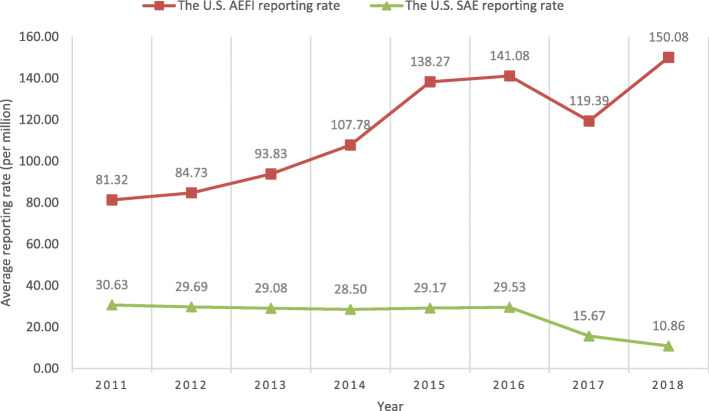
Our results show that the top frequent AEs are expected mild reactions like injection site erythema (4.29%), pyrexia (3.66%), and injection site swelling (3.21%). 94.5% of the reports are not serious and the average population-based serious reporting rate over the 8 years was 25.3 reports per 1 million population. We also identified 15 potential cognitive biases that might affect people's vaccination decision-making and nudge them toward vaccine hesitancy. We categorized these biases based on the factors that trigger them and discussed how they contribute to vaccine hesitancy.
This paper provided an evidence-based communicable summary of VAERS. As the most trusted sources of vaccine information, health practitioners can use this summary to provide evidence-based vaccine information to vaccine decision-makers (patients/parents) and mitigate concerns over vaccine safety and AEs. In addition, we identified 15 potential cognitive biases that might affect the vaccination decision-making process and nudge people toward vaccine hesitancy. Any plan, intervention, and message to increase vaccination uptake should be modified to decrease the effect of these potential cognitive biases.
疫苗犹豫已成为近几十年来公共卫生面临的一个日益严峻的挑战。在导致疫苗犹豫的诸多因素中,对疫苗安全性和不良反应(AE)的担忧起着主导作用。此外,认知偏差在将这些担忧与疫苗犹豫行为联系起来方面起着至关重要的作用,但它们的作用尚未得到全面研究。在这项研究中,我们的首要目标是解决对疫苗 AE 的担忧,以提高疫苗接种率。我们的第二个目标是确定将疫苗犹豫的担忧与疫苗犹豫行为联系起来的潜在认知偏差,并确定它们在疫苗决策过程中被触发的机制。
首先,为了减轻对 AE 的担忧,我们对 2011 年至 2018 年美国疫苗不良事件报告系统(VAERS)进行了定量分析,并提供了可用于提高疫苗接种率的 AE 非严重性的证据。其次,我们专注于疫苗接种决策过程。我们回顾了认知偏差和疫苗犹豫的文献,以确定影响疫苗犹豫的最常见认知偏差,并采用预防采用过程模型(PAPM)对其进行分类。
我们的研究结果表明,最常见的 AE 是预期的轻度反应,如注射部位红斑(4.29%)、发热(3.66%)和注射部位肿胀(3.21%)。94.5%的报告不严重,8 年来平均人群中严重报告率为每 100 万人中有 25.3 例报告。我们还确定了 15 种可能影响人们接种疫苗决策并促使他们对疫苗犹豫不决的潜在认知偏差。我们根据触发这些偏差的因素对其进行了分类,并讨论了它们如何导致疫苗犹豫。
本文提供了基于证据的 VAERS 可传播摘要。作为疫苗信息最可信的来源,卫生保健从业者可以使用该摘要为疫苗决策者(患者/家长)提供基于证据的疫苗信息,并减轻对疫苗安全性和 AE 的担忧。此外,我们确定了 15 种可能影响疫苗接种决策过程并促使人们对疫苗犹豫不决的潜在认知偏差。任何旨在增加疫苗接种率的计划、干预措施和信息传递都应加以修改,以减少这些潜在认知偏差的影响。