
非关节炎性不可修复性肩袖撕裂的反式肩关节置换术
Reverse Shoulder Arthroplasty in the Management of Irreparable Rotator Cuff Tears without Arthritis.
作者信息
Harreld Kevin L, Puskas Brian L, Andersen Jaron, Frankle Mark
机构信息
Florida Orthopaedic Institute, 13020 North Telecom Parkway, Tampa, FL 33637. E-mail address for M.A. Frankle:
出版信息
JBJS Essent Surg Tech. 2011 Sep 28;1(2):e12. doi: 10.2106/JBJS.ST.K.00006. eCollection 2011 Jul-Sep.
INTRODUCTION
The ability to provide reliable outcomes in treatment of patients with degenerative rotator cuff tears has become increasingly complicated, as a result of more advanced disease and the increased array of treatment choices.
STEP 1 PREOPERATIVE PLANNING: Develop and communicate with a consistent team of interdisciplinary physicians both preoperatively and postoperatively; utilize advanced imaging modalities to evaluate muscle atrophy as well as glenoid and humeral bone stock.
STEP 2 PATIENT POSITIONING: Place the patient in a beach-chair position, check the abdominal strap, and position yourself facing the axilla.
STEP 3 SURGICAL APPROACH: Develop the subdeltoid and subacromial spaces and take care to avoid vigorous over-retraction of the deltoid.
STEP 4 HUMERAL EXPOSURE AND PREPARATION: Perform the head cut utilizing the 135° resection guide, broach the humerus, and ream the humeral socket.
STEP 5 GLENOID EXPOSURE AND PREPARATION GLENOSPHERE INSERTION: Ream the inferior surface to bleeding subchondral bone; bleeding subchondral bone on the inferior 50% of the prepared glenoid surface indicates a sufficient depth.
STEP 6 FINAL HUMERAL PREPARATION: At final reaming, the edge of the reamer should sit flush with the cut surface of the humerus.
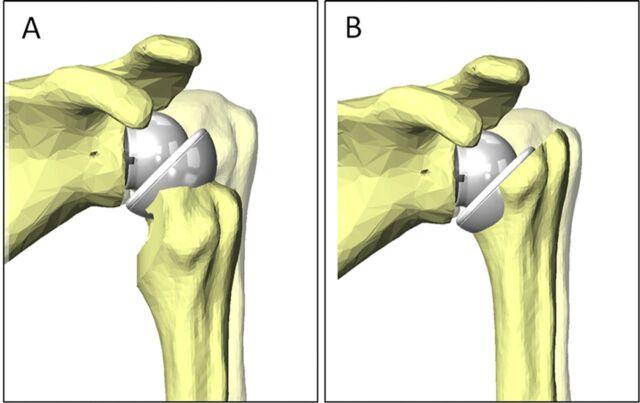
STEP 7 TRIALING: Proper soft-tissue balance is frequently achieved by positioning the humeral component so that the rim of the socket lies just above the humeral osteotomy site at the anatomic neck.
STEP 8 COMPONENT IMPLANTATION AND CLOSURE: When cementing the humeral component, the socket should match the reamed proximal part of the humerus.
RESULTS
Initially, reverse shoulder arthroplasty was primarily used to treat osteoarthritis of the glenohumeral joint resulting from chronic rotator cuff deficiency or for true rotator cuff tear arthropathy.
WHAT TO WATCH FOR
Indications Contraindications Pitfalls & Challenges.
引言
由于病情更严重以及治疗选择增多,为退行性肩袖撕裂患者提供可靠治疗结果的能力变得愈发复杂。
步骤1术前规划:术前和术后与一组固定的跨学科医生团队进行沟通协作;利用先进的成像方式评估肌肉萎缩以及肩胛盂和肱骨头的骨量。
步骤2患者体位:将患者置于沙滩椅位,检查腹部固定带,并使自己面对腋窝。
步骤3手术入路:显露三角肌下和肩峰下间隙,注意避免过度用力牵拉三角肌。
步骤4肱骨显露与准备:使用135°截骨导向器进行头部截骨,扩髓肱骨,并扩锉肱骨头臼。
步骤5肩胛盂显露、准备及球头植入:扩锉肩胛盂下表面至出血的软骨下骨;在准备好的肩胛盂表面下50%区域出血的软骨下骨表明深度足够。
步骤6肱骨最终准备:在最终扩锉时,扩锉器边缘应与肱骨截骨面平齐。
步骤7试模:通过放置肱骨假体使臼边缘恰好在解剖颈处的肱骨截骨部位上方,常可实现适当的软组织平衡。
步骤8假体植入与缝合:在骨水泥固定肱骨假体时,臼应与扩锉后的肱骨近端匹配。
结果
最初,反式肩关节置换术主要用于治疗因慢性肩袖缺损导致的盂肱关节骨关节炎或真正的肩袖撕裂关节病。
注意事项
适应证、禁忌证、陷阱与挑战。




 Zotero 插件