Self Wesley H, Tenforde Mark W, Rhoads Jillian P, Gaglani Manjusha, Ginde Adit A, Douin David J, Olson Samantha M, Talbot H Keipp, Casey Jonathan D, Mohr Nicholas M, Zepeski Anne, McNeal Tresa, Ghamande Shekhar, Gibbs Kevin W, Files D Clark, Hager David N, Shehu Arber, Prekker Matthew E, Erickson Heidi L, Gong Michelle N, Mohamed Amira, Henning Daniel J, Steingrub Jay S, Peltan Ithan D, Brown Samuel M, Martin Emily T, Monto Arnold S, Khan Akram, Hough Catherine L, Busse Laurence W, Ten Lohuis Caitlin C, Duggal Abhijit, Wilson Jennifer G, Gordon Alexandra June, Qadir Nida, Chang Steven Y, Mallow Christopher, Rivas Carolina, Babcock Hilary M, Kwon Jennie H, Exline Matthew C, Halasa Natasha, Chappell James D, Lauring Adam S, Grijalva Carlos G, Rice Todd W, Jones Ian D, Stubblefield William B, Baughman Adrienne, Womack Kelsey N, Lindsell Christopher J, Hart Kimberly W, Zhu Yuwei, Mills Lisa, Lester Sandra N, Stumpf Megan M, Naioti Eric A, Kobayashi Miwako, Verani Jennifer R, Thornburg Natalie J, Patel Manish M
MMWR Morb Mortal Wkly Rep. 2021 Sep 24;70(38):1337-1343. doi: 10.15585/mmwr.mm7038e1.
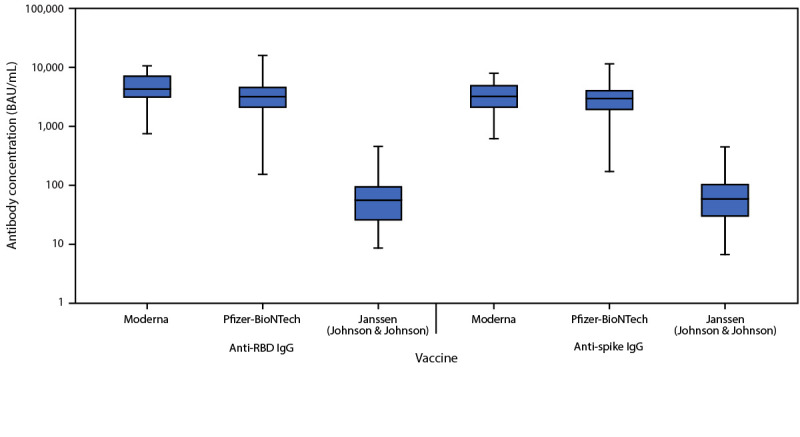
Three COVID-19 vaccines are authorized or approved for use among adults in the United States (1,2). Two 2-dose mRNA vaccines, mRNA-1273 from Moderna and BNT162b2 from Pfizer-BioNTech, received Emergency Use Authorization (EUA) by the Food and Drug Administration (FDA) in December 2020 for persons aged ≥18 years and aged ≥16 years, respectively. A 1-dose viral vector vaccine (Ad26.COV2 from Janssen [Johnson & Johnson]) received EUA in February 2021 for persons aged ≥18 years (3). The Pfizer-BioNTech vaccine received FDA approval for persons aged ≥16 years on August 23, 2021 (4). Current guidelines from FDA and CDC recommend vaccination of eligible persons with one of these three products, without preference for any specific vaccine (4,5). To assess vaccine effectiveness (VE) of these three products in preventing COVID-19 hospitalization, CDC and collaborators conducted a case-control analysis among 3,689 adults aged ≥18 years who were hospitalized at 21 U.S. hospitals across 18 states during March 11-August 15, 2021. An additional analysis compared serum antibody levels (anti-spike immunoglobulin G [IgG] and anti-receptor binding domain [RBD] IgG) to SARS-CoV-2, the virus that causes COVID-19, among 100 healthy volunteers enrolled at three hospitals 2-6 weeks after full vaccination with the Moderna, Pfizer-BioNTech, or Janssen COVID-19 vaccine. Patients with immunocompromising conditions were excluded. VE against COVID-19 hospitalizations was higher for the Moderna vaccine (93%; 95% confidence interval [CI] = 91%-95%) than for the Pfizer-BioNTech vaccine (88%; 95% CI = 85%-91%) (p = 0.011); VE for both mRNA vaccines was higher than that for the Janssen vaccine (71%; 95% CI = 56%-81%) (all p<0.001). Protection for the Pfizer-BioNTech vaccine declined 4 months after vaccination. Postvaccination anti-spike IgG and anti-RBD IgG levels were significantly lower in persons vaccinated with the Janssen vaccine than the Moderna or Pfizer-BioNTech vaccines. Although these real-world data suggest some variation in levels of protection by vaccine, all FDA-approved or authorized COVID-19 vaccines provide substantial protection against COVID-19 hospitalization.
在美国,三种新冠疫苗已被授权或批准用于成人(1,2)。两种两剂次的mRNA疫苗,即Moderna公司的mRNA-1273和辉瑞-生物科技公司的BNT162b2,分别于2020年12月获得美国食品药品监督管理局(FDA)的紧急使用授权(EUA),适用年龄分别为≥18岁和≥16岁。一种单剂次的病毒载体疫苗(杨森公司[强生公司]的Ad26.COV2)于2021年2月获得EUA,适用年龄为≥18岁(3)。辉瑞-生物科技公司的疫苗于2021年8月23日获得FDA批准,适用于≥16岁的人群(4)。FDA和美国疾病控制与预防中心(CDC)目前的指南建议符合条件的人群接种这三种产品中的一种,不偏好任何特定疫苗(4,5)。为评估这三种产品预防新冠住院的疫苗效力(VE),CDC及其合作者对2021年3月11日至8月15日期间在美国18个州的21家医院住院的3689名≥18岁的成年人进行了病例对照分析。另一项分析比较了100名在接种Moderna、辉瑞-生物科技公司或杨森新冠疫苗满2 - 6周后在三家医院招募的健康志愿者中,针对导致新冠的病毒SARS-CoV-2的血清抗体水平(抗刺突免疫球蛋白G[IgG]和抗受体结合域[RBD]IgG)。免疫功能低下的患者被排除。Moderna疫苗预防新冠住院的VE(93%;95%置信区间[CI]=91%-95%)高于辉瑞-生物科技公司的疫苗(88%;95%CI=85%-