
抗N-甲基-D-天冬氨酸(NMDA)受体脑炎中极端δ刷状模式的癫痫发作及预后理解:一项系统评价
Understanding Seizures and Prognosis of the Extreme Delta Brush Pattern in Anti-N-Methyl-D-Aspartate (NMDA) Receptor Encephalitis: A Systematic Review.
作者信息
Parwani Jashank, Ortiz Juan Fernando, Alli Ammar, Lalwani Ayushi, Ruxmohan Samir, Tamton Hyder, Cuenca Victor D, Gonzalez Dina, Anwer Fatima, Eissa-Garcés Ahmed, Alzamora Ivan Mateo, Paez Maria
机构信息
Neurology, Lokmanya Tilak Municipal Medical College, Mumbai, IND.
Neurology, Universidad San Francisco de Quito, Quito, ECU.
出版信息
Cureus. 2021 Sep 21;13(9):e18154. doi: 10.7759/cureus.18154. eCollection 2021 Sep.
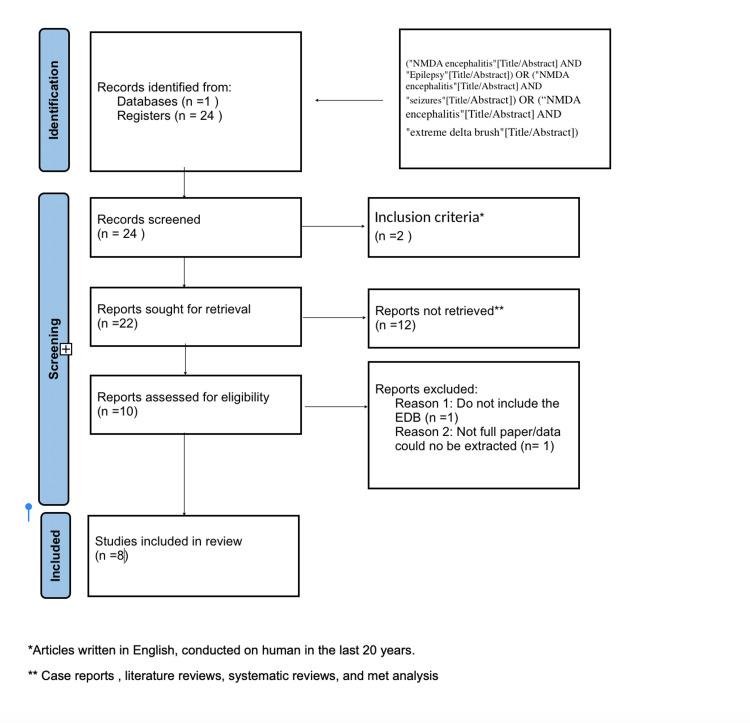
Anti-N-methyl-d-aspartate (NMDA) receptor encephalitis (ANMDARE) is an autoimmune disorder with neurological and psychiatric features. The disease presents with a viral prodrome, followed by psychiatric manifestations. In the next phase, movement disorders or/and seizures occur. Finally, in the last phase, there is a decrease in the level of consciousness. Central hypoventilation and autonomic dysfunction can occur. Recently a unique EEG (electroencephalogram) pattern has been associated with anti-NMDA receptor encephalitis, the extreme delta brush (EDB). Although the association of the EDB with ANMDARE is known by the medical community, its significance is mainly unknown. A systematic review on NMDARE is also scarce. We decided to conduct a systematic review on this topic to consolidate the knowledge and establish the importance of the EDB as a prognostic factor. To conduct this systematic review, we used only studies conducted in humans, written in English, and published in the last 20 years. We used PubMed as a database and searched the following search terms: ("NMDA encephalitis"[Title/Abstract] AND "Epilepsy"[Title/Abstract]) OR (NMDA encephalitis"[Title/Abstract] AND "seizures" [Title/Abstract]) OR ("NMDA encephalitis"[Title/Abstract] AND "extreme delta brush"[Title/Abstract]). The protocol used for this systematic review was the Meta-analyses Of Observational Studies in Epidemiology (MOOSE) protocol, and to analyze the bias of the studies, we used the ROBINS-1 tool. Eight studies were collected from our search strategy. Our data pulling showed that seizures were present in 178/249 (71.48%) patients. Status Epilepticus was reported in 29/96 (30.20%), and the EBD was seen in 30.89% (55/178) patients with seizures. The range of EDB was 5.9%-33% among the studies. Because the sample size was small, the statistical power was decreased. We had a low overall risk of bias. The wide range in the results could be related to the timing of the EEG recording. EDB was associated overall with increased length of hospital stay, increased ICU admission, and incidence of status epilepticus. The etiology of the EDB remains mainly unknown. However, it has been postulated that in NMDAR encephalitis, there is a disruption of the rhythmic neuronal activity. When antibodies block/target the NMDAR, the rhythmic neuronal activity is disrupted, leading to the unique EDB pattern. Another theory suggests that delta activity is caused because of focal abnormalities in the brain, and the superimposition of the beta waves is related to the alterations of the NMDA receptors.
抗 N-甲基-D-天冬氨酸(NMDA)受体脑炎(ANMDARE)是一种具有神经和精神特征的自身免疫性疾病。该病先出现病毒前驱症状,随后出现精神症状。在下一阶段,会出现运动障碍或/和癫痫发作。最后,在最后阶段,意识水平会下降。可能会出现中枢性通气不足和自主神经功能障碍。最近,一种独特的脑电图(EEG)模式——极端δ刷(EDB)与抗 NMDA 受体脑炎相关。尽管医学界已知 EDB 与 ANMDARE 有关联,但其意义主要仍不明确。关于 NMDARE 的系统评价也很匮乏。我们决定对该主题进行系统评价,以巩固相关知识并确定 EDB 作为预后因素的重要性。为进行这项系统评价,我们仅使用过去 20 年发表的、以英文撰写的、针对人类的研究。我们将 PubMed 用作数据库,并搜索了以下检索词:(“NMDA 脑炎”[标题/摘要] 且 “癫痫”[标题/摘要])或(“NMDA 脑炎”[标题/摘要] 且 “癫痫发作”[标题/摘要])或(“NMDA 脑炎”[标题/摘要] 且 “极端δ刷”[标题/摘要])。本系统评价使用的方案是流行病学观察性研究的 Meta 分析(MOOSE)方案,并且为分析研究的偏倚,我们使用了 ROBINS-1 工具。通过我们的检索策略共收集到八项研究。我们的数据提取显示,178/249(71.48%)的患者出现癫痫发作。96 例中有 29 例(30.20%)报告有癫痫持续状态,癫痫发作患者中有 【此处原文有误,应为 30.89%(55/178)】的患者出现 EBD。各研究中 EDB 的范围为 5.9% - 33%。由于样本量较小,统计效能降低。我们总体偏倚风险较低。结果的广泛差异可能与 EEG 记录的时间有关。EDB 总体上与住院时间延长、入住重症监护病房增加以及癫痫持续状态的发生率增加有关。EDB 的病因主要仍不明确。然而,据推测在 NMDAR 脑炎中,节律性神经元活动受到破坏。当抗体阻断/靶向 NMDAR 时,节律性神经元活动被破坏,导致独特的 EDB 模式。另一种理论认为,δ活动是由大脑中的局灶性异常引起的,而β波的叠加与 NMDA 受体的改变有关。

 Zotero 插件