
利拉鲁肽对比二甲双胍单药治疗控制不佳的 2 型糖尿病患者的口服降糖药作为附加疗法的血糖控制维持:初级保健中的一项随机临床试验(LIRA-PRIME)。
Maintenance of glycaemic control with liraglutide versus oral antidiabetic drugs as add-on therapies in patients with type 2 diabetes uncontrolled with metformin alone: A randomized clinical trial in primary care (LIRA-PRIME).
机构信息
Catalina Research Institute, LLC, Montclair, California, USA.
Hillcrest Family Health Center, Waco, Texas, USA.
出版信息
Diabetes Obes Metab. 2022 Feb;24(2):204-211. doi: 10.1111/dom.14566. Epub 2021 Oct 18.
AIM
To compare (in the LIRA-PRIME [NCT02730377], a randomized open-label trial), the efficacy of liraglutide in controlling glycaemia versus an oral antidiabetic drug (OAD) in patients with uncontrolled type 2 diabetes (T2D), despite metformin use in a primary care setting (n = 219 sites, n = 9 countries).
MATERIALS AND METHODS
Adults (n = 1991) with T2D (HbA1c 7.5%-9.0%) receiving metformin were randomized 1:1 to liraglutide (≤1.8 mg/d) or one OAD, selected by the investigator, added to metformin, for up to 104 weeks. Primary endpoint: time to inadequate glycaemic control (HbA1c > 7.0%) at two scheduled consecutive visits after week 26. Outcomes were assessed for liraglutide versus a pooled OAD group, and (post hoc) liraglutide versus sodium-glucose co-transporter-2 inhibitors, dipeptidyl peptidase-4 inhibitors, and sulphonylureas individually.
RESULTS
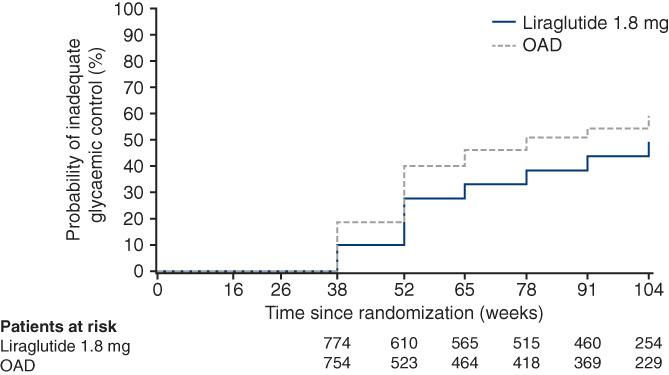
Among randomized patients (liraglutide, n = 996; OAD, n = 995), 47.6% were female, mean age was 57.4 years and mean HbA1c was 8.2%. Median time to inadequate glycaemic control was 44 weeks longer with liraglutide versus OAD (109 weeks [25% percentile, 38; 75% percentile, not available] vs. 65 weeks [25% percentile, 35; 75% percentile, 107], P < .0001). Changes in HbA1c and body weight at week 104 or at premature treatment discontinuation significantly favoured liraglutide over OAD. Hypoglycaemia rates were comparable between groups and few patients discontinued because of adverse events (liraglutide, 7.9% [n = 79]; OAD, 4.1% [n = 41]). Similar results were observed in the post hoc analysis for liraglutide versus individual OAD classes.
CONCLUSIONS
Glycaemic control was better maintained with liraglutide versus OAD, supporting liraglutide use when intensifying therapy in primary care patients with T2D.
目的
在 LIRA-PRIME [NCT02730377](一项随机、开放标签试验)中比较,在初级保健环境中使用二甲双胍的情况下,利拉鲁肽控制血糖的疗效与一种口服降糖药(OAD)相比,在血糖控制不佳的 2 型糖尿病(T2D)患者中(n=219 个地点,n=9 个国家)。
材料和方法
接受二甲双胍治疗的 T2D(HbA1c 7.5%-9.0%)成年人(n=1991)按 1:1 随机分为利拉鲁肽(≤1.8mg/d)或一种 OAD,由研究者选择,加用至二甲双胍,最长 104 周。主要终点:在第 26 周后的两次计划连续就诊时,HbA1c 控制不佳(>7.0%)的时间。对利拉鲁肽与 OAD 进行了评估,还进行了事后分析,比较了利拉鲁肽与钠-葡萄糖共转运蛋白 2 抑制剂、二肽基肽酶-4 抑制剂和磺酰脲类药物的疗效。
结果
在随机分组的患者(利拉鲁肽组,n=996;OAD 组,n=995)中,47.6%为女性,平均年龄为 57.4 岁,平均 HbA1c 为 8.2%。与 OAD 相比,利拉鲁肽组 HbA1c 控制不佳的中位时间延长了 44 周(109 周[25%分位数,38;75%分位数,未达到]vs.65 周[25%分位数,35;75%分位数,107],P<0.0001)。在第 104 周或提前停止治疗时,HbA1c 和体重的变化明显优于 OAD。两组低血糖发生率相当,少数患者因不良事件停药(利拉鲁肽组,7.9%[n=79];OAD 组,4.1%[n=41])。事后分析中,利拉鲁肽与个别 OAD 类药物相比也观察到了类似的结果。
结论
与 OAD 相比,利拉鲁肽能更好地维持血糖控制,支持在初级保健中对 T2D 患者强化治疗时使用利拉鲁肽。

 Zotero 插件