De Nicolò Amedeo, Stroffolini Giacomo, Antonucci Miriam, Mula Jacopo, De Vivo Elisa Delia, Cusato Jessica, Palermiti Alice, Cariti Giuseppe, Di Perri Giovanni, Corcione Silvia, De Rosa Francesco Giuseppe, D'Avolio Antonio
Laboratory of Clinical Pharmacology and Pharmacogenetics, Department of Medical Sciences, University of Turin, 10149 Torino, Italy.
Unit of Infectious Diseases, Department of Medical Sciences, University of Turin, 10124 Torino, Italy.
Biomedicines. 2021 Sep 22;9(10):1288. doi: 10.3390/biomedicines9101288.
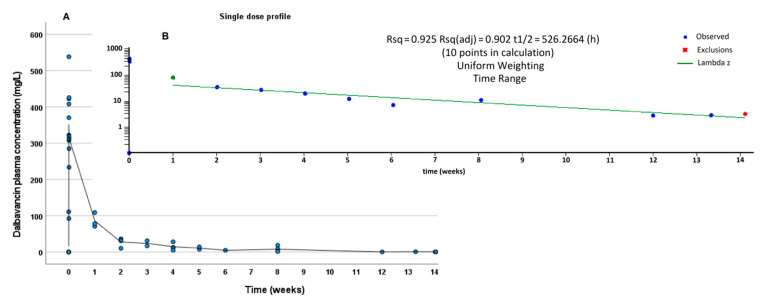
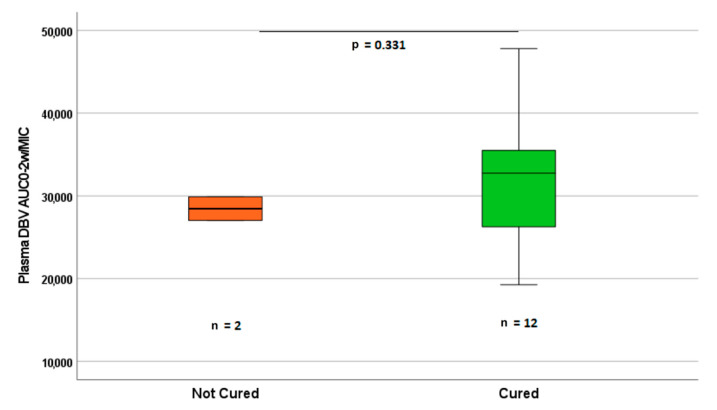
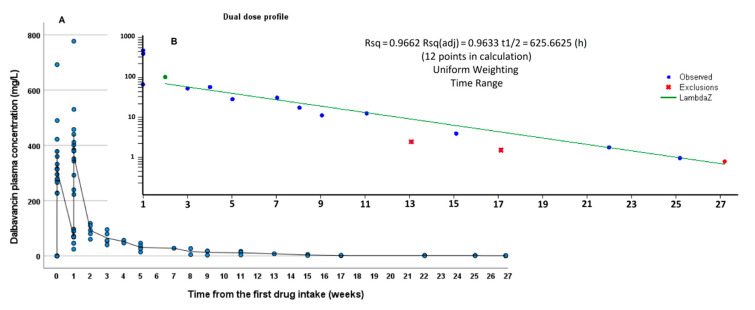
Dalbavancin is a lipoglycopeptide approved for treatment of Gram-positive infections of skin and skin-associated structures (ABSSSI). Currently, off-label use at high dosages for osteoarticular infections deserves attention. This work aimed to study the long-term plasma pharmacokinetics of dalbavancin in outpatients with ABSSSI or osteoarticular infections, treated either with one or two 1500 mg doses of dalbavancin. A liquid chromatography-tandem mass spectrometry method was used to measure total dalbavancin concentrations in plasma samples. The results were analyzed through a non-compartmental analysis (NCA). Breakpoint minimum inhibitory concentration (MIC) was used to calculate AUC/MIC and T > MIC parameters, adjusted by 93% protein binding. A total of 14 patients were enrolled, 11 with osteoarticular infection and 3 with ABSSSI. Long-term pharmacokinetics showed median T > MIC (0.125 mg/L) of 11.9 and 13.7 weeks for single and dual dose, respectively. Similarly, median AUC/MIC ratios of 20,590 and 31,366 were observed for single and dual dose regimens, respectively. No adverse events were observed, and treatment success was achieved in 12/14 patients. Failure was associated with the worst clinical conditions, bone infections, and single dose. The results of this study show that dalbavancin exposure exceeds previously suggested pharmacodynamic targets. Optimization of these targets is needed for the osteoarticular setting.
达巴万星是一种已获批准用于治疗皮肤及皮肤相关结构革兰氏阳性感染(ABSSSI)的脂糖肽类药物。目前,其高剂量的超说明书用药在骨关节炎感染方面值得关注。这项研究旨在探讨达巴万星在接受单剂量或两剂量1500mg达巴万星治疗的ABSSSI或骨关节炎感染门诊患者中的长期血浆药代动力学。采用液相色谱 - 串联质谱法测定血浆样本中达巴万星的总浓度。通过非房室分析(NCA)对结果进行分析。采用断点最低抑菌浓度(MIC)计算AUC/MIC和T>MIC参数,并根据93%的蛋白结合率进行校正。共纳入14例患者,其中11例为骨关节炎感染,3例为ABSSSI。长期药代动力学研究显示,单剂量和双剂量给药的T>MIC(0.125mg/L)中位数分别为11.9周和13.7周。同样,单剂量和双剂量给药方案的AUC/MIC比值中位数分别为20590和31366。未观察到不良事件,14例患者中有12例治疗成功。治疗失败与最差的临床状况、骨感染和单剂量给药有关。本研究结果表明,达巴万星的暴露量超过了先前建议的药效学靶点。骨关节炎感染情况需要对这些靶点进行优化。