Yamamura Yuki, Kawamura Yoshimi, Oiwa Yuki, Oka Kaori, Onishi Nobuyuki, Saya Hideyuki, Miura Kyoko
Department of Aging and Longevity Research, Faculty of Life Sciences, Kumamoto University, Kumamoto, 860-0811, Japan.
Division of Gene Regulation, Institute for Advanced Medical Research, Keio University School of Medicine, Tokyo, 160-0016, Japan.
Inflamm Regen. 2021 Nov 1;41(1):31. doi: 10.1186/s41232-021-00182-7.
The naked mole-rat (NMR) is the longest-lived rodent with a maximum lifespan of more than 37 years and shows a negligible senescence phenotype, suggesting that tissue stem cells of NMRs are highly capable of maintaining homeostasis. However, the properties of NMR tissue stem cells, including neural stem cells (NSCs), are largely unclear.
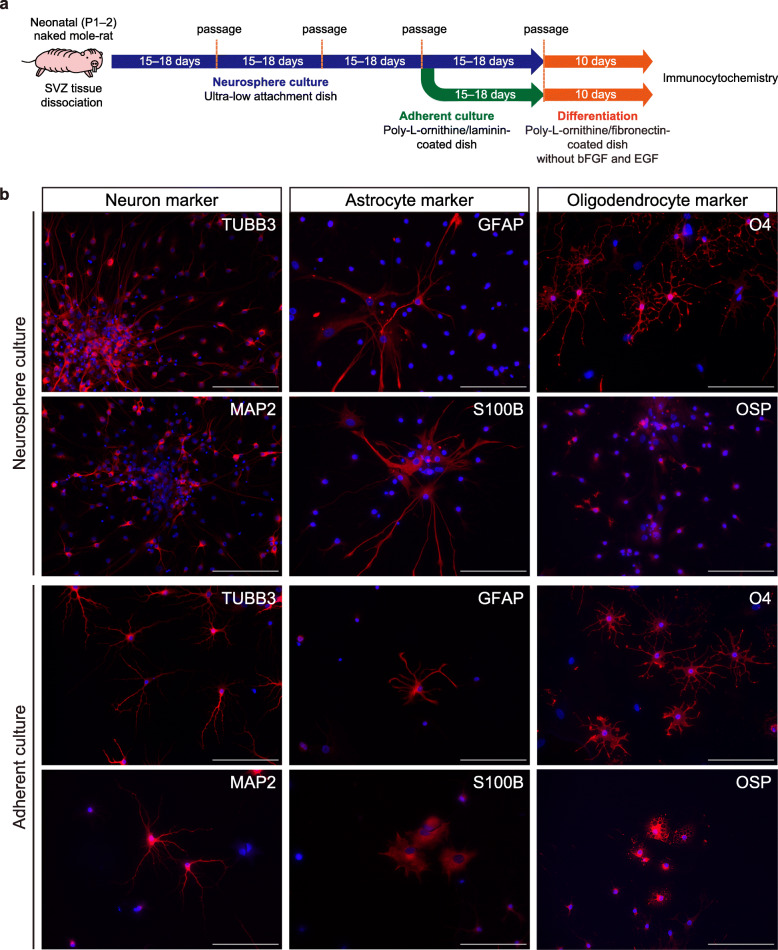
Neural stem/progenitor cells (NS/PCs) were isolated from the subventricular zone of the neonate NMR brain (NMR-NS/PCs) and cultured in neurosphere and adherent culture conditions. Expression of NSC markers and markers of neurons, astrocytes, and oligodendrocytes was analyzed by immunocytochemistry. In adherent culture conditions, the proliferation rate and cell cycle of NMR-NS/PCs were assessed and compared with those of NS/PCs from mice (mouse-NS/PCs). The DNA damage response to γ-irradiation was analyzed by immunocytochemistry and reverse transcription-quantitative PCR.
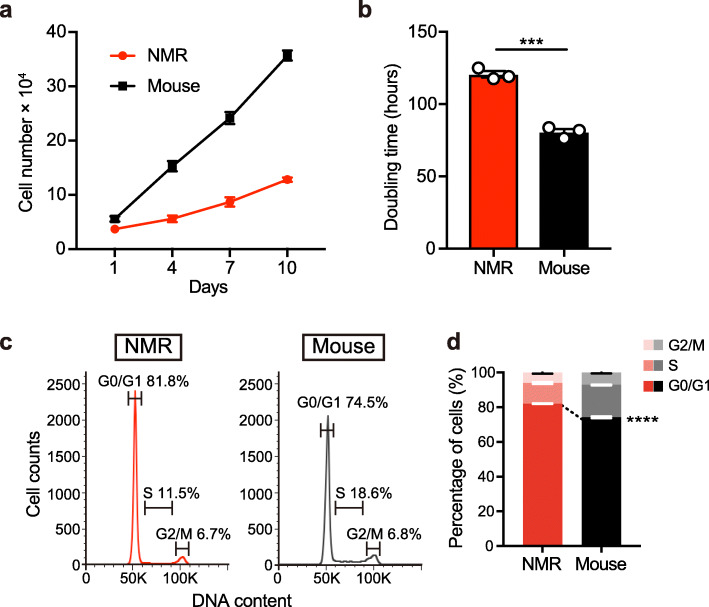
NMR-NS/PCs expressed several NSC markers and differentiated into neurons, astrocytes, and oligodendrocytes. NMR-NS/PCs proliferated markedly slower than mouse-NS/PCs, and a higher percentage of NMR-NS/PCs than mouse-NS/PCs was in G0/G1 phase. Notably, upon γ-irradiation, NMR-NS/PCs exhibited a faster initiation of the DNA damage response and were less prone to dying than mouse-NS/PCs.
NMR-NS/PCs were successfully isolated and cultured. The slow proliferation of NMR-NS/PCs and their resistance to DNA damage may help to prevent stem cell exhaustion in the brain during the long lifespan of NMRs. Our findings provide novel insights into the mechanism underlying delayed aging of NMRs. Further analysis of NMR tissue stem cells may lead to the development of new strategies that can prevent aging in humans.
裸鼹鼠是寿命最长的啮齿动物,最大寿命超过37年,且表现出可忽略不计的衰老表型,这表明裸鼹鼠的组织干细胞具有很强的维持内环境稳定的能力。然而,包括神经干细胞(NSCs)在内的裸鼹鼠组织干细胞的特性在很大程度上尚不清楚。
从新生裸鼹鼠脑的脑室下区分离神经干/祖细胞(NS/PCs)(裸鼹鼠-NS/PCs),并在神经球和贴壁培养条件下培养。通过免疫细胞化学分析神经干细胞标志物以及神经元、星形胶质细胞和少突胶质细胞标志物的表达。在贴壁培养条件下,评估裸鼹鼠-NS/PCs的增殖率和细胞周期,并与小鼠的NS/PCs(小鼠-NS/PCs)进行比较。通过免疫细胞化学和逆转录定量PCR分析对γ射线照射的DNA损伤反应。
裸鼹鼠-NS/PCs表达多种神经干细胞标志物,并分化为神经元、星形胶质细胞和少突胶质细胞。裸鼹鼠-NS/PCs的增殖明显比小鼠-NS/PCs慢,且处于G0/G1期的裸鼹鼠-NS/PCs百分比高于小鼠-NS/PCs。值得注意的是,在γ射线照射后,裸鼹鼠-NS/PCs表现出更快启动DNA损伤反应,并且比小鼠-NS/PCs更不易死亡。
成功分离并培养了裸鼹鼠-NS/PCs。裸鼹鼠-NS/PCs的缓慢增殖及其对DNA损伤的抗性可能有助于在裸鼹鼠的长寿过程中防止脑内干细胞耗竭。我们的研究结果为裸鼹鼠延缓衰老的潜在机制提供了新的见解。对裸鼹鼠组织干细胞的进一步分析可能会导致开发出能够预防人类衰老的新策略。