
尼伏鲁单抗和伊匹单抗联合免疫治疗罕见妇科恶性肿瘤患者:CA209-538 临床试验结果。
Combination immunotherapy with nivolumab and ipilimumab in patients with rare gynecological malignancies: results of the CA209-538 clinical trial.
机构信息
Department of Medical Oncology, Olivia Newton-John Cancer Centre, Austin Health, Melbourne, Victoria, Australia
Olivia Newton-John Cancer Research Institute, Melbourne, Victoria, Australia.
出版信息
J Immunother Cancer. 2021 Nov;9(11). doi: 10.1136/jitc-2021-003156.
BACKGROUND
Patients with rare cancers represent 55% of all gynecological malignancies and have poor survival outcomes due to limited treatment options. Combination immunotherapy with the anti-programmed cell death protein 1 (anti-PD-1) antibody nivolumab and the anti-cytotoxic T-lymphocyte-associated protein 4 (anti-CTLA-4) antibody ipilimumab has demonstrated significant clinical efficacy across a range of common malignancies, justifying evaluation of this combination in rare gynecological cancers.
METHODS
This multicenter phase II study enrolled 43 patients with advanced rare gynecological cancers. Patients received induction treatment with nivolumab and ipilimumab at a dose of 3 mg/kg and 1 mg/kg, respectively, every 3 weeks for four doses. Treatment was continued with nivolumab monotherapy at 3 mg/kg every 2 weeks until disease progression or a maximum of 2 years. The primary endpoint was the proportion of patients with disease control at week 12 (complete response, partial response or stable disease (SD) by Response Evaluation Criteria In Solid Tumor V.1.1). Exploratory evaluations correlated clinical outcomes with tumor programmed death-ligand 1 (PD-L1) expression and tumor mutational burden (TMB).
RESULTS
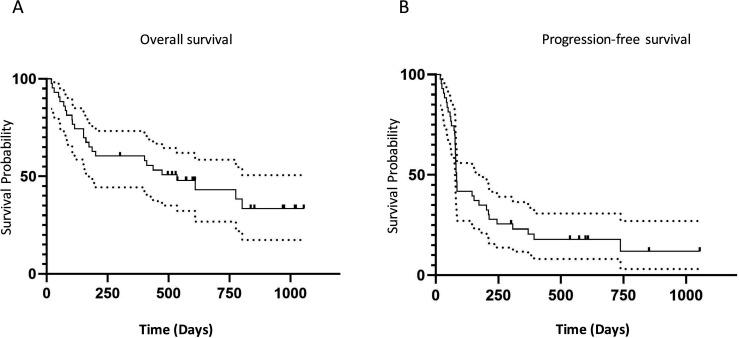
The objective response rate in the radiologically evaluable population was 36% (12/33 patients) and in the intention-to-treat population was 28% (12/43 patients), with additional 7 patients obtaining SD leading to a disease control rate of 58% and 44%, respectively. Durable responses were seen across a range of tumor histologies. Thirty-one (72%) patients experienced an immune-related adverse event (irAE) with a grade 3/4 irAE observed in seven (16%) patients. Response rate was higher among those patients with baseline PD-L1 expression (≥1% on tumor cells) but was independent of TMB.
CONCLUSIONS
Ipilimumab and nivolumab combination treatment has significant clinical activity with a favorable safety profile across a range of advanced rare gynecological malignancies and warrants further investigation in these tumor types.
背景
罕见癌症患者占所有妇科恶性肿瘤的 55%,由于治疗选择有限,生存结局较差。抗程序性死亡蛋白 1(抗 PD-1)抗体纳武单抗(nivolumab)和抗细胞毒性 T 淋巴细胞相关蛋白 4(抗 CTLA-4)抗体伊匹单抗(ipilimumab)的联合免疫治疗已在一系列常见恶性肿瘤中显示出显著的临床疗效,这证明了在罕见妇科癌症中评估这种联合治疗的合理性。
方法
这项多中心 2 期研究纳入了 43 例晚期罕见妇科癌症患者。患者接受纳武单抗和伊匹单抗诱导治疗,剂量分别为 3mg/kg 和 1mg/kg,每 3 周给药 4 次。治疗继续采用纳武单抗单药治疗,剂量为 3mg/kg,每 2 周给药 1 次,直至疾病进展或最多 2 年。主要终点是第 12 周时疾病控制的患者比例(完全缓解、部分缓解或根据实体瘤反应评估标准 1.1 版的稳定疾病(SD))。探索性评估将临床结果与肿瘤程序性死亡配体 1(PD-L1)表达和肿瘤突变负荷(TMB)相关联。
结果
在可进行影像学评估的人群中,客观缓解率为 36%(33 例患者中的 12 例),在意向治疗人群中为 28%(43 例患者中的 12 例),另外还有 7 例患者获得 SD,疾病控制率分别为 58%和 44%。在一系列肿瘤组织学中都观察到了持久的反应。31 例(72%)患者发生免疫相关不良事件(irAE),其中 7 例(16%)患者出现 3/4 级 irAE。在基线时 PD-L1 表达(肿瘤细胞上≥1%)较高的患者中,缓解率更高,但与 TMB 无关。
结论
伊匹单抗和纳武单抗联合治疗在一系列晚期罕见妇科恶性肿瘤中具有显著的临床活性,且具有良好的安全性,值得在这些肿瘤类型中进一步研究。



 Zotero 插件