Gan Jiadi, Huang Yihua, Liao Jun, Pang Lanlan, Fang Wenfeng
Department of Medical Oncology, State Key Laboratory of Oncology in South China, Collaborative Innovation Center for Cancer Medicine, Sun Yat-sen University Cancer Center, Guangzhou, 510060, People's Republic of China.
Onco Targets Ther. 2021 Nov 18;14:5297-5307. doi: 10.2147/OTT.S335217. eCollection 2021.
HER2 (or ERBB2) amplification is an important mechanism for acquired resistance to EGFR tyrosine kinase inhibitors (TKI). The benefits of HER2-targeted therapy have been limited. Herein, we investigated the molecular and clinical patterns of HER2 amplification in non-small cell lung cancer (NSCLC) patients during progression on EGFR-TKIs and the potential of combining EGFR-TKI and pyrotinib to overcome resistance.
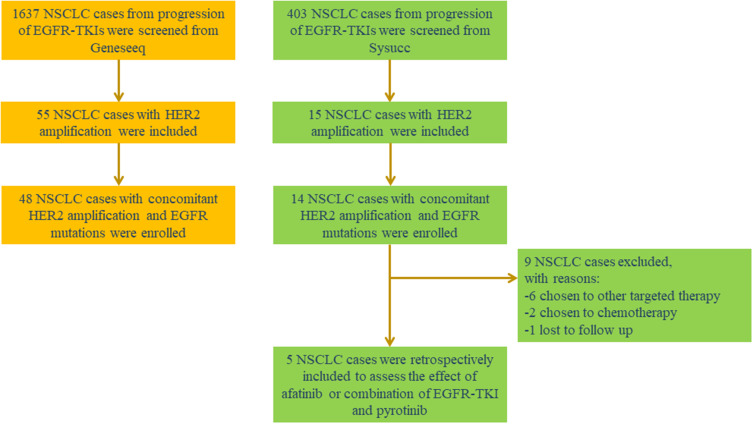
In this study, 1,637 NSCLC cases from Geneseeq after progression of EGFR-TKIs were screened and analyzed by next generation sequencing (NGS), in which 48 patients with HER2 amplification were eligible and enrolled. A total of 403 patients from Sun Yat-sen University Cancer Center (SYSUCC) were screened and five patients with concomitant EGFR mutations and HER2 amplification were retrospectively collected to assess the effect of afatinib or combination of EGFR-TKI and pyrotinib.
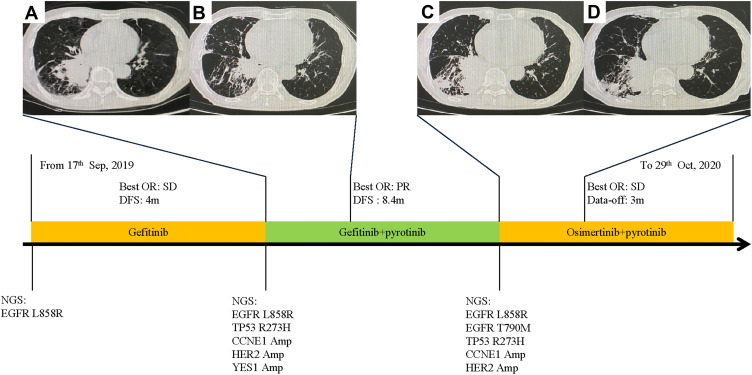
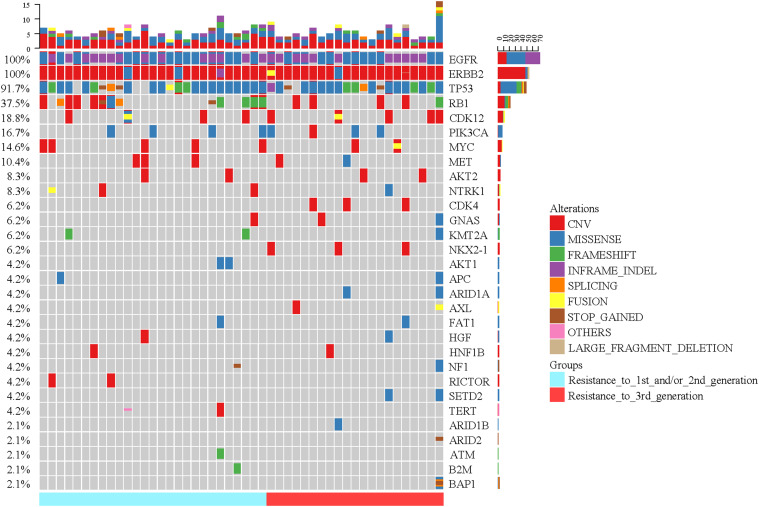
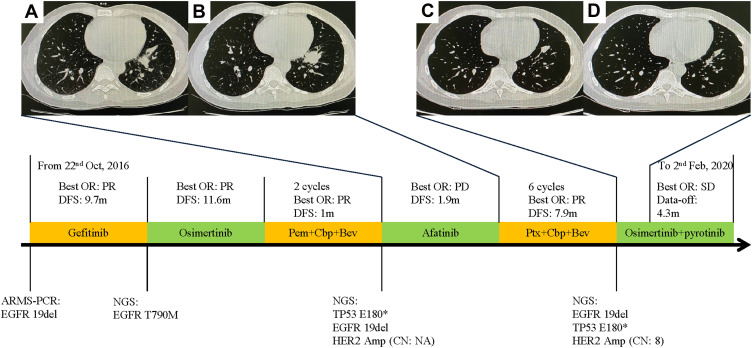
In the 48 patients from the Geneseeq cohort, 27 (56.2%) patients suffered from resistance of 1st/2nd generation EGFR-TKI, and 21 (43.8%) patients from 3rd generation. As for the five patients forming the SYSUCC cohort, three patients were treated with afatinib, one achieved partial response (PR) with progression-free survival (PFS) of 6 months and two quickly developed disease progression. Two patients were treated with EGFR-TKIs plus pyrotinib, one receiving gefitinib plus pyrotinib achieved PR with PFS of 8 months and benefited from osimertinib plus pyrotinib for 3 months till data-off; one receiving osimertinib plus pyrotinib achieved SD for 4 months till data-off. The most common co-occurring alteration was TP53 (91.7%) in the mutation profile of the 48 patients from the Geneseeq cohort, and four patients had TP53 co-mutations of the five patients from the SYSUCC cohort.
In this study, we detected 7% HER2 amplification present in EGFR-TKIs resistance. Patients with concomitant EGFR mutation and HER2 amplification may derive clinical benefit from therapies that target both EGFR and HER2.
HER2(或ERBB2)扩增是获得性EGFR酪氨酸激酶抑制剂(TKI)耐药的重要机制。HER2靶向治疗的益处有限。在此,我们研究了非小细胞肺癌(NSCLC)患者在接受EGFR-TKIs治疗进展期间HER2扩增的分子和临床模式,以及联合使用EGFR-TKI和吡咯替尼克服耐药的潜力。
在本研究中,对Geneseeq公司提供的1637例EGFR-TKIs治疗进展后的NSCLC病例进行下一代测序(NGS)筛选和分析,其中48例HER2扩增患者符合条件并纳入研究。对中山大学肿瘤防治中心(SYSUCC)的403例患者进行筛选,并回顾性收集5例EGFR突变合并HER2扩增的患者,以评估阿法替尼或EGFR-TKI与吡咯替尼联合使用的效果。
在Geneseeq队列的48例患者中,27例(56.2%)患者对第一代/第二代EGFR-TKI耐药,21例(43.8%)患者对第三代EGFR-TKI耐药。对于构成SYSUCC队列的5例患者,3例接受阿法替尼治疗,1例获得部分缓解(PR),无进展生存期(PFS)为6个月,2例很快出现疾病进展。2例接受EGFR-TKIs加吡咯替尼治疗,1例接受吉非替尼加吡咯替尼治疗获得PR,PFS为8个月,并从奥希替尼加吡咯替尼治疗中获益3个月直至数据截止;1例接受奥希替尼加吡咯替尼治疗获得疾病稳定(SD)4个月直至数据截止。在Geneseeq队列的48例患者的突变谱中,最常见的共发改变是TP53(91.7%),在SYSUCC队列的5例患者中,有4例存在TP53共突变。
在本研究中,我们检测到EGFR-TKIs耐药患者中存在7%的HER2扩增。EGFR突变合并HER2扩增的患者可能从同时靶向EGFR和HER2的治疗中获得临床益处。