
与胃癌相关的枢纽基因和潜在治疗药物的生物信息学分析
Bioinformatics Analysis of Hub Genes and Potential Therapeutic Agents Associated with Gastric Cancer.
作者信息
Zhang Shiyu, Xiang Xuelian, Liu Li, Yang Huiying, Cen Dongliang, Tang Guodu
机构信息
Department of Gastroenterology, The First Affiliated Hospital of Guangxi Medical University, Nanning City, Guangxi Province, People's Republic of China.
出版信息
Cancer Manag Res. 2021 Nov 30;13:8929-8951. doi: 10.2147/CMAR.S341485. eCollection 2021.
PURPOSE
The current treatment methods available for advanced gastric cancer are not very promising. Hence, it is important to explore novel biomarkers and potential therapeutic agents to treat gastric cancer (GC). This study aimed to identify hub genes associated with GC prognosis and explore potential drugs for its treatment.
MATERIALS AND METHODS
Three gene expression data of GC and normal tissues were downloaded from the Gene Expression Omnibus (GEO) and processed to identify the differentially expressed genes (DEGs). We conducted a comprehensive analysis of DEGs, including functional enrichment analysis, construction of protein-protein interaction (PPI) network, identification of hub genes, survival analysis and expression verification of hub genes. Finally, we constructed the network of miRNA-mRNA, and predicted the drugs that might be effective for GC treatment.
RESULTS
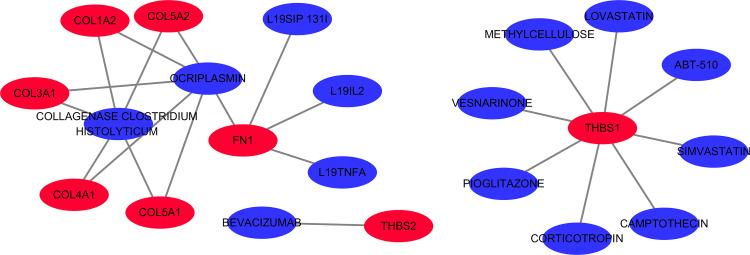
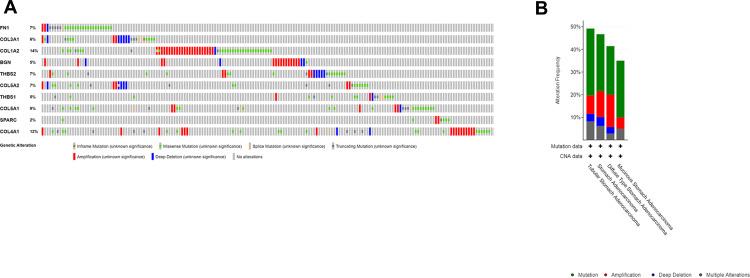
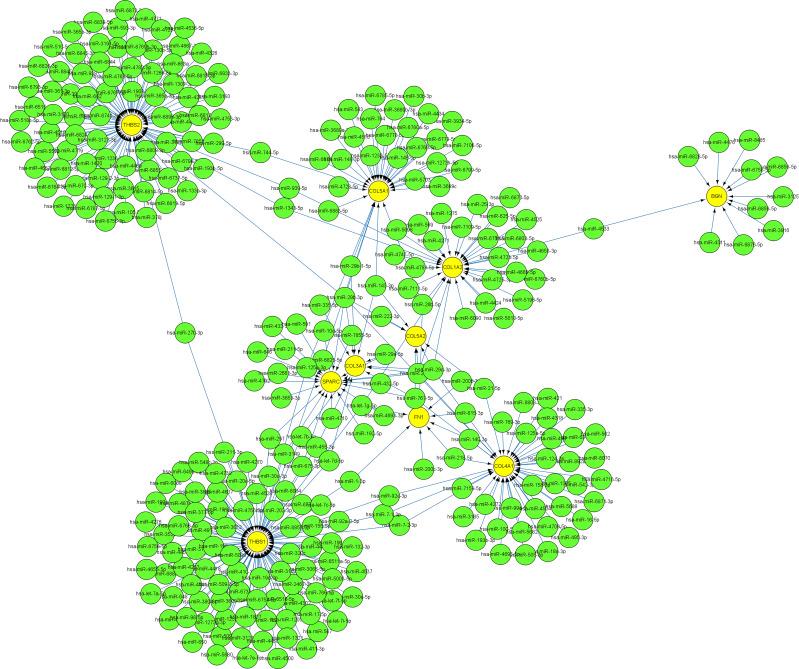
A total of 340 DEGs, including 94 up-regulated and 246 down-regulated genes, were identified. Among the up-regulated DEGs, the enrichment terms were primarily related to tumorigenesis and tumor progression, extracellular matrix organization, and collagen catabolic process. Additionally, 10 hub genes (, and ) were identified, out of which 7 genes were significantly associated with poor overall survival (OS) in GC. The expression levels of these 7 hub genes were verified using real-time PCR, immunohistochemistry, and the GEPIA2 (Gene Expression Profiling Interactive Analysis) server. A regulatory network of miRNA-mRNA was also constructed, and the top 4 interactive miRNAs (hsa-miR-29b-3p, hsa-miR-140-3p, hsa-miR-29a-3p, and hsa-miR-29c-3p) that targeted the most hub genes were identified. Finally, fourteen small molecules were predicted to be effective in treating GC.
CONCLUSION
The identification of the hub genes, miRNA-mRNA network, and potential candidate drugs associated with GC provides new insights into the molecular mechanisms and treatment of GC.
目的
目前可用于晚期胃癌的治疗方法前景不太乐观。因此,探索新的生物标志物和潜在治疗药物来治疗胃癌(GC)很重要。本研究旨在鉴定与GC预后相关的枢纽基因,并探索其治疗的潜在药物。
材料与方法
从基因表达综合数据库(GEO)下载了三个GC和正常组织的基因表达数据,并进行处理以鉴定差异表达基因(DEG)。我们对DEG进行了全面分析,包括功能富集分析、蛋白质-蛋白质相互作用(PPI)网络构建、枢纽基因鉴定、生存分析和枢纽基因表达验证。最后,我们构建了miRNA-mRNA网络,并预测了可能对GC治疗有效的药物。
结果
共鉴定出340个DEG,包括94个上调基因和246个下调基因。在上调的DEG中,富集术语主要与肿瘤发生和肿瘤进展、细胞外基质组织以及胶原蛋白分解代谢过程有关。此外,鉴定出10个枢纽基因(……),其中7个基因与GC患者的总生存期(OS)差显著相关。使用实时PCR、免疫组织化学和GEPIA2(基因表达谱交互式分析)服务器验证了这7个枢纽基因的表达水平。还构建了miRNA-mRNA调控网络,并鉴定了靶向最多枢纽基因的前4个相互作用miRNA(hsa-miR-29b-3p、hsa-miR-140-3p、hsa-miR-29a-3p和hsa-miR-29c-3p)。最后,预测有14种小分子对GC治疗有效。
结论
与GC相关的枢纽基因、miRNA-mRNA网络和潜在候选药物的鉴定为GC的分子机制和治疗提供了新的见解。




 Zotero 插件