
用于大规模物联网网络的具有分组感知功能的MAC协议GMAC
MAC protocol with grouping awareness GMAC for large scale Internet-of-Things network.
作者信息
Sameer Sadeq Abdulrahman, Hassan Rosilah, Hafizah Mohd Aman Azana, Sallehudin Hasimi, Allehaibi Khalid, Albogami Nasser, Satria Prabuwono Anton
机构信息
Center for Cyber Security, Universiti Kebangsaan Malaysia UKM, Bangi, Selangor, Malaysia.
Department of Computer Science, King Abdulaziz University, Jeddah, Saudi Arabia.
出版信息
PeerJ Comput Sci. 2021 Nov 22;7:e733. doi: 10.7717/peerj-cs.733. eCollection 2021.
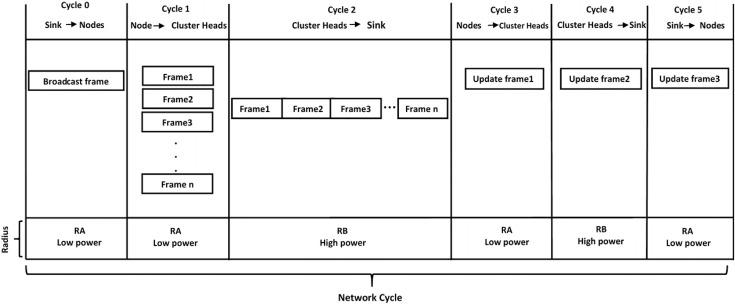
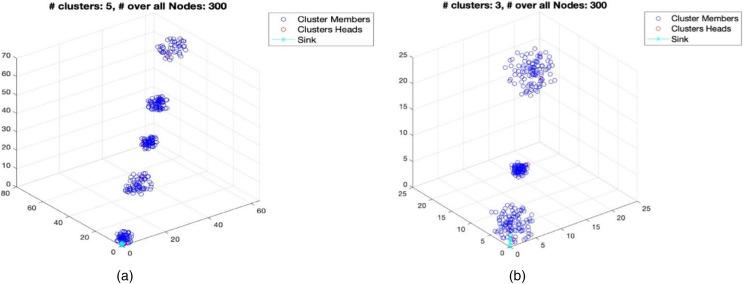
The development of Medium Access Control (MAC) protocols for Internet of Things should consider various aspects such as energy saving, scalability for a wide number of nodes, and grouping awareness. Although numerous protocols consider these aspects in the limited view of handling the medium access, the proposed Grouping MAC (GMAC) exploits prior knowledge of geographic node distribution in the environment and their priority levels. Such awareness enables GMAC to significantly reduce the number of collisions and prolong the network lifetime. GMAC is developed on the basis of five cycles that manage data transmission between sensors and cluster head and between cluster head and sink. These two stages of communication increase the efficiency of energy consumption for transmitting packets. In addition, GMAC contains slot decomposition and assignment based on node priority, and, therefore, is a grouping-aware protocol. Compared with standard benchmarks IEEE 802.15.4 and industrial automation standard 100.11a and user-defined grouping, GMAC protocols generate a Packet Delivery Ratio (PDR) higher than 90%, whereas the PDR of benchmark is as low as 75% in some scenarios and 30% in others. In addition, the GMAC accomplishes lower end-to-end (e2e) delay than the least e2e delay of IEEE with a difference of 3 s. Regarding energy consumption, the consumed energy is 28.1 W/h for GMAC-IEEE Energy Aware (EA) and GMAC-IEEE, which is less than that for IEEE 802.15.4 (578 W/h) in certain scenarios.
物联网介质访问控制(MAC)协议的开发应考虑多个方面,如节能、对大量节点的可扩展性以及分组感知。尽管许多协议在处理介质访问的有限视角下考虑了这些方面,但所提出的分组MAC(GMAC)利用了环境中地理节点分布及其优先级的先验知识。这种感知使GMAC能够显著减少冲突数量并延长网络寿命。GMAC是基于五个周期开发的,这些周期管理传感器与簇头之间以及簇头与汇聚节点之间的数据传输。这两个通信阶段提高了数据包传输的能量消耗效率。此外,GMAC包含基于节点优先级的时隙分解和分配,因此是一种分组感知协议。与标准基准IEEE 802.15.4、工业自动化标准100.11a和用户定义分组相比,GMAC协议产生的数据包交付率(PDR)高于90%,而在某些情况下基准的PDR低至75%,在其他情况下低至30%。此外,GMAC实现的端到端(e2e)延迟比IEEE的最小端到端延迟低3秒。在能耗方面,GMAC - IEEE能源感知(EA)和GMAC - IEEE的能耗为28.1瓦/小时,在某些情况下低于IEEE 802.15.4(578瓦/小时)。





 Zotero 插件