Viani Gustavo Arruda, Gouveia Andre Guimaraes, Moraes Fabio Ynoe
Department of Medical Imagings, Hematology and Oncology, Ribeirão Preto Medical School, University of São Paulo (FMRP-USP), São Paulo, Brazil.
Radiation Oncology Department, Americas Centro de Oncologia Integrado, Rio de Janeiro, Brazil.
J Thorac Dis. 2021 Nov;13(11):6272-6282. doi: 10.21037/jtd-21-573.
For patients with locally advanced non-small cell lung cancer (NSCLC), the standard treatment is concurrent or sequential chemotherapy with radiotherapy. Most treatment schedules use radiotherapy with conventional fractionation; however, the application of hypofractionated radiotherapy (HYPO-RT) regimens is rising. A meta-analysis was performed to assess the efficacy and safety of chemotherapy combined with HYPO-RT and indirectly compare with the outcomes from previous studies employing concomitant conventional radiotherapy (CONV-RT).
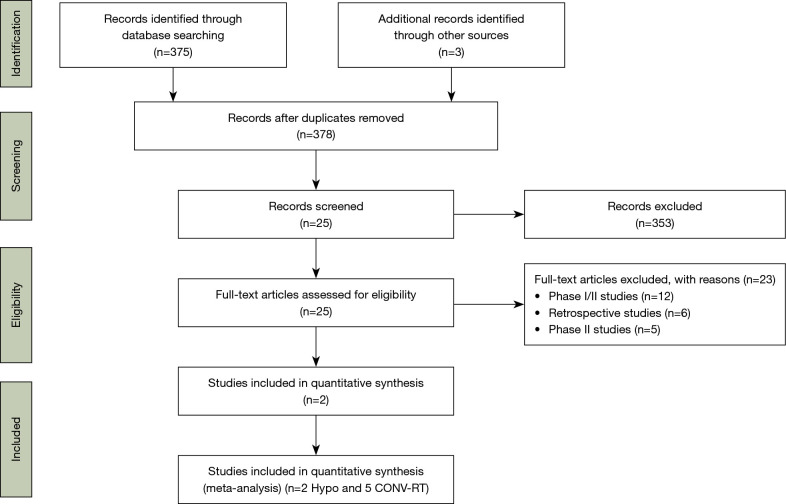
Randomized controlled trials (RCTs) were identified on the electronic database sources through June 2020. Following the PRISMA guidelines, a meta-analysis was performed to assess if there were significant differences in the overall mortality (OM), local failure (LF), and disease progression (DP), comparing HYPO-RT-C sequential chemotherapy followed HYPO-RT (HYPO-RT-S). To establish an indirect comparison with the current standard treatment, we calculate the risk ratio (RR) of the OM from RCTs using conventional chemoradiation, concurrent (CONV-RT-C), and sequential (CONV-RT-S), and compared with HYPO-RT. A P value <0.05 was considered significant.
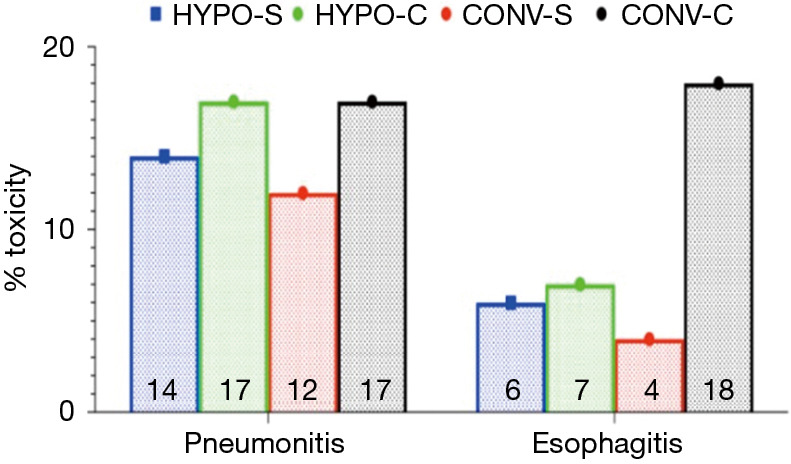
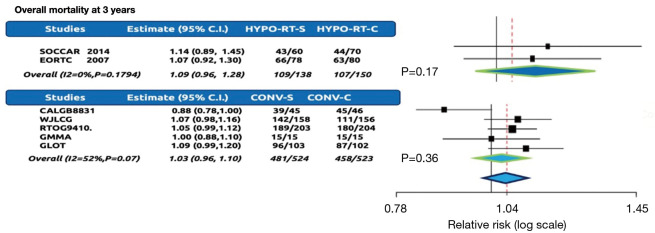
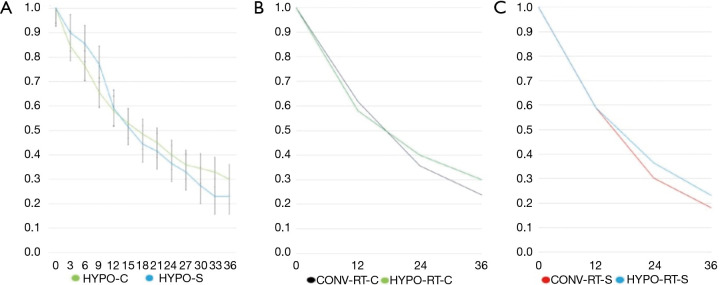
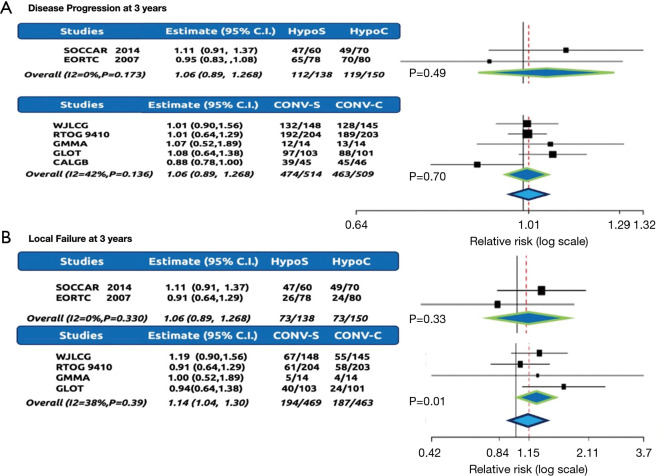
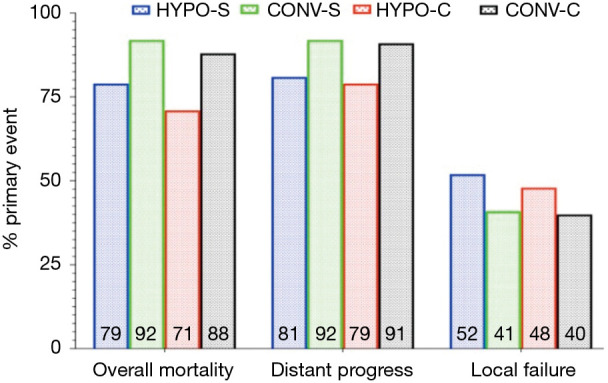
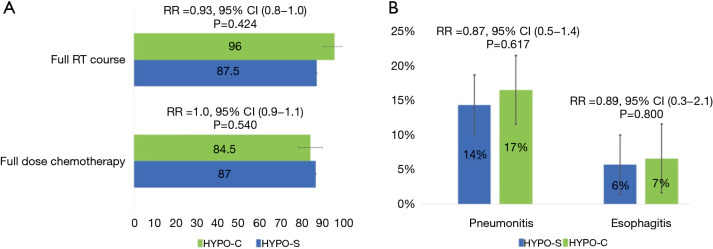
Two RCTs with a total of 288 patients were included. The RR for the OM, DP and LF at 3 year comparing HYPO-RT-C HYPO-RT-S were 1.09 (95% CI: 0.96-1.28, P=0.17), 1.06 (95% CI: 0.82-1.23, P=0.610), and 1.06 (95% CI: 0.86-1.29, P=0.490), respectively. The late grade 3 pneumonitis and esophagitis had no significant difference between HYPO-RT groups. In the indirect comparison of RCTs using CONV-RT, the RR for the OM at 3 years was 1.03 (95% CI: 0.96-1.10, P=0.36) with no significant difference for the HYPO-RT arms 1.09 (95% CI: 0.96-1.28, P=0.17).
HYPO-RT given with chemotherapy provides satisfactory OM, LF, and DP in locally advanced NSCLC with similar rates to the CONV-RT. These findings support HYPO-RT inclusion in future clinical trials as an experimental arm in addition to the incorporation of new strategies, such as immunotherapy.
对于局部晚期非小细胞肺癌(NSCLC)患者,标准治疗是同步或序贯化疗联合放疗。大多数治疗方案采用常规分割放疗;然而,短程分割放疗(HYPO-RT)方案的应用正在增加。进行了一项荟萃分析,以评估化疗联合HYPO-RT的疗效和安全性,并间接与以往采用同步常规放疗(CONV-RT)的研究结果进行比较。
通过电子数据库检索截至2020年6月的随机对照试验(RCT)。按照PRISMA指南,进行荟萃分析,以评估短程分割放疗序贯化疗(HYPO-RT-S)与短程分割放疗同步化疗(HYPO-RT-C)在总死亡率(OM)、局部失败(LF)和疾病进展(DP)方面是否存在显著差异。为了与当前标准治疗进行间接比较,我们计算了采用常规放化疗、同步(CONV-RT-C)和序贯(CONV-RT-S)的RCT中OM的风险比(RR),并与HYPO-RT进行比较。P值<0.05被认为具有统计学意义。
纳入两项RCT,共288例患者。比较HYPO-RT-C与HYPO-RT-S,3年时OM、DP和LF的RR分别为1.09(95%CI:0.96-1.28,P=0.17)、1.06(95%CI:0.82-1.23,P=0.610)和1.06(95%CI:0.86-1.29,P=0.490)。HYPO-RT组之间3级晚期肺炎和食管炎无显著差异。在使用CONV-RT的RCT间接比较中,3年时OM的RR为1.03(95%CI:0.96-1.10,P=0.36),HYPO-RT组为1.09(95%CI:0.96-1.28,P=0.17),无显著差异。
化疗联合HYPO-RT在局部晚期NSCLC中提供了令人满意的OM、LF和DP,与CONV-RT的发生率相似。这些发现支持将HYPO-RT纳入未来的临床试验,作为除免疫治疗等新策略之外的一个试验组。