Wang Shuhang, Jiang Miaomiao, Yang Zuozhen, Huang Xiaoyun, Li Ning
Clinical Cancer Center, National Cancer Center/National Clinical Research Center for Cancer/Cancer Hospital, Chinese Academy of Medical Sciences and Peking Union Medical College, Beijing 100021, PR China.
Research and Development, Zhiyu, Inc, Shenzhen, Guangdong 518000, PR China.
Genes Dis. 2020 Apr 9;9(1):245-251. doi: 10.1016/j.gendis.2020.04.001. eCollection 2022 Jan.
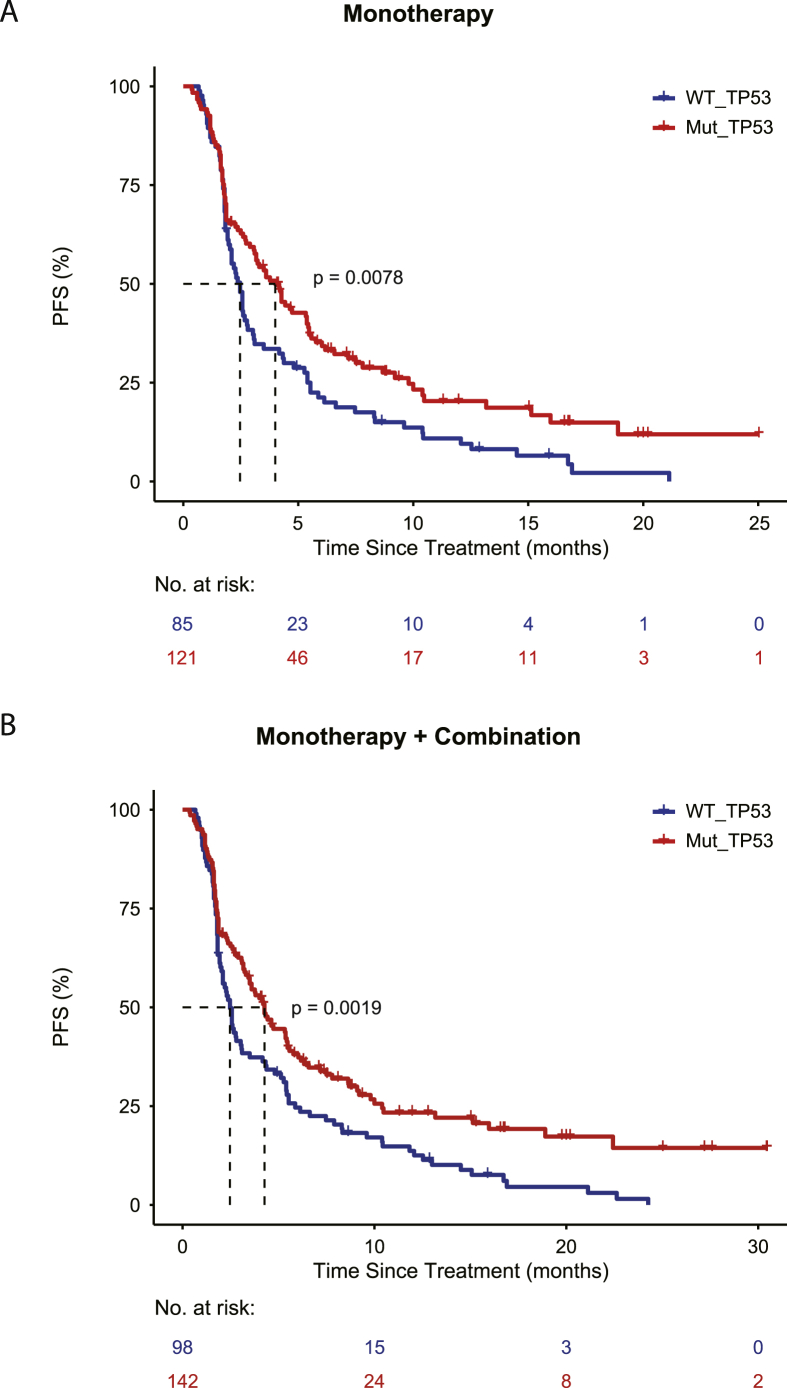
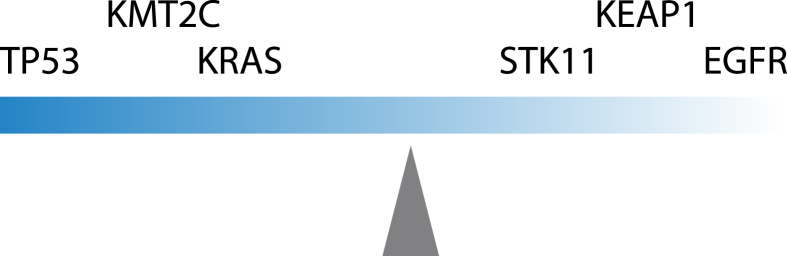
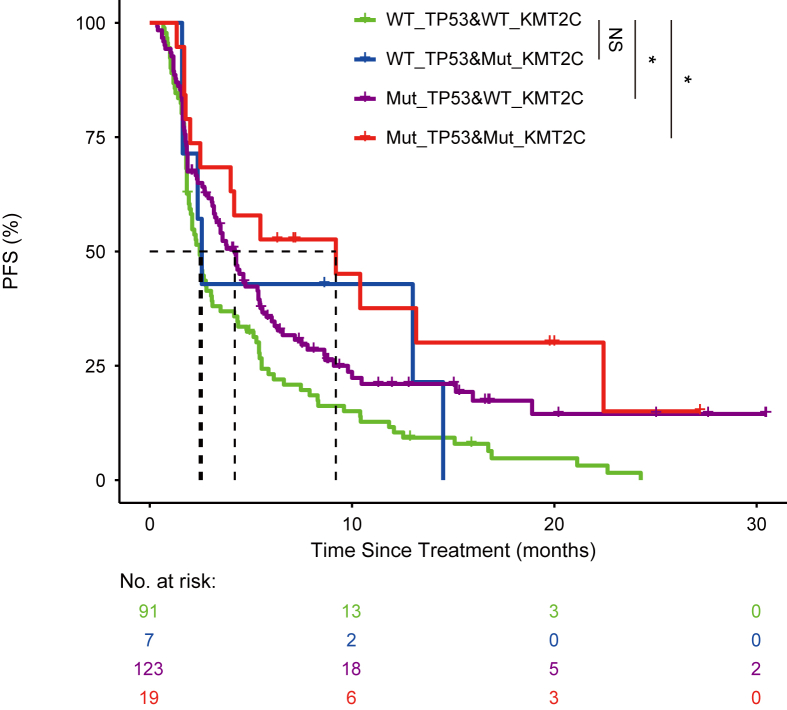
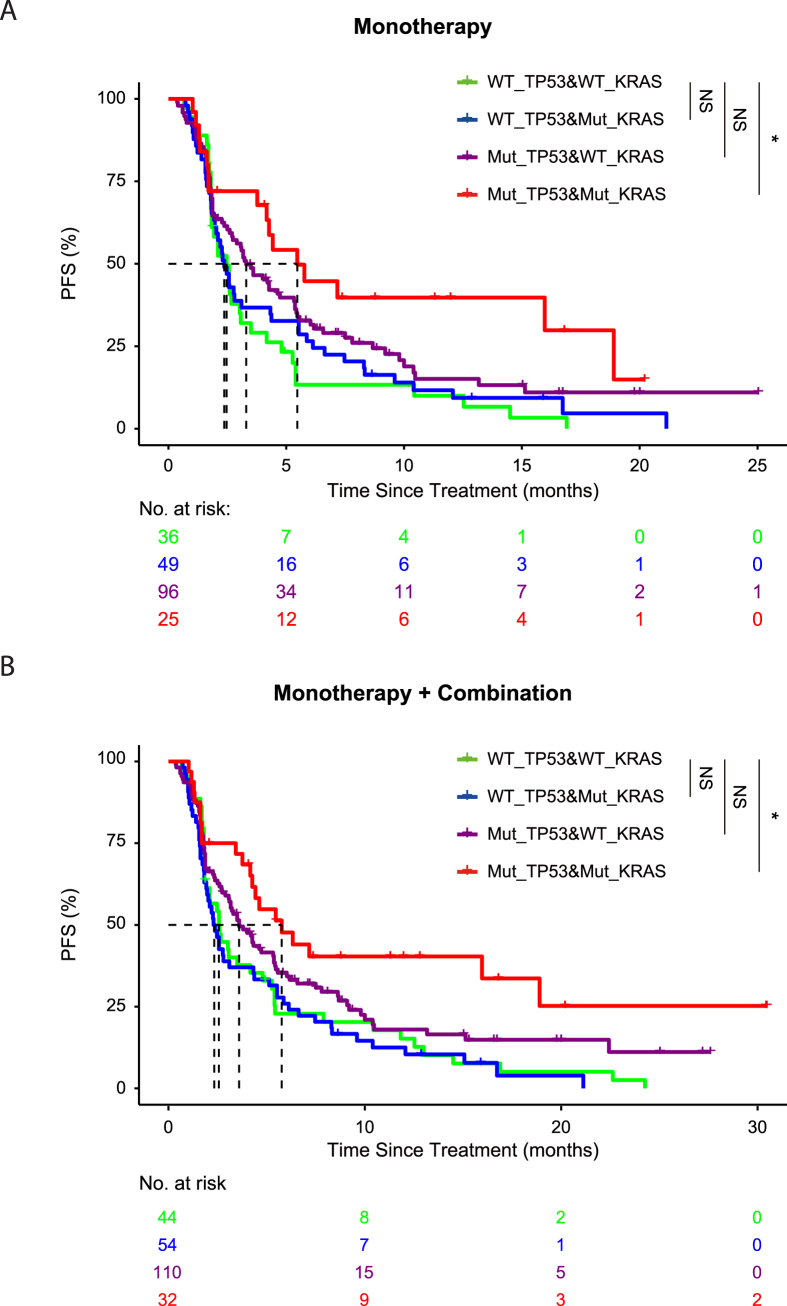
mutations was reported to be correlated to the efficacy of program death-1 (PD-1) and program death ligand-1 (PD-L1). The role of co-mutations of with other recurrently mutated genes in outcome of anti-PD-(L)1 treatment for non-small cell lung cancer (NSCLC) is unknown. Here we mined a previously generated dataset to address the effect of co-mutations on the progression free survival (PFS) of NSCLC patients. Non-synonymous mutations and clinical data of 240 NSCLC patients with anti-PD-(L)1 based therapy was downloaded from cBioPortal. Totally 206 patients received monotherapy and 34 patients received combination therapy. In 240 NSCLC patients, TP53 mutation rate was 59.2%. For the monotherapy cohort, mutated NSCLC patients have a significantly longer PFS (4.3 2.5 months, = 0.0019) compared with wild type NSCLC patients. The same tendency was also observed in the combination therapy cohort, but the difference in PFS (6.3 5.4 months, = 0.12) was not significant. Ever-smoker had a longer PFS compared to never-smokers (4.0 2.7 months). For further co-mutation analysis with including mutation (53/240, 22.1%), mutation (26/240, 10.8%), mutation (56/240, 23.3%), mutation (28/240, 11.7%) and mutation (86/240, 35.8%). Patients with both plus mutations in all 240 patients had a longer PFS compared with co-wild population (PFS 9.2 4.2 months, = 0.012) when treated with PD-1/PD-L1 inhibitors. 3 might be the dominating mutation correlating with longer PFS in PD-1/PD-L1 monotherapy. Different genes displayed distinct effect when co-mutated with in NSCLC patients.
据报道,基因突变与程序性死亡-1(PD-1)和程序性死亡配体-1(PD-L1)的疗效相关。其他常见突变基因与非小细胞肺癌(NSCLC)抗PD-(L)1治疗结果的共突变作用尚不清楚。在此,我们挖掘了一个先前生成的数据集,以探讨共突变对NSCLC患者无进展生存期(PFS)的影响。从cBioPortal下载了240例接受基于抗PD-(L)1治疗的NSCLC患者的非同义突变和临床数据。共有206例患者接受单药治疗,34例患者接受联合治疗。在240例NSCLC患者中,TP53突变率为59.2%。对于单药治疗队列,与野生型NSCLC患者相比,突变的NSCLC患者的PFS显著更长(4.3±2.5个月,P = 0.0019)。在联合治疗队列中也观察到相同趋势,但PFS差异(6.3±5.4个月,P = 0.12)不显著。曾经吸烟者的PFS比从不吸烟者更长(4.0±2.7个月)。为了进一步进行包括突变(53/240,22.1%)、突变(26/240,10.8%)、突变(56/240,23.3%)、突变(28/240,11.7%)和突变(86/240,35.8%)在内的与的共突变分析。在所有240例患者中,同时存在和突变的患者在接受PD-1/PD-L1抑制剂治疗时,与共野生群体相比,PFS更长(PFS 9.2±4.2个月,P = 0.012)。3可能是与PD-1/PD-L1单药治疗中更长PFS相关的主要突变。在NSCLC患者中,不同基因与共突变时表现出不同的效应。