Merzkani Massini A, Bentall Andrew J, Smith Byron H, Benavides Lopez Xiomara, D'Costa Matthew R, Park Walter D, Kremers Walter K, Issa Naim, Rule Andrew D, Chakkera Harini, Reddy Kunam, Khamash Hasan, Wadei Hani M, Mai Martin, Alexander Mariam P, Amer Hatem, Kukla Aleksandra, El Ters Mireille, Schinstock Carrie A, Gandhi Manish J, Heilman Raymond, Stegall Mark D
Division of Nephrology and Hypertension, Mayo Clinic, Rochester, MN.
William J. von Liebig Center for Transplantation and Clinical Regeneration, Mayo Clinic, Rochester, MN.
Transplant Direct. 2022 Jan 13;8(2):e1273. doi: 10.1097/TXD.0000000000001273. eCollection 2022 Feb.
Improving both patient and graft survival after kidney transplantation are major unmet needs. The goal of this study was to assess risk factors for specific causes of graft loss to determine to what extent patients who develop either death with a functioning graft (DWFG) or graft failure (GF) have similar baseline risk factors for graft loss.
We retrospectively studied all solitary renal transplants performed between January 1, 2006, and December 31, 2018, at 3 centers and determined the specific causes of DWFG and GF. We examined outcomes in different subgroups using competing risk estimates and cause-specific Cox models.
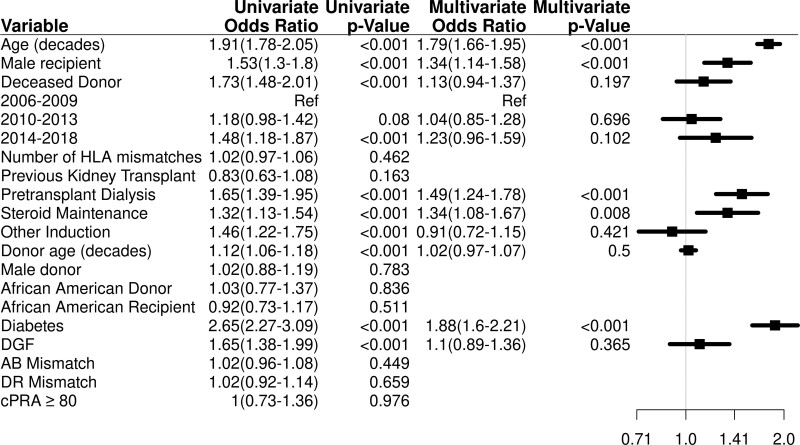
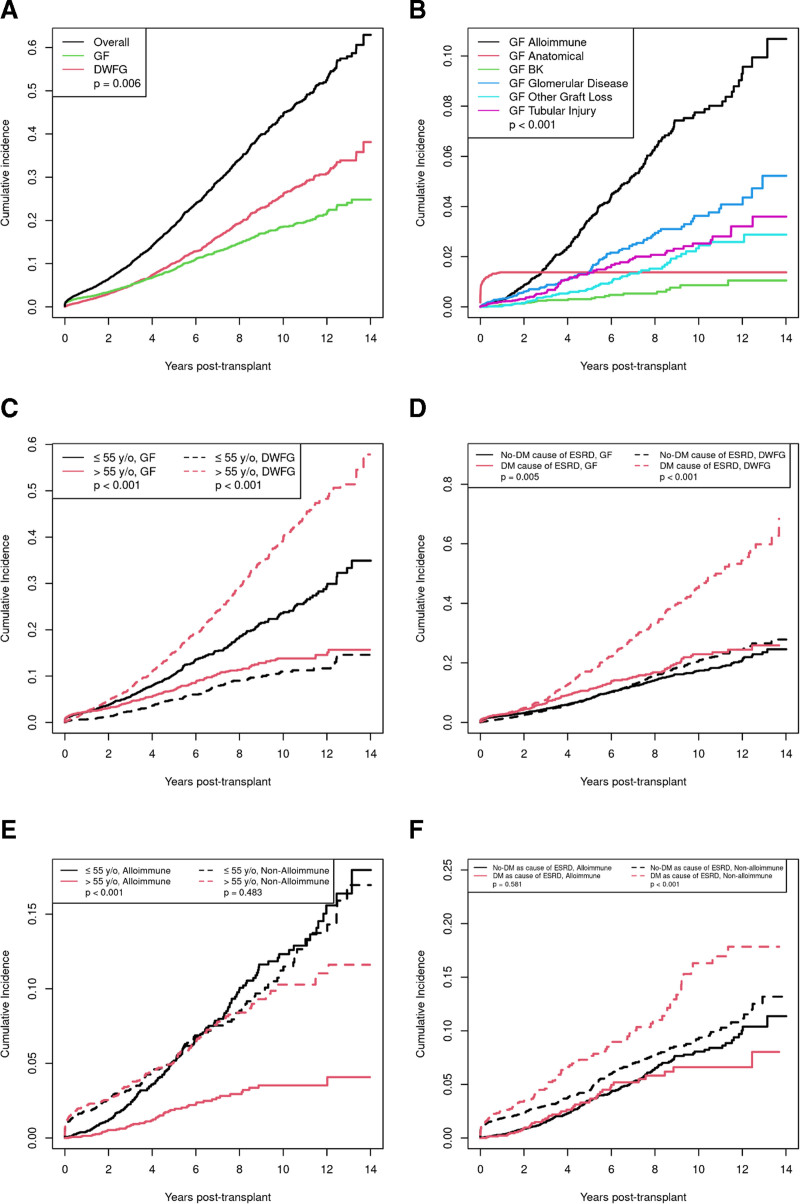
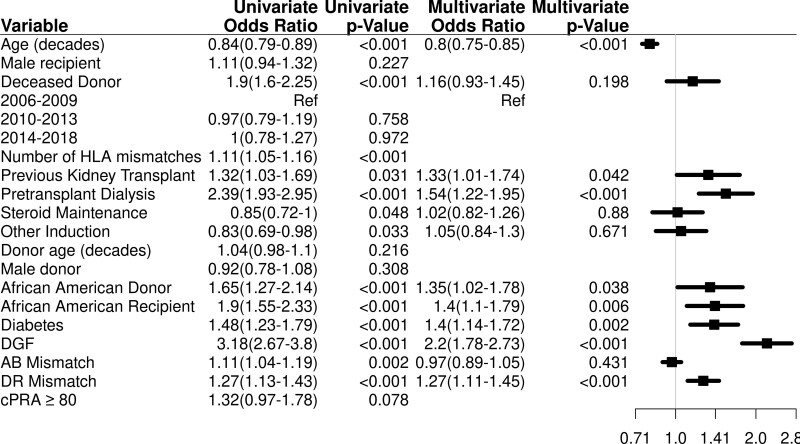
Of the 5752 kidney transplants, graft loss occurred in 21.6% (1244) patients, including 12.0% (691) DWFG and 9.6% (553) GF. DWFG was most commonly due to malignancy (20.0%), infection (19.7%), cardiac disease (12.6%) with risk factors of older age and pretransplant dialysis, and diabetes as the cause of renal failure. For GF, alloimmunity (38.7%), glomerular diseases (18.6%), and tubular injury (13.9%) were the major causes. Competing risk incidence models identified diabetes and older recipients with higher rates of both DWFG and nonalloimmune GF.
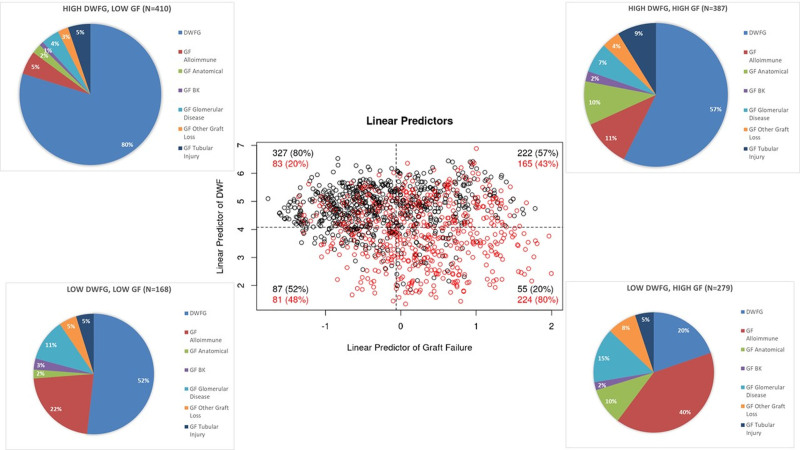
These data suggest that at baseline, 2 distinct populations can be identified who are at high risk for renal allograft loss: a younger, nondiabetic patient group who develops GF due to alloimmunity and an older, more commonly diabetic population who develops DWFG and GF due to a mixture of causes-many nonalloimmune. Individualized management is needed to improve long-term renal allograft survival in the latter group.
提高肾移植术后患者及移植物的存活率是尚未满足的主要需求。本研究的目的是评估移植物丢失的特定原因的危险因素,以确定出现移植肾有功能时死亡(DWFG)或移植物功能衰竭(GF)的患者在多大程度上具有相似的移植物丢失基线危险因素。
我们回顾性研究了2006年1月1日至2018年12月31日期间在3个中心进行的所有单肾移植,并确定了DWFG和GF的具体原因。我们使用竞争风险估计和特定病因的Cox模型检查了不同亚组的结果。
在5752例肾移植中,21.6%(1244例)患者发生移植物丢失,包括12.0%(691例)DWFG和9.6%(553例)GF。DWFG最常见的原因是恶性肿瘤(20.0%)、感染(19.7%)、心脏病(12.6%),其危险因素为年龄较大和移植前透析,以及糖尿病作为肾衰竭的病因。对于GF,同种免疫(38.7%)、肾小球疾病(18.6%)和肾小管损伤(13.9%)是主要原因。竞争风险发生率模型确定糖尿病和老年受者的DWFG和非同种免疫性GF发生率较高。
这些数据表明,在基线时,可以识别出两个不同的肾移植丢失高危人群:一个是因同种免疫而发生GF的年轻、非糖尿病患者组;另一个是因多种原因(许多是非同种免疫性原因)而发生DWFG和GF的老年、更常见的糖尿病患者群体。需要个体化管理以提高后一组患者的长期肾移植存活率。