
牛肺线虫重组主要精子蛋白的免疫试验
Immunization Trials with Recombinant Major Sperm Protein of the Bovine Lungworm .
作者信息
Springer Andrea, von Holtum Christian, von Samson-Himmelstjerna Georg, Strube Christina
机构信息
Institute for Parasitology, Centre for Infection Medicine, University of Veterinary Medicine Hannover, 30559 Hannover, Germany.
出版信息
Pathogens. 2022 Jan 2;11(1):55. doi: 10.3390/pathogens11010055.
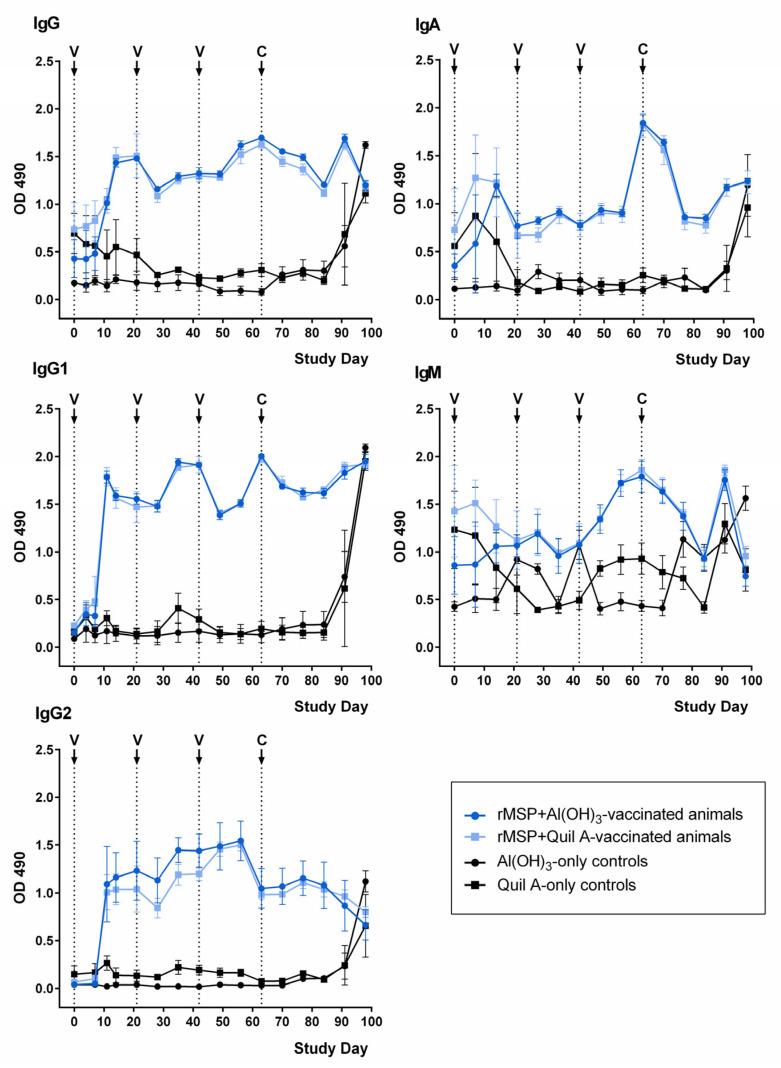
The lungworm is one of the most economically important bovine parasites in temperate climate regions. Following infection, induces a temporary protective immunity, and a vaccine based on attenuated, infective larvae is commercially available. However, due to several disadvantages of the live vaccine, the development of a recombinant subunit vaccine is highly desirable. Therefore, the major sperm protein (MSP), which is essential for the parasite's reproduction, was tested as a recombinantly -expressed glutathione-S-transferase (GST)-fused vaccine antigen in immunization trials with two different adjuvants, Quil A and Al(OH). Calves (N = 4 per group) were immunized on study day (SD) 0, 21 and 42 and given a challenge infection on SD 63-65. The two control groups received only the respective adjuvant. Based on geometric means (GM), a 53.64% reduction in larvae per female worm was observed in the rMSP Quil A group vs. its control group (arithmetic means (AM): 54.43%), but this difference was not statistically significant. In the rMSP Al(OH) group, the mean number of larvae per female worm was even higher than in the respective control group (GM: 9.24%, AM: 14.14%). Furthermore, male and female worm burdens and the absolute number of larvae did not differ significantly, while the Al(OH) control group harbored significantly longer worms than the vaccinated group. Vaccinated animals showed a rise in rMSP-specific antibodies, particularly IgG and its subclass IgG1, and the native protein was detected by immunoblots. Although rMSP alone did not lead to significantly reduced worm fecundity, it might still prove useful as part of a multi-component vaccine.
在温带气候地区,肺线虫是对牛经济影响最为重要的寄生虫之一。感染后,会诱导产生暂时的保护性免疫,一种基于减毒感染性幼虫的疫苗已在市场上销售。然而,由于活疫苗存在若干缺点,因此非常需要开发一种重组亚单位疫苗。因此,在寄生虫繁殖中起关键作用的主要精子蛋白(MSP),作为重组表达的谷胱甘肽-S-转移酶(GST)融合疫苗抗原,在使用两种不同佐剂(Quil A和氢氧化铝)的免疫试验中进行了测试。每组4头犊牛,分别在研究日(SD)0、21和42进行免疫,并在SD 63 - 65进行攻击感染。两个对照组仅接受相应的佐剂。基于几何平均数(GM),rMSP Quil A组与对照组相比,每只雌虫的幼虫数量减少了53.64%(算术平均数(AM):54.43%),但这种差异无统计学意义。在rMSP氢氧化铝组中,每只雌虫的幼虫平均数甚至高于相应的对照组(GM:9.24%,AM:14.14%)。此外,雄虫和雌虫的虫荷以及幼虫的绝对数量差异不显著,而氢氧化铝对照组的虫体明显长于疫苗接种组。接种疫苗的动物体内rMSP特异性抗体有所升高,尤其是IgG及其亚类IgG1,免疫印迹法检测到了天然蛋白。虽然单独的rMSP并未显著降低虫体繁殖力,但作为多组分疫苗的一部分可能仍有用处。



 Zotero 插件