
竖脊肌平面阻滞联合脂质体布比卡因在小儿脊柱侧弯手术中的应用。
Erector Spinae Plane Blocks With Liposomal Bupivacaine for Pediatric Scoliosis Surgery.
机构信息
From the Shriners Hospitals for Children Northern California (Dr. Stondell, and Dr. Roberto), and the University of California Davis Medical Center (Dr. Roberto), Sacramento, CA.
出版信息
J Am Acad Orthop Surg Glob Res Rev. 2022 Jan 21;6(1):e21.00272. doi: 10.5435/JAAOSGlobal-D-21-00272.
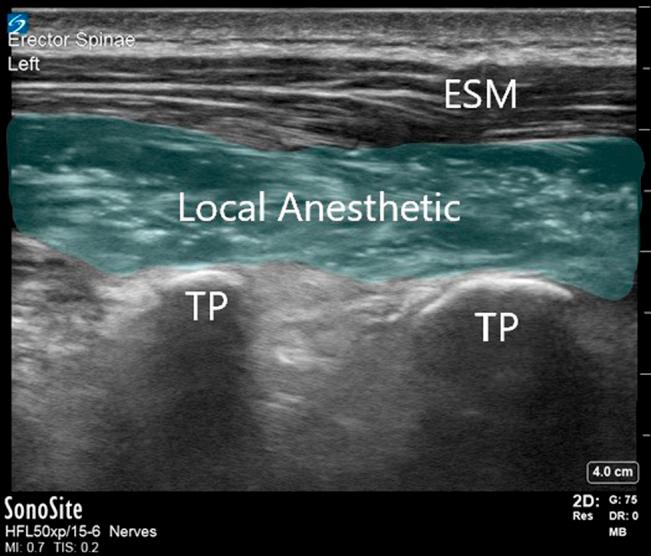
Pain management in patients with adolescent idiopathic scoliosis (AIS) undergoing posterior spinal fusion can be challenging. Various analgesic techniques are currently used, including enhanced recovery after surgery principles, spinal opioids or continuous epidural infusion, intravenous methadone, or surgical site infiltration of local anesthetic. Another recently developed technique, ultrasound-guided erector spinae plane blockade (ESPB), has been used successfully in spine surgery and may offer advantages because of its ease of placement, excellent safety profile, and opioid sparing qualities. Liposomal bupivacaine is a long-acting local anesthetic that was recently approved for infiltration and fascial plane blocks in pediatric patients of ages 6 years and older. This medication may prove to be beneficial when administered through ESPB in patients with AIS undergoing posterior spinal fusion because it can provide prolonged analgesia after a single injection. Here, we present a case report of two such patients, and we compare outcomes with a retrospective cohort of 13 patients with AIS who received IV methadone instead of ESPB. ESPB patients seemed to have less opioid use and shorter length of stay but higher pain scores, although the sample size is too small for meaningful statistical analysis. Future prospective trials are needed to see if differences in outcomes truly exist.
青少年特发性脊柱侧凸(AIS)患者接受后路脊柱融合术后的疼痛管理颇具挑战。目前使用了各种镇痛技术,包括术后强化康复原则、脊柱阿片类药物或连续硬膜外输注、静脉美沙酮或局部麻醉的手术部位浸润。另一种最近开发的技术,超声引导竖脊肌平面阻滞(ESPB),已成功应用于脊柱手术中,可能因其易于放置、极好的安全性和阿片类药物节约特性而具有优势。脂质体布比卡因是一种长效局部麻醉剂,最近批准用于 6 岁及以上儿科患者的浸润和筋膜平面阻滞。在接受后路脊柱融合术的 AIS 患者中,通过 ESPB 给予这种药物可能会带来益处,因为它可以在单次注射后提供长时间的镇痛。在这里,我们报告了两例此类患者的病例,并将结果与接受 IV 美沙酮而不是 ESPB 的 13 例 AIS 患者的回顾性队列进行了比较。尽管样本量太小,无法进行有意义的统计分析,但 ESPB 患者似乎使用的阿片类药物更少,住院时间更短,但疼痛评分更高。需要进行未来的前瞻性试验,以确定结果是否确实存在差异。


 Zotero 插件