
新型肌病模型的遗传剖析揭示了 CapZα 和 Leiomodin 3 在肌原纤维伸长过程中的作用。
Genetic dissection of novel myopathy models reveals a role of CapZα and Leiomodin 3 during myofibril elongation.
机构信息
Australian Regenerative Medicine Institute, Monash University, Clayton, Australia.
Victoria Node, EMBL Australia, Clayton, Australia.
出版信息
PLoS Genet. 2022 Feb 11;18(2):e1010066. doi: 10.1371/journal.pgen.1010066. eCollection 2022 Feb.
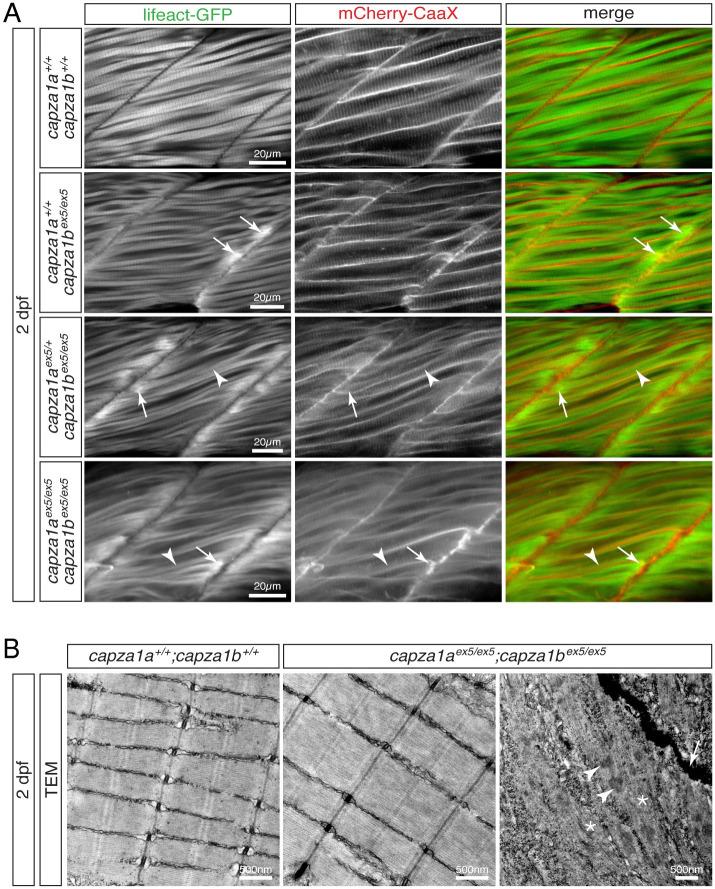
Myofibrils within skeletal muscle are composed of sarcomeres that generate force by contraction when their myosin-rich thick filaments slide past actin-based thin filaments. Although mutations in components of the sarcomere are a major cause of human disease, the highly complex process of sarcomere assembly is not fully understood. Current models of thin filament assembly highlight a central role for filament capping proteins, which can be divided into three protein families, each ascribed with separate roles in thin filament assembly. CapZ proteins have been shown to bind the Z-disc protein α-actinin to form an anchoring complex for thin filaments and actin polymerisation. Subsequent thin filaments extension dynamics are thought to be facilitated by Leiomodins (Lmods) and thin filament assembly is concluded by Tropomodulins (Tmods) that specifically cap the pointed end of thin filaments. To study thin filament assembly in vivo, single and compound loss-of-function zebrafish mutants within distinct classes of capping proteins were analysed. The generated lmod3- and capza1b-deficient zebrafish exhibited aspects of the pathology caused by variations in their human orthologs. Although loss of the analysed main capping proteins of the skeletal muscle, capza1b, capza1a, lmod3 and tmod4, resulted in sarcomere defects, residual organised sarcomeres were formed within the assessed mutants, indicating that these proteins are not essential for the initial myofibril assembly. Furthermore, detected similarity and location of myofibril defects, apparent at the peripheral ends of myofibres of both Lmod3- and CapZα-deficient mutants, suggest a function in longitudinal myofibril growth for both proteins, which is molecularly distinct to the function of Tmod4.
骨骼肌中的肌原纤维由肌节组成,当富含肌球蛋白的粗丝在基于肌动蛋白的细丝上滑动时,肌节通过收缩产生力。尽管肌节成分的突变是人类疾病的主要原因,但肌节组装的高度复杂过程尚未完全了解。目前的细丝组装模型强调了细丝帽蛋白的核心作用,这些蛋白可以分为三个蛋白家族,每个家族在细丝组装中都具有不同的作用。CapZ 蛋白已被证明与 Z 盘蛋白α-肌动蛋白结合,形成细丝和肌动蛋白聚合的锚定复合物。随后的细丝延伸动力学被认为是由 Leiomodins(Lmods)促进的,而细丝组装则由 Tropomodulins(Tmods)完成,它们特异性地帽状细丝的尖端。为了在体内研究细丝组装,分析了具有不同帽蛋白类别的单个和复合功能丧失斑马鱼突变体。生成的 lmod3 和 capza1b 缺陷斑马鱼表现出其人类同源物变异引起的病理学的某些方面。尽管分析的骨骼肌主要帽蛋白 capza1b、capza1a、lmod3 和 tmod4 的缺失导致肌节缺陷,但在所评估的突变体中形成了有组织的残余肌节,表明这些蛋白对于初始肌纤维组装不是必需的。此外,在 Lmod3 和 CapZα缺陷突变体的肌纤维外围末端明显检测到肌原纤维缺陷的相似性和位置,表明这两种蛋白在纵向肌原纤维生长中具有功能,这与 Tmod4 的功能在分子上不同。


 Zotero 插件