Faculty of Agriculture, Kindai University, Nara, 631-8505, Japan.
Faculty of Life and Environmental Sciences, University of Tsukuba, Tsukuba, Ibaraki, 305-8572, Japan.
Sci Rep. 2022 Feb 18;12(1):2835. doi: 10.1038/s41598-022-06770-y.
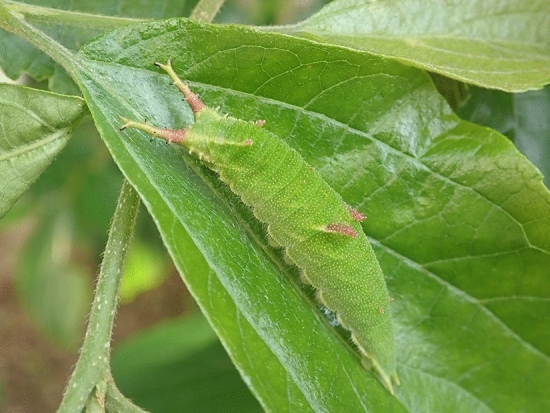
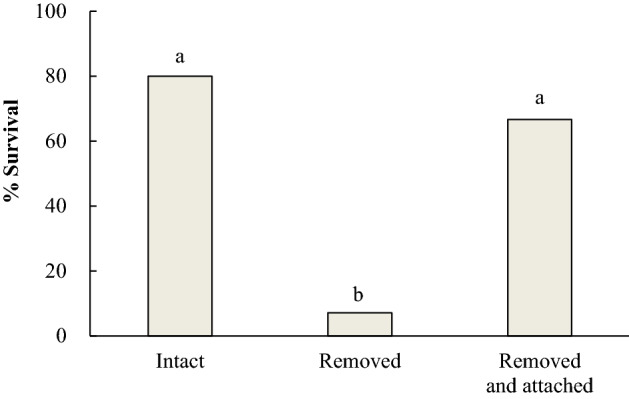
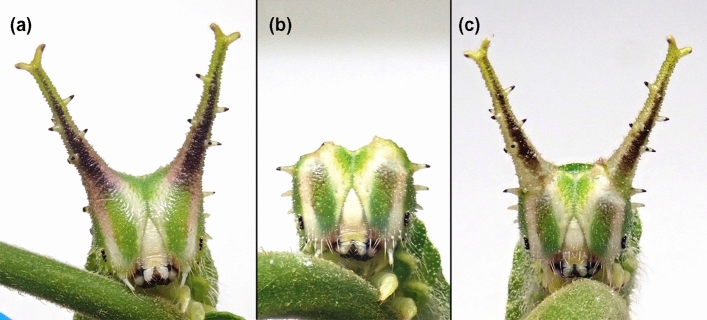
Animals sometimes have prominent projections on or near their heads serving diverse functions such as male combat, mate attraction, digging, capturing prey, sensing or defence against predators. Some butterfly larvae possess a pair of long frontal projections; however, the function of those projections is not well known. Hestina japonica butterfly larvae have a pair of long hard projections on their heads (i.e., horns). Here we hypothesized that they use these horns to protect themselves from natural enemies (i.e., predators and parasitoids). Field surveys revealed that the primary natural enemies of H. japonica larvae were Polistes wasps. Cage experiments revealed that larvae with horns intact and larvae with horns removed and fitted with horns of other individuals succeeded in defending themselves against attacks of Polistes wasps significantly more often than larvae with horns removed. We discuss that the horns counter the paper wasps' hunting strategy of first biting the larvae's 'necks' and note that horns evolved repeatedly only within the Nymphalidae in a phylogeny of the Lepidoptera. This is the first demonstration that arthropods use head projections for physical defence against predators.
动物的头部或附近有时会有突出的结构,这些结构具有多种功能,例如雄性战斗、吸引配偶、挖掘、捕捉猎物、感知或防御捕食者。一些蝴蝶幼虫有一对长长的额前突起,但这些突起的功能尚不清楚。日本虎凤蝶幼虫的头部有一对长长的硬突起(即角)。在这里,我们假设它们用这些角来保护自己免受天敌(即捕食者和寄生蜂)的侵害。野外调查显示,日本虎凤蝶幼虫的主要天敌是胡蜂。笼养实验表明,角完整的幼虫、角被移除并用其他个体的角代替的幼虫以及角被移除的幼虫,在抵御胡蜂攻击时,成功的次数明显多于角被移除的幼虫。我们讨论了角可以对抗胡蜂先咬幼虫“脖子”的捕猎策略,并注意到角在鳞翅目昆虫的系统发育中仅在蛱蝶科中重复进化。这是第一次证明节肢动物使用头部突起来进行物理防御以对抗捕食者。