
A型肉毒毒素(BoNT/A1)治疗神经原性逼尿肌过度活动的二次失败:一项离体功能研究。
BoNT/A1 Secondary Failure for the Treatment of Neurogenic Detrusor Overactivity: An Ex Vivo Functional Study.
机构信息
IPSEN Innovation, 91940 Les Ulis, France.
Pelvipharm, 78180 Montigny-le-Bretonneux, France.
出版信息
Toxins (Basel). 2022 Jan 21;14(2):77. doi: 10.3390/toxins14020077.
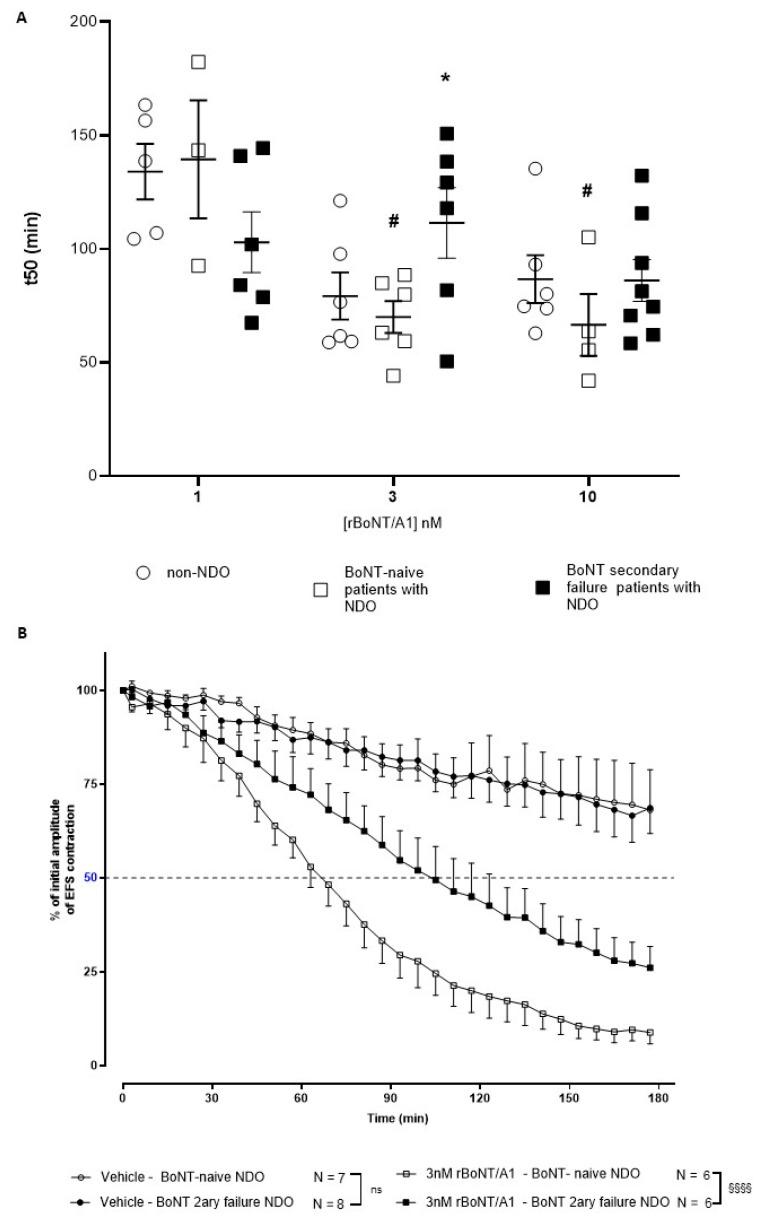
Management of neurogenic detrusor overactivity (NDO) remains a clinical priority to improve patients' quality of life and prevent dramatic urological complications. Intradetrusor injection of onabotulinumtoxinA (BoNT/A1, botulinum neurotoxin A1) is approved as second therapeutic line in these patients, demonstrating a good efficacy. However, a loss of its efficacy over time has been described, with no clear understanding of the underlying mechanisms. This paper aims at shedding new light on BoNT/A1 secondary failure in NDO through functional and structural analysis. Three groups of patients (either non-NDO, NDO with no toxin history or toxin secondary failure) were investigated using an ex vivo bladder strip assay. Detrusor strips were tensed in organ baths and submitted to electrical field stimulation to generate contractions. Recombinant BoNT/A1 was then added at various concentrations and contractions recorded for 4 h. Histology exploring BoNT/A1 targets, fibrosis and neuronal markers was also used. Detrusor strips from patients with BoNT/A1 secondary failure displayed a smaller sensitivity to toxin ex vivo at 3 nM compared to the other groups. Histological evaluation demonstrated the presence of cleaved Synaptosomal-Associated Protein, 25 kDa (c-SNAP25) in the detrusor from the toxin-secondary failure population, indicating some remaining in vivo sensitivity to BoNT/A1 despite the therapeutic escape. Moreover, residual c-SNAP25 did not affect parasympathetic-driven contractions observed ex vivo. This study confirms the slightly lower efficacy of BoNT/A1 in the BoNT/A1 secondary failure NDO group, suggesting that the escape from BoNT/A1 efficacy in NDO occurs at least at the parasympathetic level and could imply compensatory mechanisms for detrusor contraction.
神经源性逼尿肌过度活动(NDO)的管理仍然是改善患者生活质量和预防严重泌尿科并发症的临床重点。在这些患者中,经尿道内注射肉毒毒素 A(BoNT/A1,肉毒神经毒素 A1)被批准作为二线治疗方法,疗效良好。然而,随着时间的推移,其疗效逐渐丧失,其潜在机制尚不清楚。本文旨在通过功能和结构分析,阐明 NDO 中 BoNT/A1 继发性失效的机制。使用离体膀胱条检测法对三组患者(非 NDO 患者、无毒素史的 NDO 患者或毒素继发性失效的 NDO 患者)进行了研究。在器官浴中紧张逼尿肌条,并施加电场刺激以产生收缩。然后以不同浓度添加重组 BoNT/A1 并记录 4 小时的收缩。还使用了探索 BoNT/A1 靶标、纤维化和神经元标志物的组织学。与其他两组相比,BoNT/A1 继发性失效患者的逼尿肌条在 3 nM 时对毒素的体外敏感性较小。组织学评估表明,在毒素继发性失效人群的逼尿肌中存在裂解突触相关蛋白 25 kDa(c-SNAP25),表明尽管存在治疗逃逸,但对 BoNT/A1 仍存在一些残留的体内敏感性。此外,残留的 c-SNAP25 不会影响体外观察到的副交感神经驱动的收缩。这项研究证实了 BoNT/A1 在 BoNT/A1 继发性失效 NDO 组中的疗效略低,表明 NDO 中 BoNT/A1 疗效的逃逸至少发生在副交感神经水平,并可能意味着逼尿肌收缩的代偿机制。


 Zotero 插件