
数字化模型与锥形束计算机断层扫描在测量埋伏阻生尖牙患者上颌横向尺寸中的比较
Comparison between Digital Casts and Cone Beam Computed Tomography for Measuring Maxillary Transverse Dimensions in Patients with Impacted Canines.
作者信息
Martinez Madero Elena, García Montarelo Jaime, Aguayo Grace Stefany, Martin Conchita
机构信息
Department of Orthodontics, Faculty of Odontology, Complutense University of Madrid, 28040 Madrid, Spain.
BIOCRAN (Craniofacial Biology: Orthodontics and Dentofacial Orthopedics) Research Group, Complutense University of Madrid, 28040 Madrid, Spain.
出版信息
Children (Basel). 2022 Feb 17;9(2):278. doi: 10.3390/children9020278.
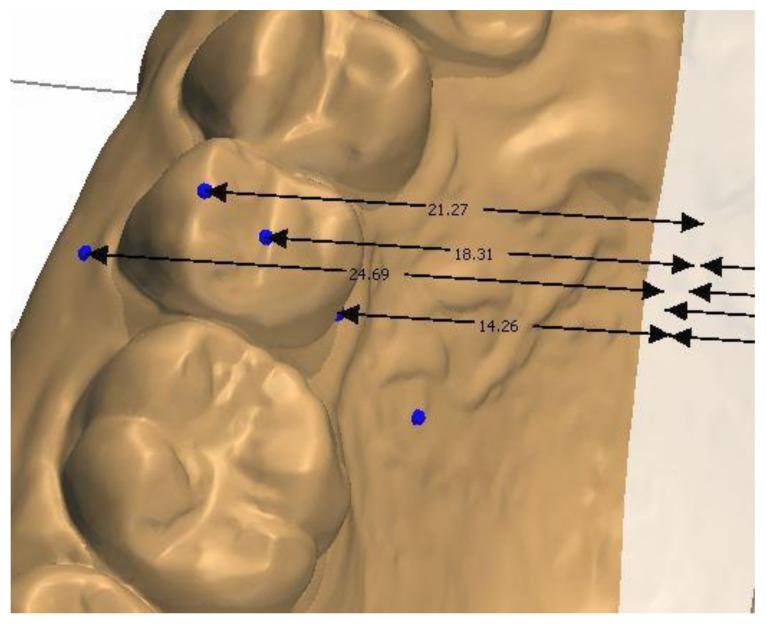
Cone beam computed tomography (CBTCT) scans ( = 45) and digital dental casts ( = 45) were both used to measure the maxillary transverse dimensions in patients with impacted maxillary canines. The objectives were to explore the associations of these dimensions with the impaction and patient characteristics, and to compare the measurements between these techniques. The maxillary width was measured on scans and casts at the Walaridge, and the intermolar width and interpremolar width levels were measured at the first and second premolars (measured from the buccal grooves and the palatal cuspids, and the palatal and lingual amelocemental junctions). Two examiners independently compared the measurements between the control quadrants (without impaction) and the case quadrants (with impaction) in patients with unilateral impactions, and between the unilateral and bilateral impaction groups. The interclass correlation coefficient (ICC) was calculated to assess the interexaminer reliability and paired or independent Student's -tests and ANOVAs were used for comparisons. The ICCs were 0.887 and 0.919, globally, for the measurements on the CBCT scans and casts, respectively, which indicates the excellent interexaminer reliability. On the CBCT scans, statistically significant differences were found between the case and control quadrants in the transverse measurements at the lingual level on the upper first molars, and at the WALA ridge level on the upper second premolars ( < 0.05) in the unilateral impaction group. Significant differences were found between the case quadrants in the unilateral versus the bilateral groups at the WALA ridge on the second premolars in casts ( < 0.05), and at the lingual point on the first molars on the CBCT scans ( < 0.05). No statistically significant differences in the transverse measurements were observed between the impacted buccal and palatal canines on either the casts or CBCT scans. To the best of our knowledge, this is the first study to compare the transverse measurements between digital models and CBCT scans.
采用锥束计算机断层扫描(CBCT)扫描(n = 45)和数字化牙模(n = 45)测量上颌尖牙阻生患者的上颌横向尺寸。目的是探讨这些尺寸与阻生情况及患者特征之间的关联,并比较这两种技术的测量结果。在上颌宽度的Walaridge处的扫描图像和模型上进行测量,在第一和第二前磨牙处测量磨牙间宽度和前磨牙间宽度水平(从颊沟和腭尖,以及腭侧和舌侧釉牙骨质界进行测量)。两名检查者独立比较单侧阻生患者的对照象限(无阻生)和病例象限(有阻生)之间的测量结果,以及单侧和双侧阻生组之间的测量结果。计算组内相关系数(ICC)以评估检查者间的可靠性,并使用配对或独立样本t检验和方差分析进行比较。CBCT扫描和模型测量的ICC总体分别为0.887和0.919,表明检查者间可靠性极佳。在CBCT扫描中,单侧阻生组在上颌第一磨牙舌侧水平和上颌第二前磨牙WALA嵴水平的横向测量中,病例象限与对照象限之间存在统计学显著差异(P < 0.05)。在模型上,第二前磨牙的WALA嵴处,单侧与双侧组的病例象限之间存在显著差异(P < 0.05);在CBCT扫描中,第一磨牙舌侧点处也存在显著差异(P < 0.05)。在模型或CBCT扫描上,颊侧和腭侧阻生尖牙之间的横向测量均未观察到统计学显著差异。据我们所知,这是第一项比较数字模型和CBCT扫描横向测量结果的研究。




 Zotero 插件