Al-Saadi Tariq, Al-Kindi Yahya, Allawati Moosa, Al-Saadi Hatem
Department of Neurology and Neurosurgery, Montreal Neurological Institute and Hospital- McGill University, Montreal, Canada.
Neurosurgery Department, Khoula Hospital, Muscat, Sultanate of Oman.
Surg J (N Y). 2022 Mar 3;8(1):e98-e107. doi: 10.1055/s-0042-1743525. eCollection 2022 Jan.
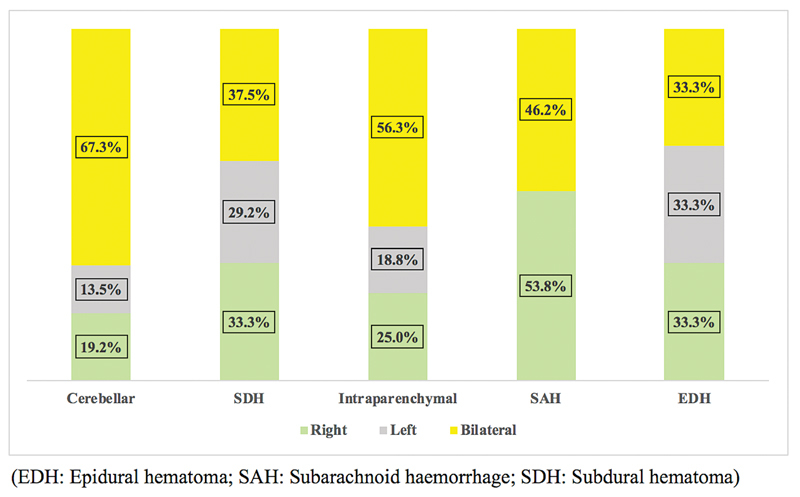
Intracranial hemorrhage (ICH) is a potentially severe complication of spinal surgeries. The occurrence of such complications causes deterioration of the patient's clinical status and delayed discharge from the hospital. Although no specific etiological factors were identified for this complication, but multiple risk factors might play role in its development, they include the use of anticoagulants, presence of uncontrolled hypertension, and perioperative patient positioning. A systematic review of the literature to investigate the prevalence of different types of intracranial hemorrhages in patients who underwent spinal surgeries. A literature review was conducted using multiple research databases. Data were extracted using multiple variables that were formulated incongruent with the study aim and then further analyzed. A total of 79 studies were included in our analysis after applying the exclusion criteria and removing of repeated studies, 109 patients were identified where they were diagnosed with intracranial hemorrhage after spine surgery with a mean age of 54 years. The most common type of hemorrhage was cerebellar hemorrhage (56.0%) followed by SDH and intraparenchymal hemorrhage; 23.9 and 17.4%, respectively. The most common spine surgery was laminectomy (70.6%), followed by fixation and fusion (50.5%), excision of spinal lesions was done in 20.2% of the patient, and discectomy (14.7%). The data in this study showed that out of 112 patients with ICH, cerebellar hemorrhage was the most common type. ICH post-spine surgery is a rare complication and the real etiologies behind this complication are still unknown, cerebrospinal fluid drain and durotomy were suggested.
颅内出血(ICH)是脊柱手术潜在的严重并发症。此类并发症的发生会导致患者临床状况恶化并延迟出院。尽管尚未确定该并发症的具体病因,但多种危险因素可能在其发生过程中起作用,包括使用抗凝剂、存在未控制的高血压以及围手术期患者体位。
对接受脊柱手术患者中不同类型颅内出血的患病率进行系统的文献综述。
使用多个研究数据库进行文献综述。使用与研究目的不一致制定的多个变量提取数据,然后进行进一步分析。
在应用排除标准并去除重复研究后,我们的分析共纳入79项研究,确定了109例患者在脊柱手术后被诊断为颅内出血,平均年龄为54岁。最常见的出血类型是小脑出血(56.0%),其次是硬膜下血肿(SDH)和脑实质内出血,分别为23.9%和17.4%。最常见的脊柱手术是椎板切除术(70.6%),其次是固定融合术(50.5%),20.2%的患者进行了脊柱病变切除术,椎间盘切除术占14.7%。
本研究数据显示,在112例颅内出血患者中,小脑出血是最常见的类型。脊柱手术后的颅内出血是一种罕见的并发症,该并发症背后的真正病因仍然未知,有人提出与脑脊液引流和硬脊膜切开术有关。