Kimura Hideki, Kamiyama Kazuko, Imamoto Toru, Takeda Izumi, Masunaga Shinya, Kobayashi Mamiko, Mikami Daisuke, Takahashi Naoki, Kasuno Kenji, Sugaya Takeshi, Iwano Masayuki
Department of Clinical Laboratory, University of Fukui Hospital, Fukui, Japan.
Division of Nephrology, Department of General Medicine, School of Medicine, Faculty of Medical Sciences, University of Fukui, Fukui, Japan.
Biochem Biophys Rep. 2022 Feb 28;30:101237. doi: 10.1016/j.bbrep.2022.101237. eCollection 2022 Jul.
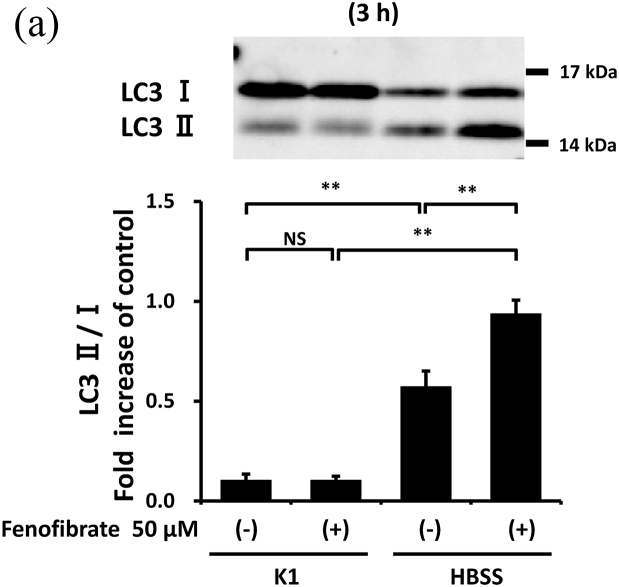
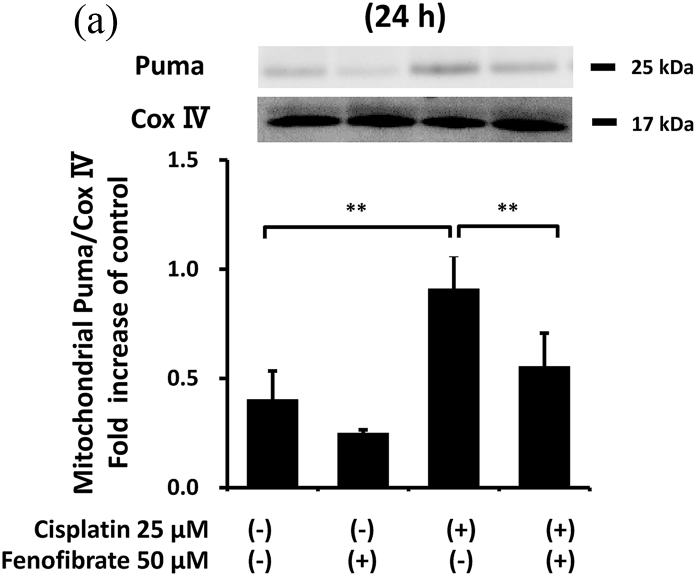
The main lesion of cisplatin nephrotoxicity is damage to proximal tubular cells due to increased apoptosis via the mitochondrial and death receptor pathways, which may be alleviated by appropriate promotion of autophagy. Fenofibrate, a peroxisome proliferator-activated receptor-alpha (PPAR-α) activator, is recently reported to promote autophagy as well as protect against cisplatin nephrotoxicity, although the mechanisms were only partially analyzed. Here, the detailed mechanisms of these putative protective effects were investigated in a murine renal proximal tubular (mProx) cell line. Fenofibrate attenuated cisplatin-induced apoptosis of mProx cells based on flow cytometry. As for the mitochondrial apoptotic pathway, the reagent reduced cisplatin-stimulated caspase-3 activation by decreasing the phosphorylation of p53, JNK, and 14-3-3, cytosolic and mitochondrial Puma accumulation, cytochrome C release to the cytosol, and resulting cytosolic caspase-9 activation. Fenofibrate also decreased cisplatin-stimulated activation of caspases-8 by suppressing MAPK and NFkB pathways and reducing the gene expression of TNF-α, TL1A, and Fas, main mediators of the death receptor apoptotic pathway. Autophagy defined by p62 reduction and an increase in LC3 II/I was promoted by fenofibrate in mProx cells under starvation. Autophagy inhibition using 3-MA further increased basal and cisplatin-induced caspase-3 and -8 activation, but had no influence on the inhibitory effects of fenofibrate on caspase activation. In conclusion, our study suggests fenofibrate to be a candidate agent to mitigate cisplatin nephrotoxicity by inhibiting the mitochondrial and death apoptotic pathways rather than by promoting autophagy.
顺铂肾毒性的主要病变是近端肾小管细胞受损,这是由于通过线粒体和死亡受体途径导致的细胞凋亡增加,而适当促进自噬可能会减轻这种损伤。非诺贝特是一种过氧化物酶体增殖物激活受体-α(PPAR-α)激活剂,最近有报道称它能促进自噬并预防顺铂肾毒性,不过其机制仅得到了部分分析。在此,我们在小鼠肾近端小管(mProx)细胞系中研究了这些假定保护作用的详细机制。基于流式细胞术,非诺贝特减轻了顺铂诱导的mProx细胞凋亡。至于线粒体凋亡途径,该试剂通过降低p53、JNK和14-3-3的磷酸化、胞质和线粒体中Puma的积累、细胞色素C释放到胞质以及由此导致的胞质半胱天冬酶-9激活,减少了顺铂刺激的半胱天冬酶-3激活。非诺贝特还通过抑制MAPK和NFkB途径以及降低死亡受体凋亡途径的主要介质TNF-α、TL1A和Fas的基因表达,减少了顺铂刺激的半胱天冬酶-8激活。在饥饿状态下,非诺贝特在mProx细胞中促进了由p62减少和LC3 II/I增加所定义的自噬。使用3-MA抑制自噬进一步增加了基础状态和顺铂诱导的半胱天冬酶-3和-8激活,但对非诺贝特对半胱天冬酶激活的抑制作用没有影响。总之,我们的研究表明非诺贝特是一种通过抑制线粒体和死亡凋亡途径而非促进自噬来减轻顺铂肾毒性的候选药物。