Servicio de Cardiología, Hospital Clínico Universitario de Santiago de Compostela, Santiago de Compostela, España; Centro de Investigación Biomédica en Red de Enfermedades Cardiovasculares (CIBERCV), España.
Servicio de Farmacia, Hospital Álvaro Cunqueiro, Vigo, España.
Clin Investig Arterioscler. 2022 Sep-Oct;34(5):245-252. doi: 10.1016/j.arteri.2022.01.003. Epub 2022 Feb 3.
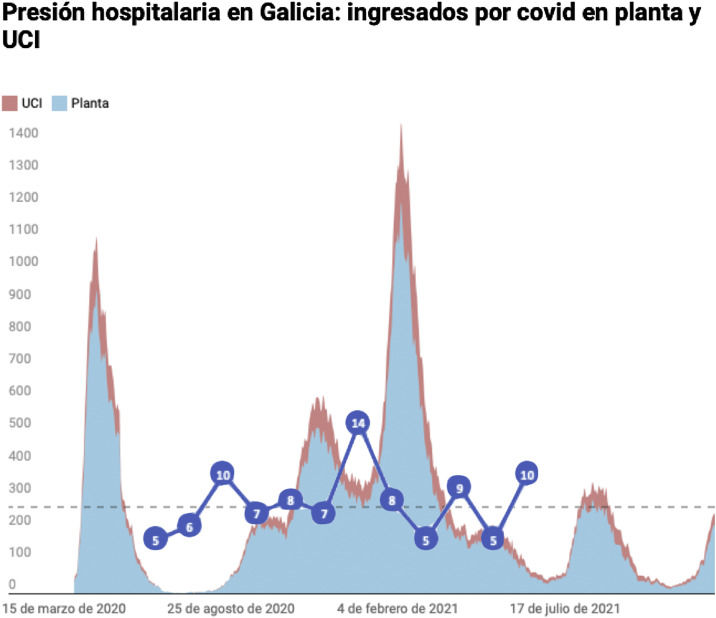
MEMOGAL study (NCT04319081) is aimed at evaluating changes in cognitive function in patients treated with PCSK9 inhibitors (PCSK9i). This is the first analysis: (1) discussion about the role of the Hospital Pharmacists during the pandemic, and also the assessment of the impact of COVID-19 in the lipid control; (2) descriptive analysis; (3) effectiveness in LDL cholesterol (LDL-c) reduction of alirocumab and evolocumab; (4) communicate PCSK9i safety.
It is a prospective Real-World Evidence analysis of patients that take PCSK9i for the first time in the usual clinical practice, and they are included after the first dispensation in the public pharmacy consultations of 12 Hospitals in Galicia from May 2020 to April 2021. Baseline values of LDL-c are the previous values before taking PCSK9 and the follow-up values are in 6 months time.
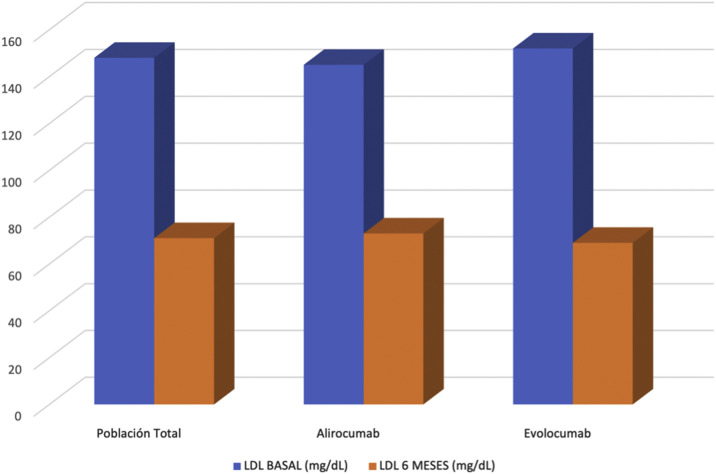
89 patients were included. 86.5% with cardiovascular disease and 53.9% with statin intolerances. 78.8% of the patients were treated with high intensity statins. Statins most used were rosuvastatin (34.1%) and atorvastatin (20.5%). Baseline value of LDL-c was 148mg/dL and the follow-up value was 71mg/dL. The baseline value of patients treated with alirocumab (N=43) was 144mg/dL and 73mg/dL in the follow-up. With evolocumab (N=46) was 151mg/dL in basaline and 69mg/dL in follow-up. The LDLc- reduction was 51.21% with evolocumab and 51.05% with alirocumab. 43.1% of the patients showed values >70mg/dL in six month time; 19.4% between 69mg/dl and 55mg/dL and 37.5% <55mg/dL. 58.3% of the patients achieved a reduction >50% of LDL-c. The adverse events were: injection point reaction (N=2), myalgias (N=1), flu-like symptoms (N=1) and neurocognitive worsening (N=1).
(1) Despite the number of prescriptions was reduced because of the pandemic, the lipid control was not affected. (2) Half of the patients treated with PSCK9i is due to statins intolerance and the 86% is for secondary prevention. (2) The reduction results were similar to pivotal clinical trials. Despite this, 39% of the total of the patients and 60% of patients with dual teraphy did not reach the goal of ESC/EAS guidelines (<55mg/dL and/or reduction>50%). There were not significant differences between evolocumab and alirocumab: 51.21% vs 51.05% (P=.972). (3) There were not any adverse events of special interest. The possible neurocognitive worsening will be studied as the primary endpoint once the MEMOGAL study has been completed.
MEMOGAL 研究(NCT04319081)旨在评估接受 PCSK9 抑制剂(PCSK9i)治疗的患者认知功能的变化。这是第一次分析:(1)讨论医院药剂师在大流行期间的作用,以及 COVID-19 对血脂控制的影响;(2)描述性分析;(3)评估阿利西尤单抗和依洛尤单抗降低 LDL 胆固醇(LDL-c)的效果;(4)沟通 PCSK9i 的安全性。
这是一项对首次在常规临床实践中使用 PCSK9i 的患者进行的前瞻性真实世界证据分析,在 2020 年 5 月至 2021 年 4 月期间,在加利西亚的 12 家医院的公共药房咨询中,在首次配药后将患者纳入研究。LDL-c 的基线值为使用 PCSK9 前的先前值,随访值为 6 个月时的值。
共纳入 89 名患者。86.5%有心血管疾病,53.9%有他汀类药物不耐受。78.8%的患者接受高强度他汀类药物治疗。最常用的他汀类药物为瑞舒伐他汀(34.1%)和阿托伐他汀(20.5%)。LDL-c 的基线值为 148mg/dL,随访值为 71mg/dL。接受阿利西尤单抗治疗的患者(N=43)的基线值为 144mg/dL,随访值为 73mg/dL。接受依洛尤单抗治疗的患者(N=46)的基线值为 151mg/dL,随访值为 69mg/dL。依洛尤单抗降低 LDL-c 水平的幅度为 51.21%,阿利西尤单抗为 51.05%。43.1%的患者在 6 个月时的 LDL-c 值>70mg/dL;19.4%在 69mg/dl 和 55mg/dL 之间,37.5%<55mg/dL。58.3%的患者 LDL-c 降低>50%。不良反应为:注射部位反应(N=2)、肌痛(N=1)、流感样症状(N=1)和认知功能恶化(N=1)。
(1)尽管由于大流行导致处方数量减少,但血脂控制并未受到影响。(2)一半接受 PCSK9i 治疗的患者是由于他汀类药物不耐受,86%是为了二级预防。(3)结果与关键性临床试验相似。尽管如此,39%的患者和 60%的双联治疗患者未达到 ESC/EAS 指南的目标值(<55mg/dL 和/或降低>50%)。依洛尤单抗和阿利西尤单抗之间无显著差异:51.21%vs 51.05%(P=0.972)。(4)无任何特殊关注的不良反应。一旦 MEMOGAL 研究完成,将作为主要终点研究可能的认知功能恶化。