• 文献检索
  • 文档翻译
  • 深度研究
  • 学术资讯
  • Suppr Zotero 插件Zotero 插件
  • 邀请有礼
  • 套餐&价格
  • 历史记录
应用&插件
Suppr Zotero 插件Zotero 插件浏览器插件Mac 客户端Windows 客户端微信小程序
定价
高级版会员购买积分包购买API积分包
服务
文献检索文档翻译深度研究API 文档MCP 服务
关于我们
关于 Suppr公司介绍联系我们用户协议隐私条款
关注我们

Suppr 超能文献

核心技术专利:CN118964589B侵权必究
粤ICP备2023148730 号-1Suppr @ 2026

文献检索

告别复杂PubMed语法,用中文像聊天一样搜索,搜遍4000万医学文献。AI智能推荐,让科研检索更轻松。

立即免费搜索

文件翻译

保留排版,准确专业,支持PDF/Word/PPT等文件格式,支持 12+语言互译。

免费翻译文档

深度研究

AI帮你快速写综述,25分钟生成高质量综述,智能提取关键信息,辅助科研写作。

立即免费体验

物理对象及其虚拟对应物的立体深度恒常性。

Stereoscopic depth constancy for physical objects and their virtual counterparts.

机构信息

Department of Psychology and Centre for Vision Research, York University, Toronto, Ontario, Canada.

出版信息

J Vis. 2022 Mar 2;22(4):9. doi: 10.1167/jov.22.4.9.

DOI:10.1167/jov.22.4.9
PMID:35315875
原文链接:https://pmc.ncbi.nlm.nih.gov/articles/PMC8944385/
Abstract

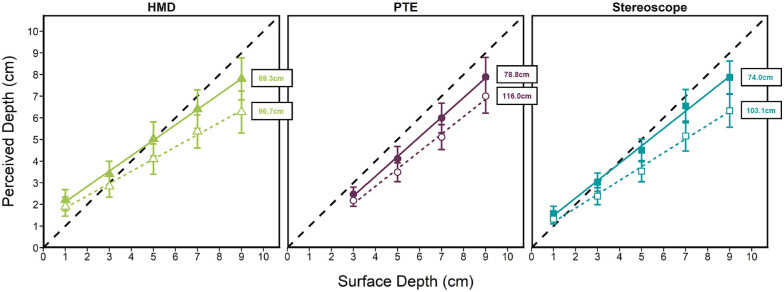
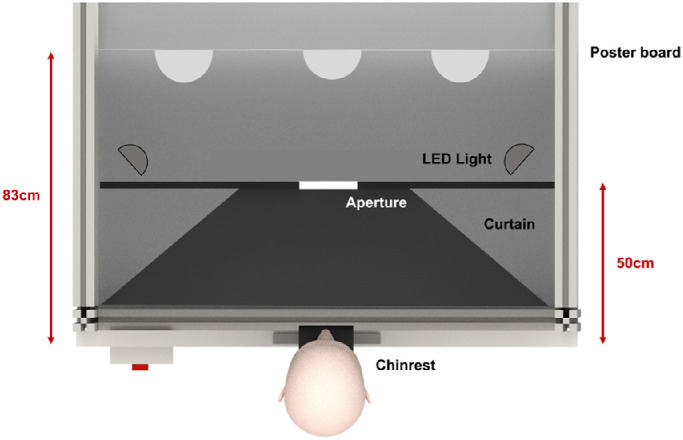
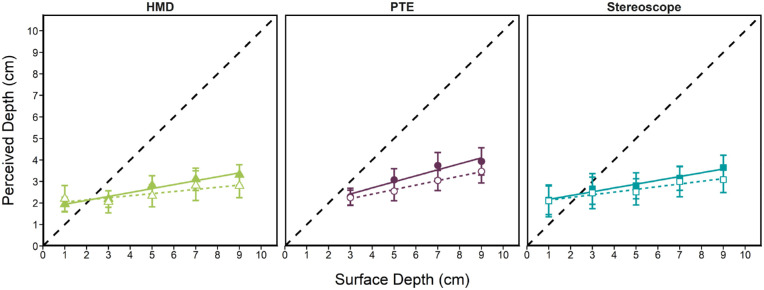
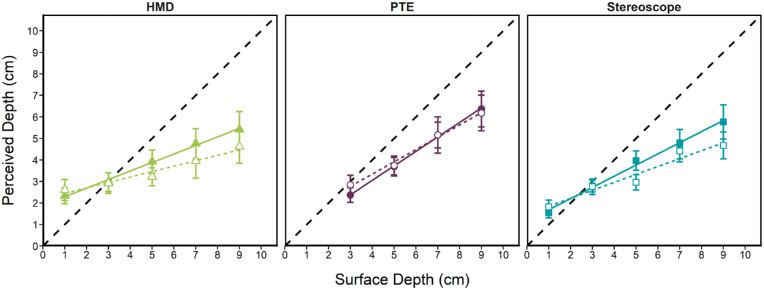
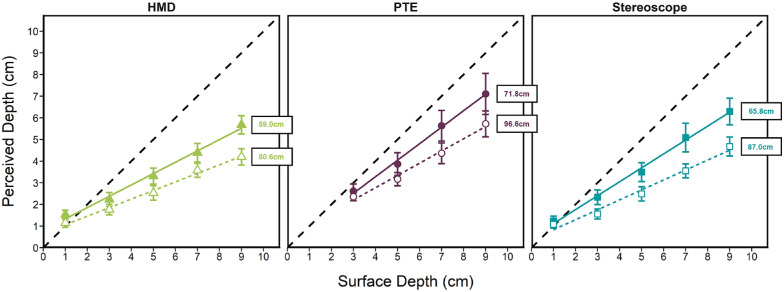
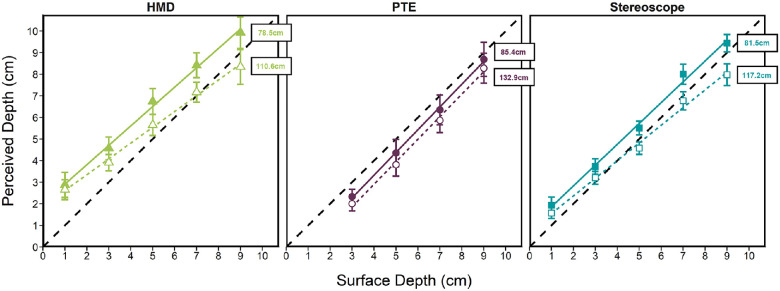
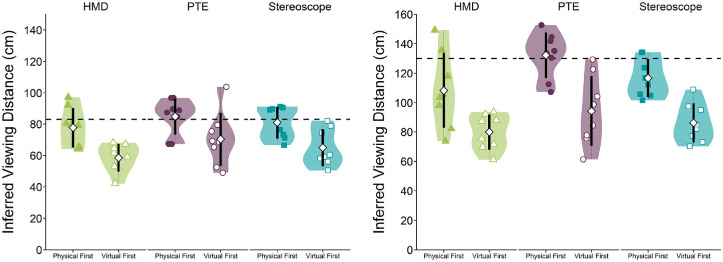
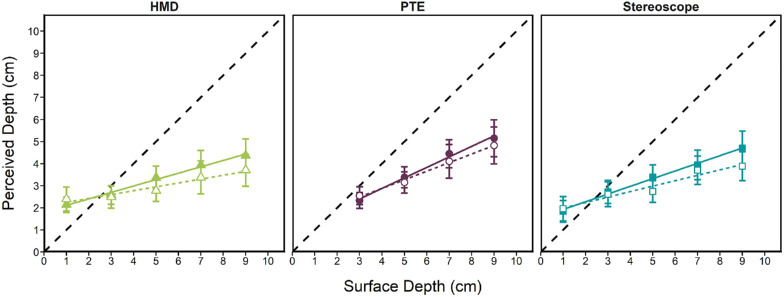
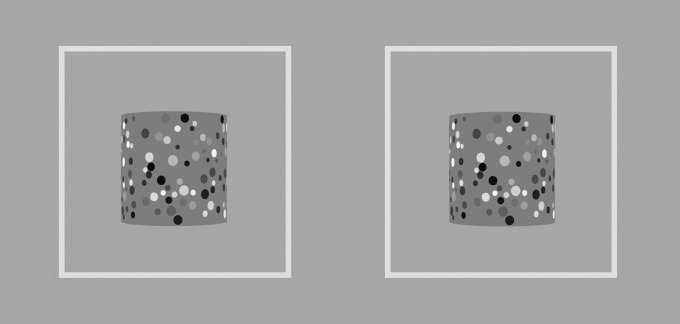
Stereopsis plays an important role in depth perception; if so, disparity-defined depth should not vary with distance. However, studies of stereoscopic depth constancy often report systematic distortions in depth judgments over distance, particularly for virtual stimuli. Our aim was to understand how depth estimation is impacted by viewing distance and display-based cue conflicts by replicating physical objects in virtual counterparts. To this end, we measured perceived depth using virtual textured half-cylinders and identical three-dimensional (3D) printed versions at two viewing distances under monocular and binocular conditions. Virtual stimuli were viewed using a mirror stereoscope and an Oculus Rift head-mounted display (HMD), while physical stimuli were viewed in a controlled test environment. Depth judgments were similar in both virtual apparatuses, which suggests that variations in the viewing geometry and optics of the HMD have little impact on perceived depth. When viewing physical stimuli binocularly, judgments were accurate and exhibited stereoscopic depth constancy. However, in all cases, depth was underestimated for virtual stimuli and failed to achieve depth constancy. It is clear that depth constancy is only complete for cue-rich physical stimuli and that the failure of constancy in virtual stimuli is due to the presence of the vergence-accommodation conflict. Further, our post hoc analysis revealed that prior experience with virtual and physical environments had a strong effect on depth judgments. That is, performance in virtual environments was enhanced by limited exposure to a related task using physical objects.

摘要

立体视在深度感知中起着重要作用;如果是这样,视差定义的深度不应随距离而变化。然而,立体深度恒常性的研究经常报告深度判断在距离上的系统扭曲,特别是对于虚拟刺激。我们的目的是通过复制虚拟对象中的物理对象来了解距离和基于显示的线索冲突对视差估计的影响。为此,我们在单眼和双眼条件下,使用虚拟纹理半圆柱和相同的三维(3D)打印版本在两个观察距离下测量感知深度。虚拟刺激使用镜像立体镜和 Oculus Rift 头戴式显示器(HMD)观看,而物理刺激在受控测试环境中观看。两种虚拟设备中的深度判断相似,这表明 HMD 的观察几何形状和光学变化对感知深度的影响很小。当双眼观察物理刺激时,判断是准确的,并表现出立体深度恒常性。然而,在所有情况下,虚拟刺激的深度都被低估,并且无法实现深度恒常性。显然,深度恒常性仅适用于线索丰富的物理刺激,而虚拟刺激中恒常性的失败是由于会聚调节冲突的存在。此外,我们的事后分析表明,对虚拟和物理环境的先验经验对深度判断有很大影响。也就是说,通过使用物理对象进行有限的相关任务暴露,在虚拟环境中的表现得到了增强。
https://cdn.ncbi.nlm.nih.gov/pmc/blobs/dbcd/8944385/424924741a53/jovi-22-4-9-f009.jpg
https://cdn.ncbi.nlm.nih.gov/pmc/blobs/dbcd/8944385/80b28149fe12/jovi-22-4-9-f001.jpg
https://cdn.ncbi.nlm.nih.gov/pmc/blobs/dbcd/8944385/120f246f5f60/jovi-22-4-9-f002.jpg
https://cdn.ncbi.nlm.nih.gov/pmc/blobs/dbcd/8944385/5c769b14ebaf/jovi-22-4-9-f003.jpg
https://cdn.ncbi.nlm.nih.gov/pmc/blobs/dbcd/8944385/d1adc69defd8/jovi-22-4-9-f004.jpg
https://cdn.ncbi.nlm.nih.gov/pmc/blobs/dbcd/8944385/fe1d5f03fa40/jovi-22-4-9-f005.jpg
https://cdn.ncbi.nlm.nih.gov/pmc/blobs/dbcd/8944385/bbd5f4d54e24/jovi-22-4-9-f006.jpg
https://cdn.ncbi.nlm.nih.gov/pmc/blobs/dbcd/8944385/f87ca0429c06/jovi-22-4-9-f007.jpg
https://cdn.ncbi.nlm.nih.gov/pmc/blobs/dbcd/8944385/b720220a980f/jovi-22-4-9-f008.jpg
https://cdn.ncbi.nlm.nih.gov/pmc/blobs/dbcd/8944385/424924741a53/jovi-22-4-9-f009.jpg
https://cdn.ncbi.nlm.nih.gov/pmc/blobs/dbcd/8944385/80b28149fe12/jovi-22-4-9-f001.jpg
https://cdn.ncbi.nlm.nih.gov/pmc/blobs/dbcd/8944385/120f246f5f60/jovi-22-4-9-f002.jpg
https://cdn.ncbi.nlm.nih.gov/pmc/blobs/dbcd/8944385/5c769b14ebaf/jovi-22-4-9-f003.jpg
https://cdn.ncbi.nlm.nih.gov/pmc/blobs/dbcd/8944385/d1adc69defd8/jovi-22-4-9-f004.jpg
https://cdn.ncbi.nlm.nih.gov/pmc/blobs/dbcd/8944385/fe1d5f03fa40/jovi-22-4-9-f005.jpg
https://cdn.ncbi.nlm.nih.gov/pmc/blobs/dbcd/8944385/bbd5f4d54e24/jovi-22-4-9-f006.jpg
https://cdn.ncbi.nlm.nih.gov/pmc/blobs/dbcd/8944385/f87ca0429c06/jovi-22-4-9-f007.jpg
https://cdn.ncbi.nlm.nih.gov/pmc/blobs/dbcd/8944385/b720220a980f/jovi-22-4-9-f008.jpg
https://cdn.ncbi.nlm.nih.gov/pmc/blobs/dbcd/8944385/424924741a53/jovi-22-4-9-f009.jpg

相似文献

1
Stereoscopic depth constancy for physical objects and their virtual counterparts.物理对象及其虚拟对应物的立体深度恒常性。
J Vis. 2022 Mar 2;22(4):9. doi: 10.1167/jov.22.4.9.
2
Stereoscopic depth constancy from a different direction.来自不同方向的立体深度恒常性。
Vision Res. 2021 Jan;178:70-78. doi: 10.1016/j.visres.2020.10.003. Epub 2020 Nov 5.
3
Depth-of-Focus Affects 3D Perception in Stereoscopic Displays.焦深影响立体显示器中的三维感知。
Perception. 2015;44(6):613-27. doi: 10.1177/0301006615594261.
4
Linear perspective cues have a greater effect on the perceptual rescaling of distant stimuli than textures in the virtual environment.线性透视线索对远距离刺激的感知缩放的影响大于虚拟环境中的纹理。
Atten Percept Psychophys. 2024 Feb;86(2):653-665. doi: 10.3758/s13414-023-02834-x. Epub 2024 Jan 5.
5
Cue vetoing in depth estimation: Physical and virtual stimuli.深度估计中的线索否决:物理和虚拟刺激。
Vision Res. 2021 Nov;188:51-64. doi: 10.1016/j.visres.2021.07.003. Epub 2021 Jul 18.
6
Cues to viewing distance for stereoscopic depth constancy.用于立体深度恒常性的观看距离线索。
Perception. 1998;27(11):1357-65. doi: 10.1068/p271357.
7
Impact of parallax and interpupillary distance on size judgment performances of virtual objects in stereoscopic displays.视差和瞳孔距离对立体显示中虚拟对象大小判断性能的影响。
Ergonomics. 2019 Jan;62(1):76-87. doi: 10.1080/00140139.2018.1526328. Epub 2018 Nov 8.
8
Accommodation and size-constancy of virtual objects.虚拟物体的调节与大小恒常性
Ann Biomed Eng. 2008 Feb;36(2):342-8. doi: 10.1007/s10439-007-9414-7. Epub 2007 Dec 8.
9
Binocular depth discrimination and estimation beyond interaction space.双眼深度辨别与交互空间之外的深度估计。
J Vis. 2009 Jan 13;9(1):10.1-14. doi: 10.1167/9.1.10.
10
Stereoscopic depth constancy.立体深度恒常性
Philos Trans R Soc Lond B Biol Sci. 2016 Jun 19;371(1697). doi: 10.1098/rstb.2015.0253.

引用本文的文献

1
Obstacle avoidance of physical, stereoscopic, and pictorial objects.物理、立体和图像物体的避障
Virtual Real. 2025;29(1):45. doi: 10.1007/s10055-025-01119-y. Epub 2025 Mar 1.
2
Applications and implications for extended reality to improve binocular vision and stereopsis.扩展现实在改善双眼视觉和立体视中的应用及影响。
J Vis. 2023 Jan 3;23(1):14. doi: 10.1167/jov.23.1.14.

本文引用的文献

1
Cue vetoing in depth estimation: Physical and virtual stimuli.深度估计中的线索否决:物理和虚拟刺激。
Vision Res. 2021 Nov;188:51-64. doi: 10.1016/j.visres.2021.07.003. Epub 2021 Jul 18.
2
Egocentric Distance Perception: A Comparative Study Investigating Differences Between Real and Virtual Environments.自我中心距离知觉:比较真实和虚拟环境差异的研究。
Perception. 2020 Sep;49(9):940-967. doi: 10.1177/0301006620951997.
3
Does vision extract absolute distance from vergence?视觉是否从辐辏中提取绝对距离?
Atten Percept Psychophys. 2020 Aug;82(6):3176-3195. doi: 10.3758/s13414-020-02006-1.
4
Size and shape constancy in consumer virtual reality.消费者虚拟现实中的大小和形状恒常性。
Behav Res Methods. 2020 Aug;52(4):1587-1598. doi: 10.3758/s13428-019-01336-9.
5
The Science Behind Virtual Reality Displays.虚拟现实显示器背后的科学。
Annu Rev Vis Sci. 2019 Sep 15;5:529-547. doi: 10.1146/annurev-vision-091718-014942. Epub 2019 Jul 5.
6
Binocular Eye Movements Are Adapted to the Natural Environment.双眼的眼动是适应自然环境的。
J Neurosci. 2019 Apr 10;39(15):2877-2888. doi: 10.1523/JNEUROSCI.2591-18.2018. Epub 2019 Feb 7.
7
Depth magnitude from stereopsis: Assessment techniques and the role of experience.立体视觉的深度量值:评估技术及经验的作用
Vision Res. 2016 Aug;125:64-75. doi: 10.1016/j.visres.2016.05.006. Epub 2016 Jul 6.
8
Learning different light prior distributions for different contexts.学习不同语境下不同的先验光分布。
Cognition. 2013 Apr;127(1):99-104. doi: 10.1016/j.cognition.2012.12.011. Epub 2013 Jan 30.
9
The zone of comfort: Predicting visual discomfort with stereo displays.舒适区:预测立体显示器引起的视觉不适
J Vis. 2011 Jul 21;11(8):11. doi: 10.1167/11.8.11.
10
Focus information is used to interpret binocular images.聚焦信息用于解释双眼图像。
J Vis. 2010 May 1;10(5):13. doi: 10.1167/10.5.13.