Angerer Monika, Wilhelm Frank H, Liedlgruber Michael, Pichler Gerald, Angerer Birgit, Scarpatetti Monika, Blume Christine, Schabus Manuel
Laboratory for Sleep, Cognition and Consciousness Research, Department of Psychology, University of Salzburg, 5020 Salzburg, Austria.
Centre for Cognitive Neuroscience Salzburg (CCNS), University of Salzburg, 5020 Salzburg, Austria.
Brain Sci. 2022 Mar 11;12(3):375. doi: 10.3390/brainsci12030375.
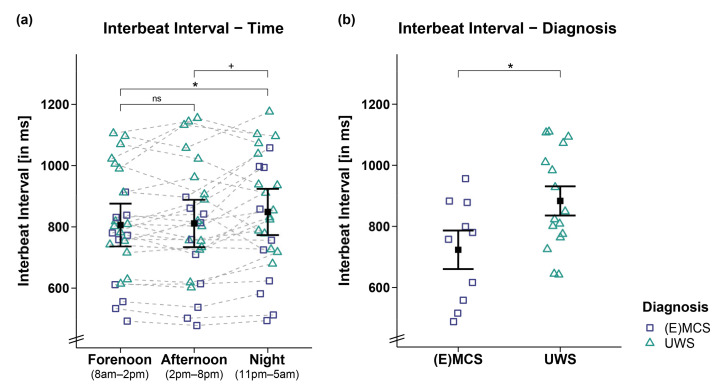
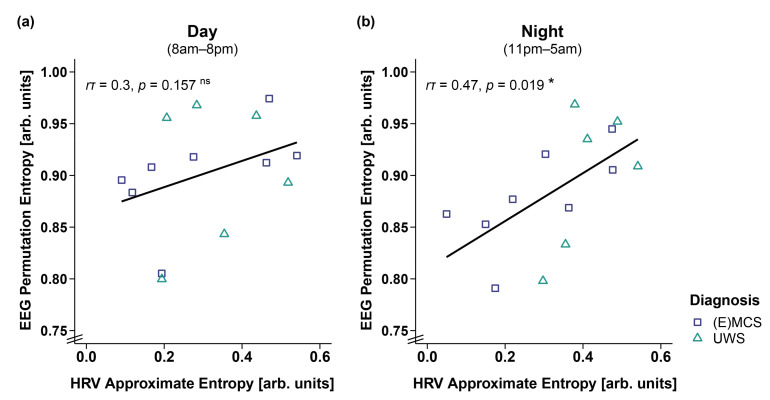
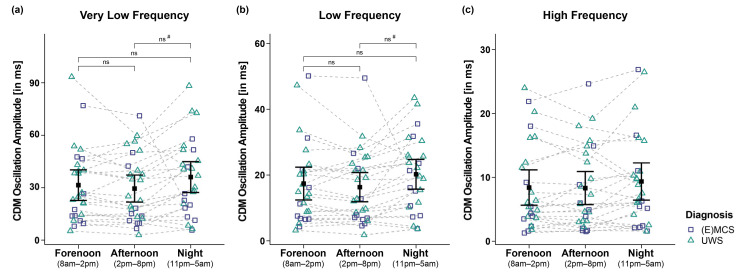
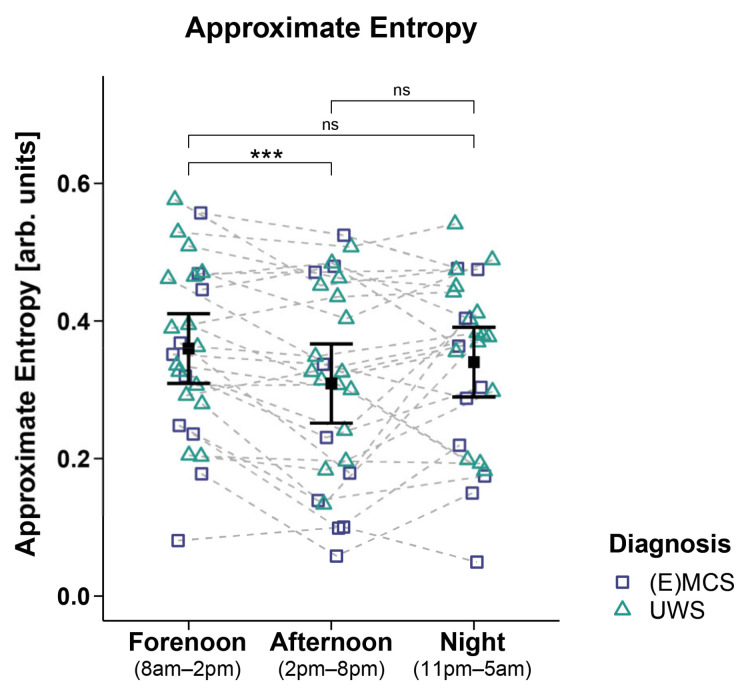
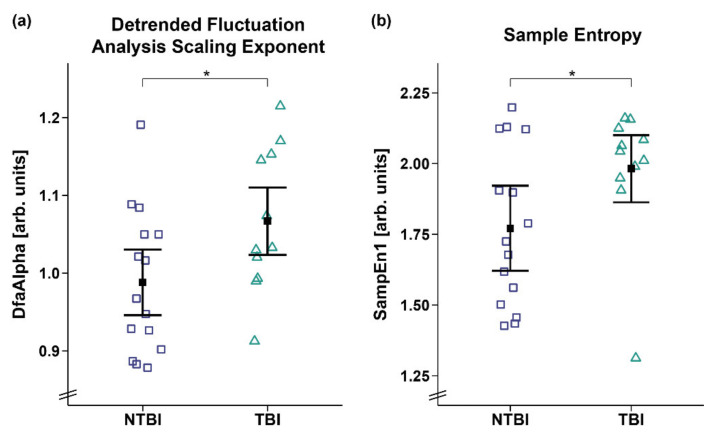
The current study investigated heart rate (HR) and heart rate variability (HRV) across day and night in patients with disorders of consciousness (DOC). We recorded 24-h electrocardiography in 26 patients with DOC (i.e., unresponsive wakefulness syndrome (UWS; = 16) and (exit) minimally conscious state ((E)MCS; = 10)). To examine diurnal variations, HR and HRV indices in the time, frequency, and entropy domains were computed for periods of clear day- (forenoon: 8 a.m.-2 p.m.; afternoon: 2 p.m.-8 p.m.) and nighttime (11 p.m.-5 a.m.). The results indicate that patients' interbeat intervals (IBIs) were larger during the night than during the day, indicating HR slowing. The patients in UWS showed larger IBIs compared to the patients in (E)MCS, and the patients with non-traumatic brain injury showed lower HRV entropy than the patients with traumatic brain injury. Additionally, higher HRV entropy was associated with higher EEG entropy during the night. Thus, cardiac activity varies with a diurnal pattern in patients with DOC and can differentiate between patients' diagnoses and etiologies. Moreover, the interaction of heart and brain appears to follow a diurnal rhythm. Thus, HR and HRV seem to mirror the integrity of brain functioning and, consequently, might serve as supplementary measures for improving the validity of assessments in patients with DOC.
本研究调查了意识障碍(DOC)患者昼夜的心率(HR)和心率变异性(HRV)。我们记录了26例DOC患者(即无反应觉醒综合征(UWS;n = 16)和(昏迷)最小意识状态((E)MCS;n = 10))的24小时心电图。为了研究昼夜变化,计算了白天(上午:8点至下午2点;下午:下午2点至晚上8点)和夜间(晚上11点至凌晨5点)的时间、频率和熵域中的HR和HRV指标。结果表明,患者的心跳间期(IBI)在夜间比白天更长,表明心率减慢。与(E)MCS患者相比,UWS患者的IBI更大,非创伤性脑损伤患者的HRV熵低于创伤性脑损伤患者。此外,夜间较高的HRV熵与较高的脑电图熵相关。因此,DOC患者的心脏活动随昼夜模式变化,并且可以区分患者的诊断和病因。此外,心脏和大脑的相互作用似乎遵循昼夜节律。因此,HR和HRV似乎反映了大脑功能的完整性,因此可能作为补充措施来提高DOC患者评估的有效性。