Delogu Giovanna L, Fais Antonella, Pintus Francesca, Goyal Chinmayi, Matos Maria J, Era Benedetta, Kumar Amit
Department of Life and Environmental Sciences, University of Cagliari, Monserrato, 09042 Cagliari, Italy.
Yorktown High School, 2727 Crompond Road, Yorktown Heights, NY 10598, USA.
Pharmaceuticals (Basel). 2022 Mar 2;15(3):304. doi: 10.3390/ph15030304.
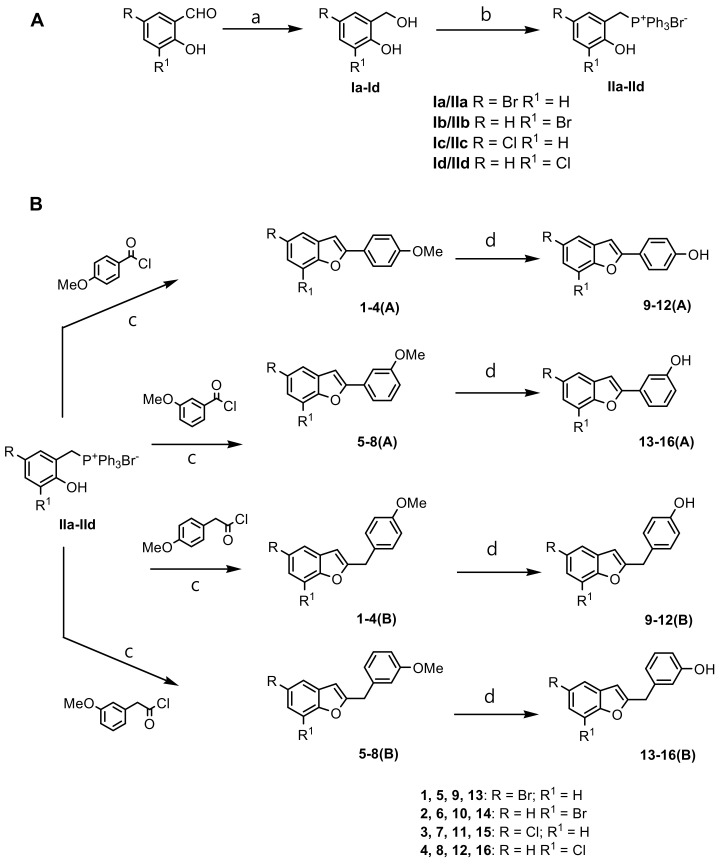
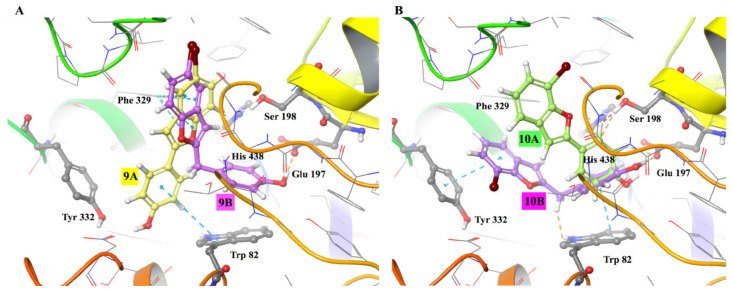
In the present work, we use a merger of computational and biochemical techniques as a rational guideline for structural modification of benzofuran derivatives to find pertinent structural features for the butyrylcholinesterase inhibitory activity and selectivity. Previously, we revealed a series of 2-phenylbenzofuran compounds that displayed a selective inhibitory activity for BChE. Here, in an effort to discover novel selective BChE inhibitors with favorable physicochemical and pharmacokinetic profiles, 2-benzylbenzofurans were designed, synthesized, and evaluated as BChE inhibitors. The 2-phenylbenzofuran scaffold structure is modified by introducing one methylene spacer between the benzofuran core and the 2-phenyl ring with a hydroxyl substituent in the para or meta position. Either position 5 or 7 of the benzofuran scaffold was substituted with a bromine or chlorine atom. Further assessment of the selected list of compounds indicated that the substituent's nature and position determined their activity and selectivity. 5-bromo-2-(4-hydroxybenzyl)benzofuran proved to be the most potent butyrylcholinesterase inhibitor (IC = 2.93 µM) of the studied series. Computational studies were carried out to correlate the theoretical and experimental binding affinity of the compounds to the BChE protein.
在本研究中,我们采用计算技术和生化技术相结合的方法,作为苯并呋喃衍生物结构修饰的合理指导方针,以寻找与丁酰胆碱酯酶抑制活性和选择性相关的结构特征。此前,我们发现了一系列对丁酰胆碱酯酶具有选择性抑制活性的2-苯基苯并呋喃化合物。在此,为了发现具有良好理化性质和药代动力学特征的新型选择性丁酰胆碱酯酶抑制剂,我们设计、合成并评估了2-苄基苯并呋喃作为丁酰胆碱酯酶抑制剂。通过在苯并呋喃核心与对位或间位带有羟基取代基的2-苯基环之间引入一个亚甲基间隔基,对2-苯基苯并呋喃支架结构进行了修饰。苯并呋喃支架的5位或7位用溴或氯原子取代。对所选化合物列表的进一步评估表明,取代基的性质和位置决定了它们的活性和选择性。5-溴-2-(4-羟基苄基)苯并呋喃被证明是所研究系列中最有效的丁酰胆碱酯酶抑制剂(IC = 2.93 µM)。我们进行了计算研究,以关联这些化合物与丁酰胆碱酯酶蛋白的理论和实验结合亲和力。