MOSC Medical College, Kolenchery, Ernakulam, Ernakulam, India.
Government Medical College, Kozhikode, India.
JCO Glob Oncol. 2022 Mar;8:e2100421. doi: 10.1200/GO.21.00421.
Comprehensive genomic profiling (CGP) assay is increasingly used in low-middle-income countries to detect clinically relevant genomic alterations despite its clinical benefits not being well known. Here, we describe the proportion of patients with advanced cancer in India who received targeted therapy for an actionable genetic alteration identified on CGP assays.
This was a multicenter, retrospective cohort study in adult patients with advanced nonhematologic malignancies who underwent a CGP test. If patients received a targeted therapy for ≥ 6 months, they were considered to have obtained a clinical benefit from the medication, whereas those continuing for ≥ 12 months were considered to have attained an exceptional response. Descriptive statistics were used to describe the proportion of patients with subsequent targeted therapy.
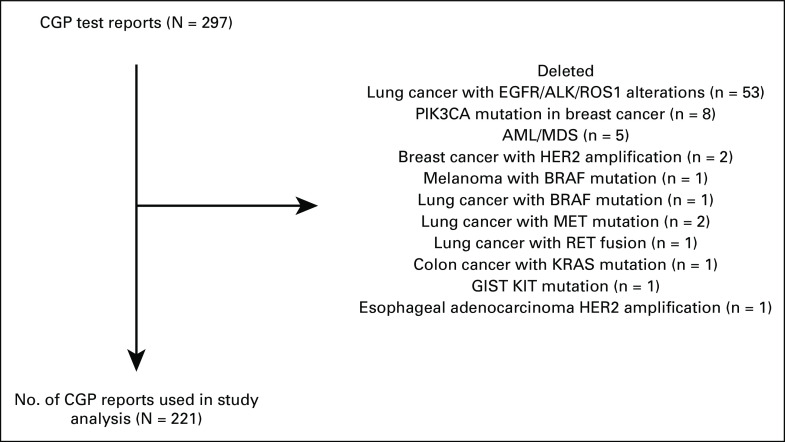
During 2019-2020, 12 medical oncologists provided CGP reports for 297 patients; 221 met the inclusion criteria. Patients received a median of two lines (range: 0-5) of prior systemic therapy. On the basis of the CGP assay, 21 patients (10%) received targeted therapy. Among them, 33% was for human epidermal growth factor receptor 2 (HER2) amplification (nonbreast cancer) and 19% for HER2 or epidermal growth factor receptor exon 20 insertion mutation (lung cancer). After excluding patients with HER2 or epidermal growth factor receptor exon 20 insertions, 8% of 217 patients received targeted therapy. In the overall cohort of 221 patients, clinical benefit was seen in nine patients (4%), of whom two were exceptional responders (1%).
We observed that in a low-middle-income country setting, 10% of patients received targeted therapy on the basis of CGP assay. Only 4% of patients who underwent CGP testing obtained a clinical benefit.
尽管全面基因组分析(CGP)检测的临床获益尚不明确,但在中低收入国家,该检测方法越来越多地用于检测有临床意义的基因组改变。本研究旨在描述在印度,接受 CGP 检测确定的可靶向遗传改变的晚期癌症患者中,接受靶向治疗的比例。
这是一项在接受 CGP 检测的晚期非血液系统恶性肿瘤成年患者中进行的多中心回顾性队列研究。如果患者接受靶向治疗≥6 个月,则认为其从药物治疗中获得了临床获益,而接受治疗≥12 个月的患者则被认为获得了显著缓解。采用描述性统计来描述接受后续靶向治疗的患者比例。
2019 年至 2020 年,12 名肿瘤内科医生提供了 297 例患者的 CGP 报告,其中 221 例符合纳入标准。患者接受了中位数为两线(范围:0-5 线)的系统治疗。根据 CGP 检测结果,21 例(10%)患者接受了靶向治疗。其中,33%为人表皮生长因子受体 2(HER2)扩增(非乳腺癌),19%为 HER2 或表皮生长因子受体外显子 20 插入突变(肺癌)。排除 HER2 或表皮生长因子受体外显子 20 插入突变的患者后,217 例患者中有 8%接受了靶向治疗。在 221 例患者的总体队列中,9 例(4%)患者观察到临床获益,其中 2 例为显著缓解者(1%)。
我们发现,在中低收入国家环境下,基于 CGP 检测有 10%的患者接受了靶向治疗。在接受 CGP 检测的患者中,只有 4%获得了临床获益。