Mărcău Flavius Cristian, Peptan Cătălin, Nedelcuță Ramona Mihaela, Băleanu Vlad Dumitru, Băleanu Anca Roxana, Niculescu Bogdan
Faculty of Educational Sciences, Law and Public Administration, "Constantin Brâncuși" University of Târgu Jiu, 210185 Târgu Jiu, Romania.
Department of Pediatrics, University of Medicine and Pharmacy of Craiova, 200349 Craiova, Romania.
Vaccines (Basel). 2022 Apr 1;10(4):547. doi: 10.3390/vaccines10040547.
Once vaccination against COVID-19 was also possible for children over 12 years of age, parents/legal guardians had to give their consent for their vaccination. It is a crucial moment, given the large number of infected people in Romania and the fact that these children are a source of transmission of the virus in the community. The refusal or hesitation of the parents/legal guardians, regarding the agreement for the vaccination of the children, determined us to focus on this subject, wishing, based on the questioning of as many parents as possible, to extract the reasons underlying these decisions.
This study is designed to observe the attitudes of parents/legal guardians regarding the refusal, hesitation, or acceptance of vaccination of children. The persons targeted to answer the questionnaire had to meet three conditions: to be at least 21 years old, to have a stable residence in Romania, and to be parents/legal guardians of at least one child under 18 years of age. The questionnaire was applied online to a number of 581 parents/legal guardians, being structured to obtain socio-demographic data and other categories of data that allow us to analyze their views on vaccinating children.
Sociological data resulting from the application of the questionnaire on 581 parents/legal guardians show that 183 (31.5%) adults and 140 (24.1%) children got infected with COVID-19. The total number of respondents shows that only 411 (70.7%) adults and 185 (31.8%) children are vaccinated.
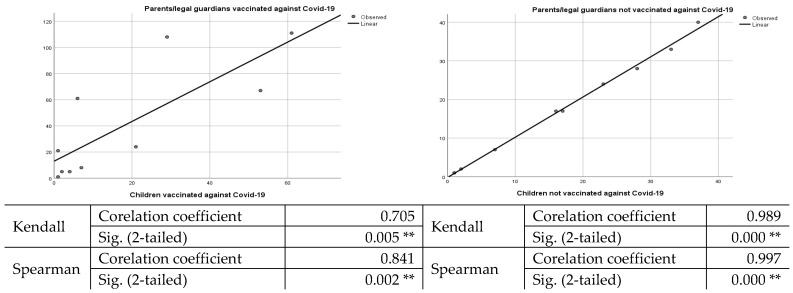
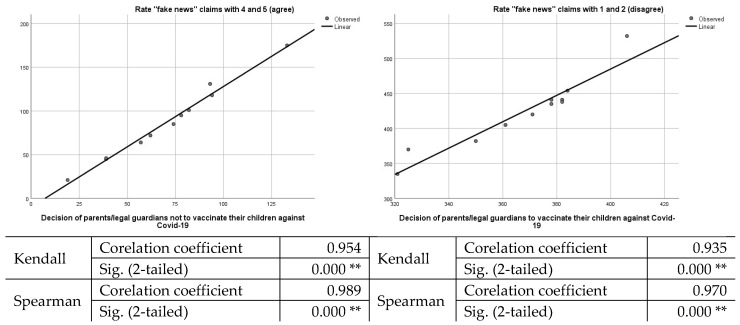
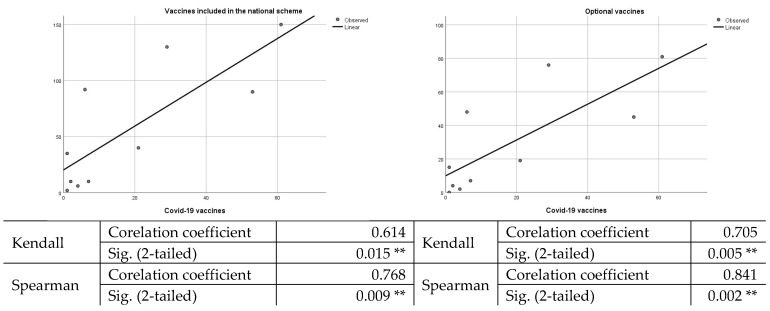
From the analysis of the data obtained through the questionnaire, following the application of the Kendall and Spearman statistical analysis tests, it is found that there is a strong link between participants' trust/distrust in "fake news" information and their decision to vaccinate their children.
一旦12岁以上儿童也可以接种新冠疫苗,父母/法定监护人必须对其接种给予同意。鉴于罗马尼亚感染人数众多,且这些儿童是社区中病毒传播源,这是一个关键时刻。父母/法定监护人对儿童接种疫苗的拒绝或犹豫,促使我们关注这个问题,希望通过尽可能多地询问父母,找出这些决定背后的原因。
本研究旨在观察父母/法定监护人对儿童接种疫苗的拒绝、犹豫或接受态度。被要求回答问卷的人必须满足三个条件:年龄至少21岁,在罗马尼亚有稳定住所,并且是至少一名18岁以下儿童的父母/法定监护人。问卷通过网络应用于581名父母/法定监护人,其结构旨在获取社会人口学数据和其他数据类别,以便我们分析他们对儿童接种疫苗的看法。
对581名父母/法定监护人进行问卷调查得出的社会学数据显示,183名(31.5%)成年人和140名(24.1%)儿童感染了新冠病毒。受访者总数表明,只有411名(70.7%)成年人和185名(31.8%)儿童接种了疫苗。
通过对问卷获得的数据进行分析,在应用肯德尔和斯皮尔曼统计分析测试后发现,参与者对“假新闻”信息的信任/不信任与他们为孩子接种疫苗的决定之间存在紧密联系。